

Supply disruptions are clearly feeding through to macroeconomic data. Preliminary German inflation figures show monthly growth of 0.6% for April, slightly below the previous estimate of 0.7%, while the annual rate is expected to accelerate from 2.7% to 2.9%. The EU-harmonized measure is projected at around 2.9%, up from 2.8% previously. Meanwhile, the Eurozone consumer confidence index has already fallen from –16.3 to –20.6 points, and the services expectations indicator dropped from 4.1 to 0.9 points, well below the preliminary forecast of 3.5 points. European Commission President Ursula von der Leyen stated that the Middle East escalation has caused cumulative economic losses estimated at €25.0 billion, noting that the crisis is transmitting primarily through higher shipping and insurance costs, longer delivery routes, and rising oil and gas prices — all of which are pushing up industrial production costs and intensifying inflationary pressures.
Turning to the key driver of EUR/USD — the US dollar — the greenback is currently holding around 98.8 on the USDX. Despite President Donald Trump's announcement of an extended ceasefire with Iran, actual de-escalation in the region remains limited and diplomatic efforts continue to yield no results. A three-phase settlement plan presented by Iranian authorities — envisaging temporary restoration of Strait of Hormuz shipping in exchange for partial lifting of maritime restrictions and deferral of nuclear program discussions — was met with deep skepticism by the White House. According to The Wall Street Journal, Trump directed relevant agencies to prepare scenarios for further intensifying economic and energy pressure on Tehran, including tightened restrictions on Iranian oil exports. Against this backdrop, the base case remains one of "dual blockade" of key Persian Gulf shipping lanes, sustaining elevated tensions in global energy markets. Sources cited by the publication noted that a full retreat from the confrontational strategy was deemed unlikely, as it would not advance Washington's strategic objectives regarding the nuclear deal. The focus therefore remains on managed pressure, keeping Iranian hydrocarbon exports constrained while the geopolitical risk premium continues to build. According to analytics firm Kpler, average daily Iranian shipments stood at around 2.1 million barrels in the first half of April, but following the imposition of the effective blockade, exports fell to just five episodic shipments — bringing the daily average down to 567,000 barrels in the second ten-day period of the month. This represents a decline of more than 70%, equivalent to the removal of over 1.5 million barrels of daily supply from the global market.
Support and Resistance Levels
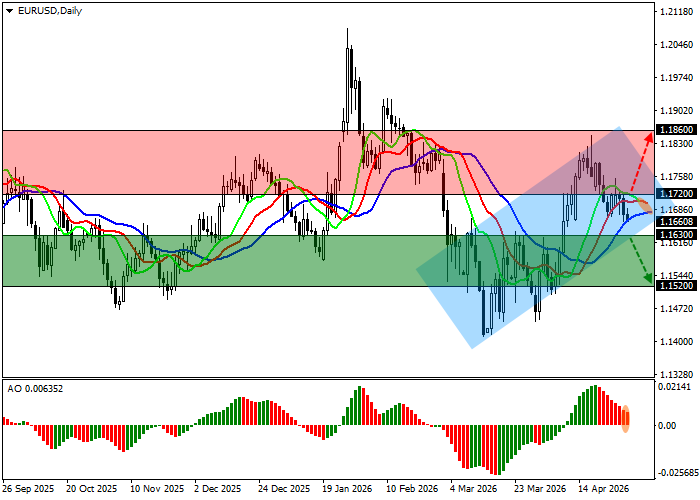
On the daily chart, the pair is attempting to pull away from the resistance line of the ascending channel at 1.1850–1.1650.
Technical indicators are preparing for a reversal, weakening the buy signal that emerged at the start of the month. The fast EMAs on the Alligator indicator remain above the signal line but continue to narrow their range, while the AO histogram is forming corrective bars, easing back within the buy zone.
Support levels: 1.1630, 1.1520.
Resistance levels: 1.1720, 1.1860.
EUR/USD Trading Scenarios and Forecast
Short positions may be considered after price consolidates below 1.1630, targeting 1.1520. Stop-loss: 1.1700. Time horizon: 7 days or more.
Long positions may be considered after price consolidates above 1.1720, targeting 1.1860. Stop-loss: 1.1650.
Main Scenario
| Timeframe | Weekly |
| Recommendation | SELL STOP |
| Entry Point | 1.1625 |
| Take Profit | 1.1520 |
| Stop Loss | 1.1700 |
| Key Levels | 1.1520, 1.1630, 1.1720, 1.1860 |
Alternative Scenario
| Recommendation | BUY STOP |
| Entry Point | 1.1725 |
| Take Profit | 1.1860 |
| Stop Loss | 1.1650 |
| Key Levels | 1.1520, 1.1630, 1.1720, 1.1860 |
