
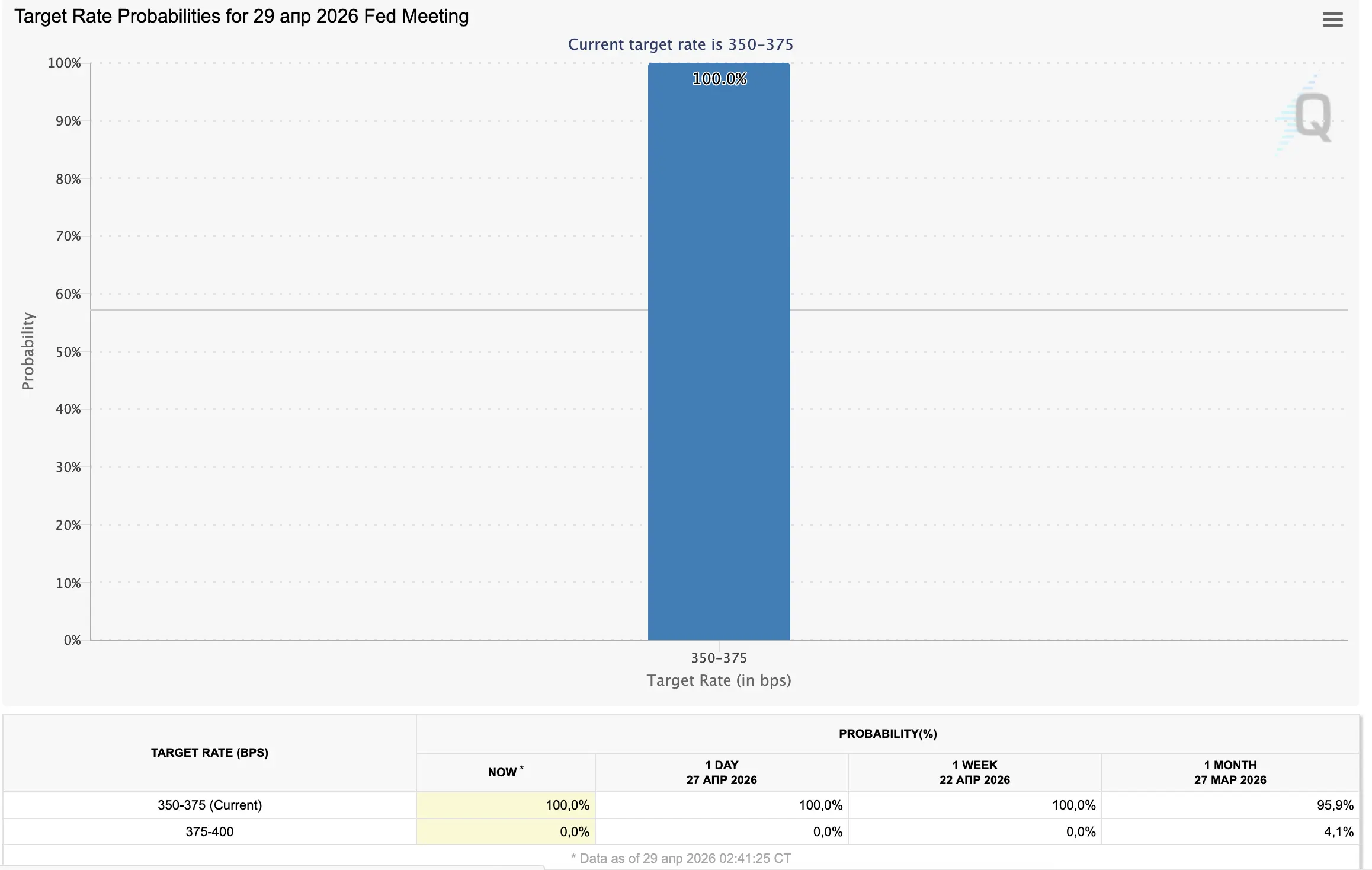
The Chicago Mercantile Exchange (CME) FedWatch Tool assigns a 100.0% probability to the rate remaining on hold in the 3.50–3.75% range, shifting the entire focus to the rhetoric of monetary authorities — and Fed Chair Jerome Powell in particular.
Powell has already warned that officials will not rush to ease monetary conditions, as policymakers must now balance the risk of inflation accelerating on the back of higher energy prices against signs of cooling in the labor market. Meanwhile, the Senate Banking Committee is expected today to endorse Kevin Warsh as the next Fed Chair once Powell's four-year term expires — all but guaranteeing a potential overhaul inside the regulator and providing further support for the dollar over the medium term. It is also worth noting that on April 24, the US Department of Justice dropped its criminal investigation into the sitting Fed Chair: DC's top federal prosecutor Jeanine Pirro announced that the case concerning the alleged misuse of funds during the renovation of the Fed's Washington headquarters had been referred to the internal inspector general. She stressed that she had ordered the proceedings closed for the duration of the review but would "not hesitate to reopen them if the facts require it."
Meanwhile, investor attention remains firmly on the outcome of the Bank of Japan meeting that concluded yesterday: as expected, the policy rate was held at around 0.75%, but the regulator sent the market a distinctly hawkish signal — not only raising its inflation forecast from 1.9% to 2.8%, but also assigning a high probability to core CPI (excluding food and energy) accelerating to 2.6% over the next two years, above the 2.0% target, while the pace of economic growth is projected to slow from 1.0% to 0.5%. It is also notable that three of the nine Monetary Policy Committee members — Hajime Takata, Naoki Tamura, and Junko Nakagawa — voted for an immediate rate hike to 1.00%, which implicitly points to a return to tightening as early as the next meetings. Despite the already visible negative spillovers from the Middle East crisis — most notably the squeeze on corporate profits and real household incomes — BoJ Governor Kazuo Ueda stressed the need to look through temporary inflation shocks driven by energy price increases. The yen's reaction to the meeting outcome was decidedly muted: after an initial advance, the bullish impulse faded quickly, and the dollar soon reasserted firm dominance in the USD/JPY pair. The key restraining factor — the risk of currency intervention by Japan's Ministry of Finance — remains relevant but has shifted in character: whereas previously this tool was discussed as a response to "excessive" yen weakness, it is now, ahead of a probable June rate hike, less likely to be deployed. Authorities appear content to wait until summer, and even a move below the psychologically significant 160.00 level would most likely trigger only verbal warnings — yet the market has grown accustomed to such signals, and they risk going unnoticed in the absence of real action.
Support and Resistance Levels
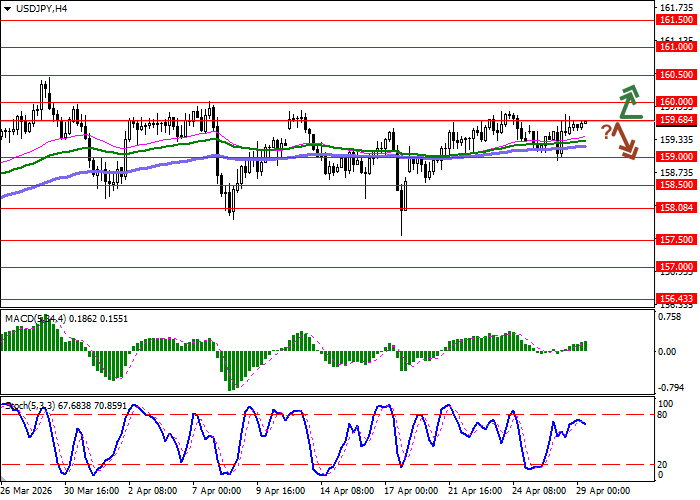
On the daily chart, Bollinger Bands are displaying flat dynamics: the price range is changing only marginally, though it remains wide enough for the current level of activity. MACD is rising, maintaining a weak buy signal above the signal line. Stochastic is turning upward after a fairly sharp decline last week, currently approaching the 80 level.
Resistance levels: 159.68, 160.00, 160.50, 161.00
Support levels: 159.00, 158.50, 158.08, 157.50.
USD/JPY Trading Scenarios and Forecast
Long positions are worth considering after a confident breakout above 159.68, targeting 161.00. Stop-loss at 159.00. Time horizon: 2–3 days.
A rejection from 159.68 as resistance followed by a break below 159.00 may signal an opportunity to open short positions targeting 158.08. Stop-loss at 159.50.
Main Scenario
| Timeframe | Intraday |
| Recommendation | BUY STOP |
| Entry Point | 159.70 |
| Take Profit | 161.00 |
| Stop Loss | 159.00 |
| Key Levels | 157.50, 158.08, 158.50, 159.00, 159.68, 160.00, 160.50, 161.00 |
Alternative Scenario
| Recommendation | SELL STOP |
| Entry Point | 158.95 |
| Take Profit | 158.08 |
| Stop Loss | 159.50 |
| Key Levels | 157.50, 158.08, 158.50, 159.00, 159.68, 160.00, 160.50, 161.00 |
