
Since the beginning of the week, the pair has shown a positive trend, as signs have emerged of a partial recovery in traffic through the Strait of Hormuz, while the International Energy Agency (IEA) has decided to release 400.0 million barrels of oil from strategic reserves, which should be enough to offset the shortfall until the problem is fully resolved. Today at 12:00 (GMT+2), February inflation data for the EU will be published. Although the figures will not yet reflect the impact of the escalation of the Middle East conflict, they may show consumer prices rising from –0.6% to 0.7% month-on-month and from 1.7% to 1.9% year-on-year, still below the 2.0% target level that European Central Bank (ECB) officials use in setting monetary policy. Core inflation, which excludes fuel and food, may increase from –1.1% to 0.8% and from 2.2% to 2.4%, respectively. Yesterday, the March economic sentiment index from the Centre for European Economic Research (ZEW) was released, showing a drop for the eurozone from 39.4 points to –8.5 points versus forecasts of 26.5, and for Germany from 58.3 points to –0.5 points instead of the expected 39.0. Germany’s subindex for current economic conditions rose from –65.9 points to –62.9 points, although it remained in negative territory. Analysts note strong concern among businesses and consumers about the development of the US-Iran confrontation, which is driving up energy prices and accelerating global inflation.
The US currency, which is determining the pair’s dynamics, is standing at 99.30 on the USDX. The positive trend linked to rising global tensions has paused due to a correction in oil prices, as their earlier rise had prompted traders to move into the dollar. Today at 20:00 (GMT+2), the Federal Reserve meeting will take place, and policymakers are most likely expected to keep the interest rate unchanged at 3.50–3.75%. Moreover, analysts report a possible revision of the regulator’s longer-term plans: the start of monetary easing may now be pushed back to the end of the year, and instead of three rate cuts, only one is now expected. At present, most officials are concerned about higher consumer prices driven by geopolitical developments, while in February inflation already stood at 2.4% year-on-year and core inflation at 2.5%. Under these conditions, a prolonged period of current borrowing costs or even a further increase looks entirely possible.
Support and resistance levels
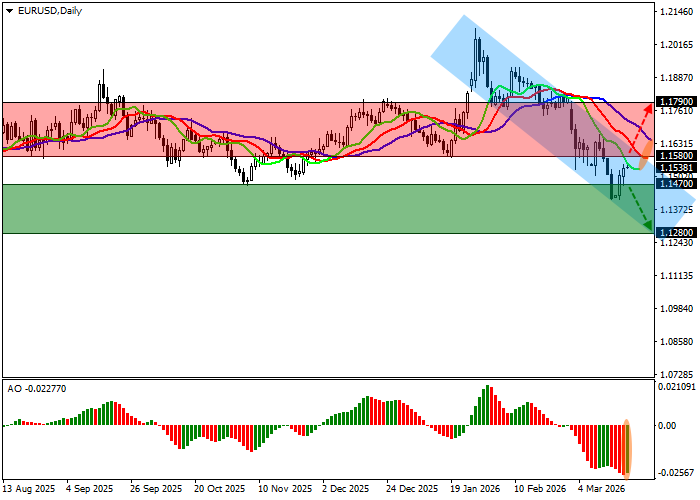
On the daily chart, the instrument is trying to remain below the resistance line of a descending channel with boundaries at 1.1580–1.1300.
Technical indicators continue to show the sell signal received at the beginning of the month: the fast EMAs of the Alligator indicator are below the signal line and widening their fluctuation range, while the AO histogram is forming corrective bars as it declines in negative territory.
Resistance levels: 1.1580, 1.1790.
Support levels: 1.1470, 1.1280.
Trading scenarios and EUR/USD forecast
Short positions may be opened after the price declines and consolidates below 1.1470, with a target at 1.1280. Stop-loss — 1.1560. Implementation period: 7 days or more.
Long positions may be opened after the price rises and consolidates above 1.1580, with a target at 1.1790. Stop-loss — 1.1500.
Scenario
| Timeframe | Weekly |
| Recommendation | SELL STOP |
| Entry point | 1.1465 |
| Take Profit | 1.1280 |
| Stop Loss | 1.1560 |
| Key levels | 1.1280, 1.1470, 1.1580, 1.1790 |
Alternative scenario
| Recommendation | BUY STOP |
| Entry point | 1.1575 |
| Take Profit | 1.1790 |
| Stop Loss | 1.1500 |
| Key levels | 1.1280, 1.1470, 1.1580, 1.1790 |
