
The annual consumer price index accelerated to 3.2% from 3.0% in April, reaching its highest level since October 2024, while the monthly indicator added 0.1%. The main driver is clearly the prolonged Middle East crisis, after which energy prices rose by 10.9% year-on-year, almost unchanged from April’s 10.8% increase. At the same time, services prices advanced by 3.5% after 3.0% a month earlier, pointing to the gradual spread of inflationary pressure beyond the energy sector. The core indicator, excluding the most volatile components and closely monitored by the European Central Bank, increased from 2.2% to 2.5% year-on-year in May, reaching a six-month high and strengthening the case for tighter monetary policy. Among the bloc’s largest economies, the fastest growth was recorded in Spain at 3.6% and Italy at 3.3%, while inflation in Germany eased from 2.9% to 2.7%, and in France accelerated from 2.5% to 2.8%. ECB Executive Board member Isabel Schnabel believes the regulator can no longer ignore the consequences of the Middle East conflict, as its economic effects are already spreading beyond the energy sector. Speaking at a conference in Seoul last Monday, she stressed that the damage to energy infrastructure and supply chains would have a long-term negative effect on price dynamics, meaning monetary authorities would have to respond even if the U.S.–Iran confrontation ended immediately. Schnabel previously noted that the interest rate could be raised as early as the June 10–11 meeting. Today at 10:00 (GMT+2), traders will focus on April producer inflation data, with analysts expecting growth of 4.8% after 2.1% a month earlier.
Meanwhile, the ECB’s annual report on the international role of the euro highlights the increasing complexity of the global payments architecture, driven by both geopolitical fragmentation and the rapid digital transformation of the financial sector, including the spread of stablecoins, which could increase competition with traditional sovereign currencies, including the euro. ECB President Christine Lagarde emphasized deeper capital market integration as a key condition for strengthening the global status of the single currency. At the same time, structural analysis shows a mixed dynamic for the euro: during periods of market turbulence, it increasingly acts as a safe-haven asset and shows limited strengthening against the U.S. dollar, including during volatility episodes linked to protectionist measures by the Republican administration. However, its international role remains secondary to the dollar, which continues to dominate the global currency system with a share of around 57.0% of global reserves versus approximately 20.0% for the euro, reflecting a persistent asymmetry in reserve preferences and global liquidity.
Meanwhile, U.S. investors focused on JOLTS data, which tracks the number of new job openings in the nonfarm sector and serves as an important indicator of the national labor market. In April, the figure rose from 6.887 million to 7.618 million, while analysts had expected 6.88 million. At the end of the week, the key nonfarm payrolls report will be released, with forecasts suggesting around 85.0K new jobs and the unemployment rate remaining at 4.3%. Annual wage growth may slow from 3.6% to 3.4%.
Support and resistance levels
On the daily chart, Bollinger Bands are turning horizontal: the price range is narrowing, reflecting mixed ultra-short-term trading dynamics. MACD is declining, maintaining a weak sell signal and remaining below the signal line. Stochastic points to the possible development of a full bearish trend in the nearest timeframes.
Resistance levels: 1.1634, 1.1661, 1.1681, 1.1700.
Support levels: 1.1600, 1.1577, 1.1529, 1.1500.
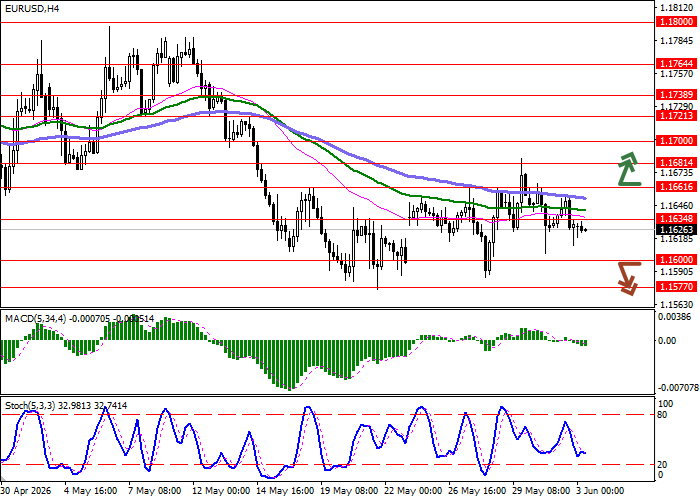
EUR/USD trading scenarios and forecast
Short positions may be opened after a confident breakout below 1.1600, with a target at 1.1500. Stop-loss — 1.1634. Expected timeframe: 2–3 days.
A return of bullish dynamics followed by a breakout above 1.1661 may become a signal to open long positions with a target at 1.1700. Stop-loss — 1.1634.
Scenario
| Timeframe | Intraday |
| Recommendation | SELL STOP |
| Entry point | 1.1595 |
| Take Profit | 1.1500 |
| Stop Loss | 1.1634 |
| Key levels | 1.1500, 1.1529, 1.1577, 1.1600, 1.1634, 1.1661, 1.1681, 1.1700 |
Alternative scenario
| Recommendation | BUY STOP |
| Entry point | 1.1665 |
| Take Profit | 1.1700 |
| Stop Loss | 1.1634 |
| Key levels | 1.1500, 1.1529, 1.1577, 1.1600, 1.1634, 1.1661, 1.1681, 1.1700 |
