

In the United Kingdom, the interest rate was kept at 3.75% as expected, with Chief Economist Hugh Pill voting for the third consecutive time in favor of an immediate 25 basis point hike to 4.00%. The decision came as the annual consumer price index accelerated to 3.3% in March from 3.0% the previous month, while the core reading edged down to 3.1% from 3.2%. Pressure continues to be amplified by volatility in energy markets and persistent uncertainty surrounding developments in the Middle East, with inflation expectations remaining above the 2.0% target through year-end.
An additional factor comes from International Monetary Fund (IMF) assessments suggesting that a sustained consolidation of oil prices around $100.0 per barrel could keep global inflation near 5.0% over the medium term, reinforcing secondary effects through production costs and supply chain disruptions. Against this backdrop, the Bank of England outlined three scenarios for assessing how the current situation may affect the national economy. The most favorable envisions CPI rising to 3.5% by year-end before gradually slowing, while the most adverse projects a peak of 6.2% by early 2027 with inflation remaining above target through 2029.
Bank of England Governor Andrew Bailey, speaking to journalists, said he could not guarantee that interest rates would remain unchanged under any of these forecasts, but assured investors that the central bank has sufficient tools to contain price pressures. Meanwhile, UK residents are drawing on savings to invest in major purchases amid economic uncertainty, seeking to protect personal finances from depreciation. According to Nationwide Building Society, which tracks the average change in prices of homes sold in a given month, average house prices rose 3.0% year-on-year in April compared to 2.2% in March, while the monthly reading slipped from 0.9% to 0.4% — still significantly better than the –0.3% forecast. Chief Economist Robert Gardner described the growth as "surprising," given that other indicators had pointed to a decline in consumer confidence: mortgage rates have risen sharply since the onset of the US-Iran standoff, making homeownership more expensive, though lenders are now beginning to adjust them gradually.
The Federal Reserve, for its part, also kept borrowing costs unchanged in the 3.50–3.75% range following its two-day meeting on April 28–29, marking the third consecutive decision to pause monetary policy adjustments. However, opinions among participants were divided: Board of Governors member Steven Miran voted for an immediate 25 basis point cut, while Cleveland Fed President Beth Hammack and her counterparts from the Minneapolis Fed, Neel Kashkari, and the Dallas Fed, Lorie Logan, opposed including signals of future policy easing in the statement. The accompanying statement noted that economic activity is recovering, the labor market remains resilient, and inflation is elevated, "partly reflecting recent increases in global energy prices" amid the Middle Eastern conflict.
Today at 16:00 (GMT+2), March data on industrial orders will be released, tracking changes in orders for durable and non-durable goods. The reading is expected to improve from 0.0% to 0.5%, which should provide support for the national currency.
Support and Resistance Levels
On the daily chart, the pair has once again made an unsuccessful attempt to update its April high and is currently trading well above the resistance line of the 1.3360–1.3150 descending channel.
Technical indicators maintain a steady buy signal despite the correction: the fast EMAs on the Alligator indicator are holding above the signal line, while the AO histogram is forming new corrective bars in the buy zone.
Support levels: 1.3500, 1.3300.
Resistance levels: 1.3650, 1.3840.
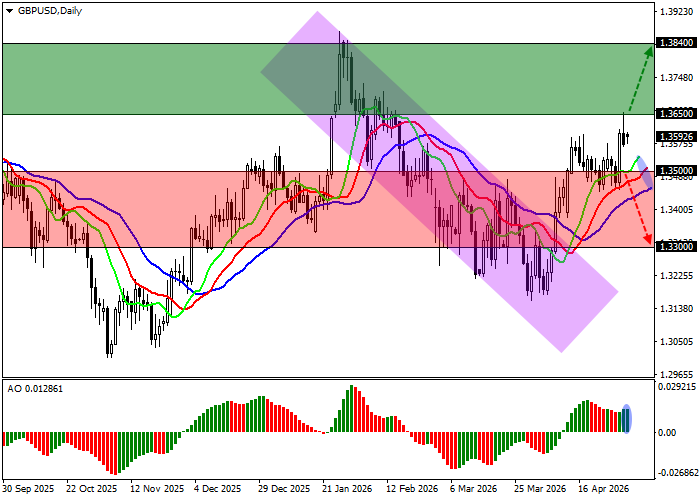
GBP/USD Trading Scenarios and Forecast
Long positions should be opened above 1.3650, targeting 1.3840. Stop-loss: 1.3550. Time horizon: 7 days or more.
Short positions should be opened below 1.3500, targeting 1.3300. Stop-loss: 1.3600.
Scenario
| Timeframe | Weekly |
| Recommendation | BUY STOP |
| Entry Point | 1.3655 |
| Take Profit | 1.3840 |
| Stop Loss | 1.3550 |
| Key Levels | 1.3300, 1.3500, 1.3650, 1.3840 |
Alternative Scenario
| Recommendation | SELL STOP |
| Entry Point | 1.3495 |
| Take Profit | 1.3300 |
| Stop Loss | 1.3600 |
| Key Levels | 1.3300, 1.3500, 1.3650, 1.3840 |
