

With the price hovering near the key 0.7800 level, the Swiss National Bank may still be considering market intervention, while the country's economy remains broadly stable. According to the Federal Statistical Office, retail sales excluding fuel fell 0.7% year-on-year in March after adjusting for public holidays, with food, beverages, and tobacco declining 1.5% and the non-food sector slowing by 0.3%. In February, calendar-adjusted services turnover decreased 1.4% month-on-month.
The US dollar is trading at 97.90 on the USDX, opening with a modest upside bias amid renewed uncertainty over the resumption of traffic through the Strait of Hormuz. President Donald Trump sent a letter to the House of Representatives notifying Congress of the conclusion of military operations, but analysts emphasize that such documents tend to be largely procedural in nature. Under the War Powers Resolution of 1973, the President is required to notify Congress within 48 hours of deploying or withdrawing armed forces from hostilities, and military presence may continue for up to 60 days — with an additional 30-day period for redeployment — without separate congressional approval. Analysts note that tens of thousands of US troops have been deployed across the Middle East in various operations and missions over the years, alongside the activity of state and non-state actors. Post-conflict stabilization therefore often takes months or years, accompanied by localized flare-ups, political crises, and extended diplomatic negotiations. Experts broadly agree that such a congressional letter should be viewed primarily as a domestic legal procedure and a mechanism of parliamentary oversight, rather than an event capable of immediately altering the situation in the Persian Gulf.
Macroeconomic data is providing additional support for the dollar: in April, the manufacturing PMI rose from 54.0 to 54.5, while the ISM's equivalent reading held at 52.7. Following the Fed's widely expected decision to keep rates on hold in the 3.50–3.75% range at end of April, market expectations have shifted toward potential monetary easing over the summer. Analysts also continue to anticipate a resolution of the US-Iran conflict, which removes any immediate case for raising borrowing costs.
Support and Resistance Levels
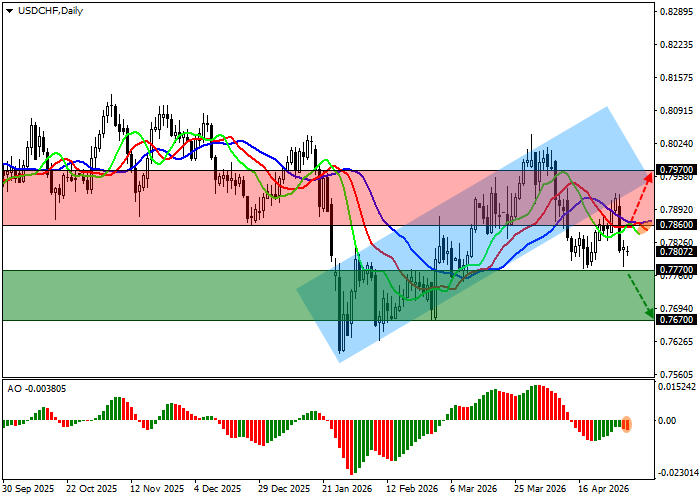
On the daily chart, the pair is holding slightly below the support line of the ascending channel with dynamic boundaries at 0.8050–0.7900.
Technical indicators are maintaining a steady sell signal at the start of the month: the fast EMAs on the Alligator indicator are notably below the signal line and moving further away from it, while the AO histogram is forming corrective bars in negative territory.
Resistance levels: 0.7860, 0.7970.
Support levels: 0.7770, 0.7670.
USD/CHF Trading Scenarios and Forecast
Short positions may be opened after a decline and consolidation below 0.7770, targeting 0.7670. Stop-loss: 0.7830. Time horizon: 7 days or more.
Long positions may be opened after a rally and consolidation above 0.7860, targeting 0.7970. Stop-loss around 0.7800.
Scenario
| Timeframe | Weekly |
| Recommendation | SELL STOP |
| Entry Point | 0.7765 |
| Take Profit | 0.7670 |
| Stop Loss | 0.7830 |
| Key Levels | 0.7670, 0.7770, 0.7860, 0.7970 |
Alternative Scenario
| Recommendation | BUY STOP |
| Entry Point | 0.7865 |
| Take Profit | 0.7970 |
| Stop Loss | 0.7800 |
| Key Levels | 0.7670, 0.7770, 0.7860, 0.7970 |
