

Inflation reached 3.1% year-on-year, which, combined with cooling labor market conditions, including a decline in employment of 92.0 thousand, makes the Fed’s task of balancing economic support and inflation control more difficult. This challenge is also being intensified by rising oil prices following the blockade of the Strait of Hormuz by Iran’s Islamic Revolutionary Guard Corps (IRGC). Early Saturday, President Donald Trump posted on Truth Social that US forces had struck Iran’s Kharg Island in the Persian Gulf, emphasizing that all military targets had been hit while oil infrastructure was left untouched. The island, only about 8.0 kilometers long, plays a critical role in Iran’s economy, as it hosts a terminal responsible for around 90.0% of the country’s oil exports. According to the BBC, Tehran has already warned that any attacks on such facilities could trigger retaliatory strikes against Middle Eastern oil companies cooperating with the United States. The situation creates major risks for the global energy market, given that key oil supply routes pass through the region.
On Thursday at 14:00 (GMT+2), traders will also focus on the outcome of the Bank of England meeting. As with the Fed, analysts do not expect a policy change, although some members of the board may argue in favor of an immediate cut in borrowing costs. Earlier the same day, at 09:00 (GMT+2), the UK labor market report for January-February will be released, with a moderate increase in employment expected relative to the previous three-month reading of 52.0 thousand. Average hourly earnings excluding bonuses are likely to slow from 4.2% to 4.0%, while including bonuses they may decline from 4.2% to 3.9%. At the same time, the unemployment rate is projected to rise from 5.2% to 5.3%.
For now, investors are digesting the broader UK economic report published last Friday, which showed zero GDP growth against a forecast of 0.2%, while industrial production fell by 0.1%. Analysts note that real GDP no longer matches the Bank of England’s first-quarter forecast of 0.3%, and weak activity combined with an inflation shock caused by the energy crisis is increasing stagflation risks. According to The Times, the escalation of the Middle East conflict could create risks for the domestic fuel market within the next 2–3 weeks. A former head of strategy at BP Plc has warned that restrictions on gasoline sales may become necessary, effectively introducing elements of rationing. In such a scenario, priority would be given to maintaining critical infrastructure, including public transportation, healthcare institutions, and food supply systems.
Support and resistance levels
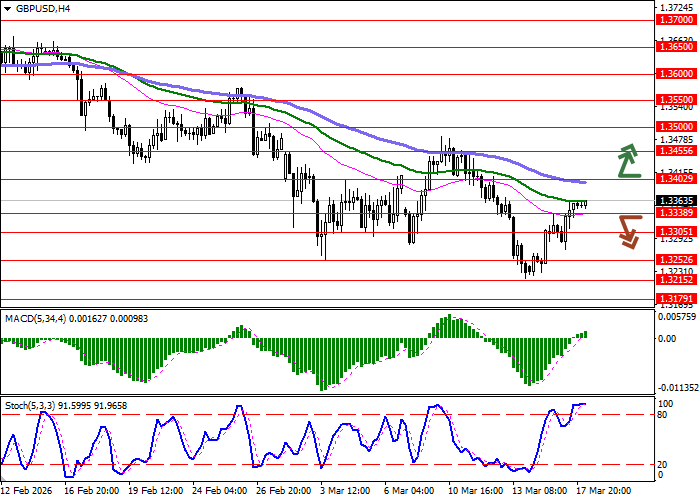
On the daily chart, Bollinger Bands are flattening into a horizontal direction, while the trading range is narrowing, reflecting mixed conditions in the ultra-short term.
MACD is turning upward, forming a new buy signal and attempting to закрепиться above the signal line. Stochastic is showing more active growth and is rapidly approaching the 80 mark, signaling increasing risks that the pound may become overbought in the ultra-short term.
Resistance levels: 1.3402, 1.3455, 1.3500, 1.3550.
Support levels: 1.3338, 1.3305, 1.3252, 1.3215.
Trading scenarios and GBP/USD forecast
Long positions may be considered after a confident breakout above 1.3402 with a target at 1.3500. Stop-loss: 1.3338. Timeframe: 1–2 days.
A return of bearish momentum followed by a breakout below 1.3338 may become a signal to open short positions with a target at 1.3215. Stop-loss: 1.3402.
Scenario
| Timeframe | Intraday |
| Recommendation | BUY STOP |
| Entry point | 1.3405 |
| Take Profit | 1.3500 |
| Stop Loss | 1.3338 |
| Key levels | 1.3215, 1.3252, 1.3305, 1.3338, 1.3402, 1.3455, 1.3500, 1.3550 |
Alternative scenario
| Recommendation | SELL STOP |
| Entry point | 1.3335 |
| Take Profit | 1.3215 |
| Stop Loss | 1.3402 |
| Key levels | 1.3215, 1.3252, 1.3305, 1.3338, 1.3402, 1.3455, 1.3500, 1.3550 |
