

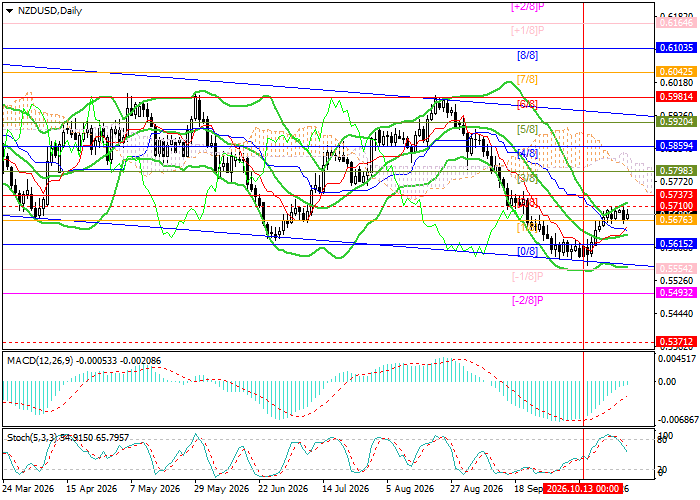
In the middle of the month, the pair tested the channel's lower boundary near 0.5570 before rebounding and consolidating ahead of the policy announcements. Market participants widely expect the RBNZ to raise its Official Cash Rate by 25 basis points, from 2.75% to 3.00%, on October 28. This would be its third increase this year as it seeks to bring inflation back within its 1.0–3.0% target range. According to the latest Stats NZ consumer price report, annual inflation stood at 3.7% in the third quarter, with petrol, new housing construction and electricity among the main contributors. The RBNZ's subsequent steps remain uncertain, and investors are looking for guidance on the pace and extent of further tightening into early 2027. Expectations for the upcoming decision were also discussed in our previous NZD/USD forecast. Meanwhile, New Zealand's general election on November 7 adds political uncertainty, with no clear frontrunner. Prime Minister Christopher Luxon and opposition leader Chris Hipkins have both placed economic issues at the centre of their campaigns.
The Federal Reserve is widely expected to leave interest rates unchanged at its October meeting, but investors will closely examine officials' guidance on policy towards the end of the year. A further 25-basis-point increase in December remains a widely anticipated scenario, although the outcome will depend on incoming economic data. A renewed escalation of hostilities in the Persian Gulf, accompanied by higher oil prices, could intensify inflation risks and strengthen the case for tighter policy. Such a shift could support the US dollar, but neither the size of a subsequent increase nor the currency's response is assured.
Support and Resistance Levels
The pair has stabilised within a narrow range of 0.5676–0.5710. A break above 0.5737 (Murray level [2/8]) could extend the recovery towards 0.5920 (Murray level [5/8], the upper boundary of the descending channel) and 0.5981 (Murray level [6/8]). Conversely, a sustained move back below 0.5615 (Murray level [0/8]) could expose 0.5493 (Murray level [–2/8], near the channel's lower boundary) and 0.5371 (Murray level [4/8] on the weekly chart).
Technical indicators offer mixed signals: Bollinger Bands are flattening after declining, and the MACD histogram's negative bars are shrinking, while the Stochastic oscillator is turning down from overbought territory.
Resistance levels: 0.5737, 0.5920, 0.5981.
Support levels: 0.5615, 0.5493, 0.5371.
Trading Scenarios and NZD/USD Forecast
Short positions may be considered below 0.5615, targeting 0.5493 and 0.5371, with a Stop Loss at 0.5710. Expected holding period: 5–7 days.
Long positions may be considered above 0.5737, targeting 0.5920 and 0.5981, with a Stop Loss at 0.5650.
Primary Scenario
| Timeframe | Weekly |
| Recommendation | SELL STOP |
| Entry Point | 0.5615 |
| Take Profit | 0.5493, 0.5371 |
| Stop Loss | 0.5710 |
| Key Levels | 0.5371, 0.5493, 0.5615, 0.5737, 0.5920, 0.5981 |
Alternative Scenario
| Recommendation | BUY STOP |
| Entry Point | 0.5737 |
| Take Profit | 0.5920, 0.5981 |
| Stop Loss | 0.5650 |
| Key Levels | 0.5371, 0.5493, 0.5615, 0.5737, 0.5920, 0.5981 |
