

Leading financial experts are calling on the Bank of Japan to tighten monetary policy. Yesterday, Arihiro Nagata, head of global markets at Sumitomo Mitsui Financial Group Inc., said that in order to stabilize the bond market, the regulator should raise the interest rate by 50 basis points. In his view, there is little doubt about such a decision, and the main question is the size of the adjustment. Yesterday, the yield on key 10-year bonds reached a 30-year high, while the yen approached the level at which the central bank previously began large-scale currency purchases. Experts believe that at the June meeting, officials will consider a plan to gradually reduce government bond issuance until March and present a similar new plan for fiscal year 2027. According to Nagata, his bank suggested that the regulator pause further reductions in the quantitative easing program and keep monthly purchases at 2.1 trillion yen.
In addition, Bank of Japan Governor Kazuo Ueda warned of growing risks to the economy amid a significant rise in energy prices. Inflation shocks are putting additional pressure on domestic prices and complicating the assessment of the future path of monetary policy. The official noted that the impact of higher oil prices will depend on several factors, including wage dynamics, the degree to which costs are passed on to final prices, and exchange rate fluctuations. The Bank of Japan is closely monitoring external risks that could change inflation expectations among economic agents in a country that has faced deflationary pressure and low consumer price growth for a long time. Given Japan’s high dependence on imported energy resources, the government approved a 513.5 billion yen support package providing subsidies for electricity and natural gas costs, aimed at partially offsetting the burden on businesses and households. This creates additional challenges for the Bank of Japan, which in recent years has maintained ultra-loose monetary policy to stabilize the consumer price index and support economic activity.
The positive dynamics of the U.S. dollar remain intact, and amid the correction, the currency is holding near 99.20 in the USDX. U.S. President Donald Trump is trying to bring the situation in the Middle East back under control and told reporters yesterday evening that he had managed to secure a ceasefire in Lebanon, prompting Iran to return to peace talks. The national currency was also supported by May business activity data: the manufacturing PMI accelerated from 54.5 points to 55.1 points, while the similar indicator from the Institute for Supply Management rose from 52.7 points to 54.0 points.
Support and resistance levels
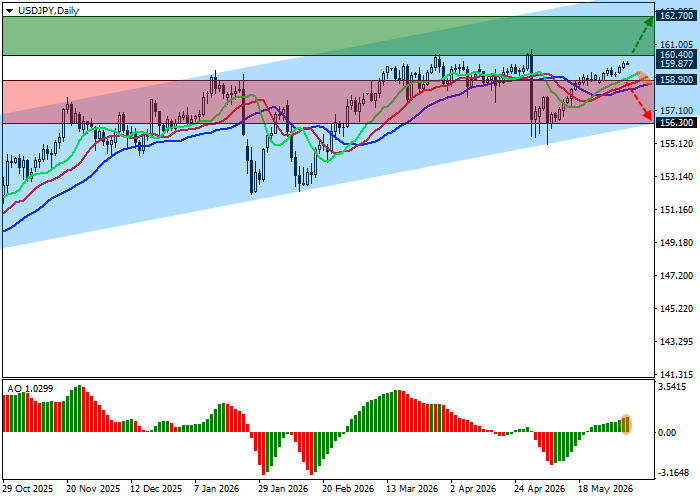
On the daily chart, the trading instrument is correcting within an upward trend, attempting to move away from the support line of the wide channel with boundaries at 163.00–158.00.
Technical indicators are strengthening the buy signal: the fast EMAs of the Alligator indicator are above the signal line, while the AO histogram is forming corrective bars in positive territory.
Resistance levels: 160.40, 162.70.
Support levels: 158.90, 156.30.
USD/JPY trading scenarios and forecast
Long positions may be opened after the price rises and consolidates above 160.40, with a target at 162.70. Stop-loss — 159.50. Expected timeframe: 7 days or more.
Short positions may be opened after the price declines and consolidates below 158.90, with a target at 156.30. Stop-loss — 160.00.
Scenario
| Timeframe | Weekly |
| Recommendation | BUY STOP |
| Entry point | 160.45 |
| Take Profit | 162.70 |
| Stop Loss | 159.50 |
| Key levels | 156.30, 158.90, 160.40, 162.70 |
Alternative scenario
| Recommendation | SELL STOP |
| Entry point | 158.85 |
| Take Profit | 156.30 |
| Stop Loss | 160.00 |
| Key levels | 156.30, 158.90, 160.40, 162.70 |
