

The updated projections were undoubtedly the most notable part of the meeting and also supported buying sentiment. This year, the Fed now expects US GDP growth of 2.4%, which is 0.1% higher than the previous December forecast, while estimates for 2027 were revised up from 2.0% to 2.3%, and for 2028 from 1.9% to 2.1%. At the same time, inflation expectations worsened. By the end of this year, consumer prices are now expected to accelerate to 2.7% from 2.4%, while the 2027 forecast stands at 2.2%, and the 2028 projection remains unchanged at 2.0%. It is clear that these revisions were influenced by the escalation of the military conflict in the Middle East, which has caused a significant increase in oil prices. At present, according to the International Energy Agency’s interactive map, traffic through the Strait of Hormuz has slowed dramatically. While an average of 84 vessels per day passed through the strait between January 1 and February 27, the figure later dropped to just 10. Daily cargo flow fell from an average of 3.400 million tons to 0.342 million tons, with energy commodities still accounting for around 70.0% of that traffic. As for interest rates, according to US officials, the benchmark could decline to 3.40% by the end of the calendar year and to 3.10% in 2027. This suggests that further easing plans remain limited, which is providing moderate support to the US dollar.
Yesterday, market participants also focused on producer price index data, which reflects changes in wholesale goods prices, including raw materials, semi-finished products, and finished goods. On an annual basis, the index rose from 2.9% to 3.4%, while the monthly reading increased from 0.5% to 0.7%, even though analysts had expected 2.9% and 0.3%, respectively. At the same time, the core indicator, which excludes the most volatile components, adjusted in February from 3.5% to 3.9% year-on-year, while the monthly reading moved from 0.8% to 0.5%.
Following today’s Bank of Japan meeting, as expected, the interest rate was kept at 0.75%, with the decision passed almost unanimously, as only one board member voted for an immediate rate increase. In its accompanying statement, the regulator noted rising inflation risks linked to the Middle East conflict, which so far shows no signs of de-escalation. At the same time, the BOJ acknowledged that inflation may temporarily slow below the 2.0% mark in the near term, which could result in a longer pause in monetary policy adjustments. As for the economic impact of rapidly rising oil prices, Japan could indeed face serious problems, since around 95.0% of its supplies come specifically from the Middle East. In this context, Prime Minister Sanae Takaichi has already promised to keep retail gasoline prices at 170.0 yen per liter.
In addition, traders are paying increasing attention to the foreign exchange market itself, since the weakening of the yen has become prolonged and pronounced. The currency has fallen toward the 160.00 level, which the market views as psychologically critical because foreign exchange interventions had previously occurred near this area. This primarily refers to developments in 2022, when Japan’s Ministry of Finance entered the market directly with US dollar sales for the first time in decades. The downward pressure on the yen is driven by several factors, but the most important remains the interest rate gap between the Bank of Japan and other major central banks, especially the Federal Reserve.
Support and resistance levels
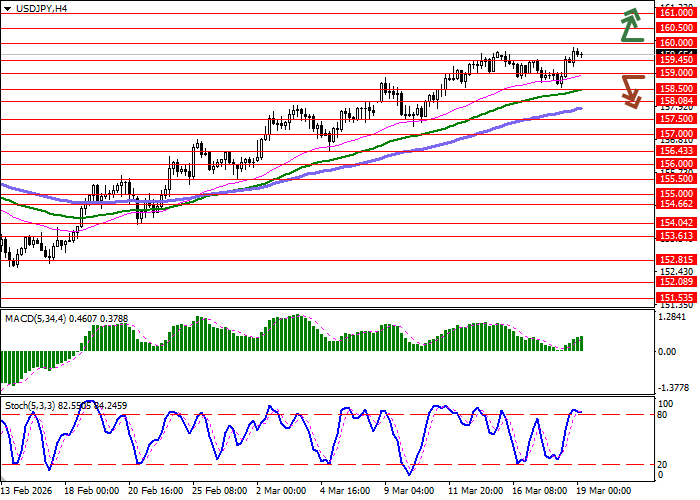
On the daily chart, Bollinger Bands are showing moderate growth: the price range is expanding, opening the way for bulls toward new record highs. MACD is forming a fresh buy signal and is attempting to stabilize above the signal line. Stochastic has turned higher after a brief decline, although this has not yet relieved the instrument from strong overbought conditions, so traders are advised to wait for clearer confirmation from the indicators.
Resistance levels: 160.00, 160.50, 161.00, 161.50.
Support levels: 159.45, 159.00, 158.50, 158.08.
Trading scenarios and USD/JPY forecast
Long positions may be considered after a confident breakout above 160.00, with a target at 161.00. Stop-loss — 159.45. Timeframe: 1–2 days.
A return of bearish momentum followed by a breakout below 159.00 could become a signal to open short positions with a target at 158.08. Stop-loss — 159.45.
Scenario
| Timeframe | Intraday |
| Recommendation | BUY STOP |
| Entry point | 160.05 |
| Take Profit | 161.00 |
| Stop Loss | 159.45 |
| Key levels | 158.08, 158.50, 159.00, 159.45, 160.00, 160.50, 161.00, 161.50 |
Alternative scenario
| Recommendation | SELL STOP |
| Entry point | 158.95 |
| Take Profit | 158.08 |
| Stop Loss | 159.45 |
| Key levels | 158.08, 158.50, 159.00, 159.45, 160.00, 160.50, 161.00, 161.50 |
