

The main factor keeping the yen under sustained pressure remains the full-scale military conflict in the Middle East, which led to the blockade of the Strait of Hormuz by Iran’s Islamic Revolutionary Guard Corps (IRGC). The new Supreme Leader of the Islamic Republic, Mojtaba Khamenei, confirmed that the closure of this critical maritime route, through which around 20.0% of global oil supplies pass, will continue until the United States and Israel end what he called their aggression. For Japan, which imports nearly 100.0% of its energy resources, this factor is critically important: rising oil prices, which have remained near 100.0 dollars per barrel for a week, are worsening the trade balance and creating inflationary pressure that the Bank of Japan will have to consider when determining the future path of interest rates. For now, the authorities have decided on a large-scale release of 80.0 million barrels of oil from the country’s strategic reserves, equivalent to roughly 45 days of domestic consumption. In their view, this measure is intended to solve two problems at once. On the one hand, it is an attempt to reduce pressure on the global energy market and limit further bullish momentum. On the other hand, it is meant to prevent domestic fuel shortages that could arise amid logistical disruptions and supply problems from Persian Gulf countries. Alongside Tokyo’s actions, the US Department of Energy also announced additional oil supply. Over the next 120 days, 172.0 million barrels of crude will be released from the country’s strategic petroleum reserve, which currently holds about 415.0 million barrels, while its total authorized capacity is around 714.0 million barrels.
Investors are now awaiting the outcome of the Bank of Japan meeting, which will take place on March 19 at 05:00 (GMT+2). The regulator is expected to keep the interest rate unchanged at 0.75% while maintaining a hawkish tone in its comments. Particular attention will be paid to distinguishing between temporary and persistent inflation, reflecting the current approach of Japanese officials to gradual monetary tightening. Previously, Governor Kazuo Ueda emphasized that the central bank’s policy is aimed at cautiously supporting the economy and ensuring stable control over inflation expectations. However, the new geopolitical factor has increased uncertainty and requires additional analysis of risks for monetary strategy. At the same time, amid the weakening yen, speculative expectations regarding possible government currency intervention are rising. At the moment, the 160.00 level is being described as psychologically important for the short-term outlook of the USD/JPY pair.
US macroeconomic data released last Friday were moderately optimistic. The core Personal Consumption Expenditures Price Index for January was revised from 3.0% to 3.1% year-on-year, while the monthly reading remained at 0.4%. At the same time, the broader indicator slowed from 2.9% to 2.8% and from 0.4% to 0.3%, respectively, which may support the case for the Federal Reserve keeping policy settings unchanged over the next few months, although even before that most analysts did not expect any adjustments until July or even September. One-year inflation expectations from the University of Michigan remained unchanged at 3.4% in March, while five-year expectations were revised slightly lower from 3.3% to 3.2%.
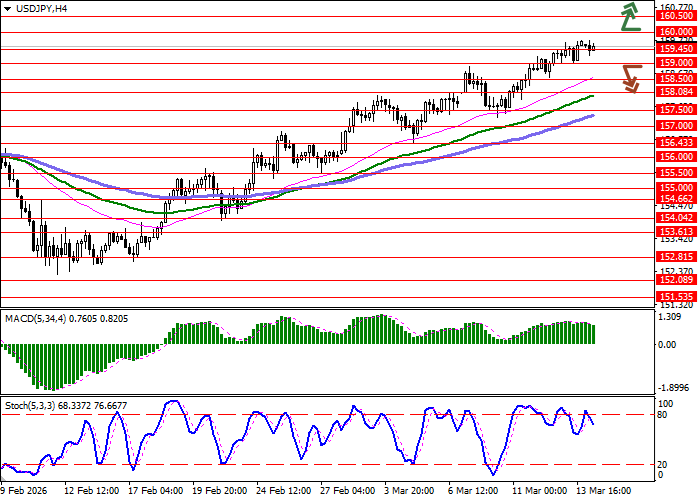
Support and resistance levels
On the daily chart, Bollinger Bands continue to show confident growth: the price range is narrowing from above, limiting the potential for further bullish momentum in the near term. MACD maintains a weak buy signal, remaining above the signal line. Stochastic is flattening out after reaching its peak levels, indicating significant risks of the US dollar being overbought in the ultra-short term.
Resistance levels: 160.00, 160.50, 161.00, 161.50.
Support levels: 159.45, 159.00, 158.50, 158.08.
Trading scenarios and USD/JPY forecast
Short positions may be considered after a confident breakout below 159.00 with a target at 158.08. Stop-loss — 159.45. Implementation period: 1–2 days.
A return of bullish momentum followed by a breakout above 160.00 could become a signal to open long positions with a target at 161.00. Stop-loss — 159.45.
Scenario
| Timeframe | Intraday |
| Recommendation | SELL STOP |
| Entry point | 158.95 |
| Take Profit | 158.08 |
| Stop Loss | 159.45 |
| Key levels | 158.08, 158.50, 159.00, 159.45, 160.00, 160.50, 161.00, 161.50 |
Alternative scenario
| Recommendation | BUY STOP |
| Entry point | 160.05 |
| Take Profit | 161.00 |
| Stop Loss | 159.45 |
| Key levels | 158.08, 158.50, 159.00, 159.45, 160.00, 160.50, 161.00, 161.50 |
