
The company continues to push aggressively into artificial intelligence technologies. CEO Elon Musk has repeatedly stressed the strategic importance of having in-house production of AI5 chips, which are expected to serve as core components in Tesla’s Full Self-Driving platform. According to Musk, relying entirely on third-party suppliers would limit the company’s ability to control development, maintain flexibility, and move quickly enough in a highly competitive environment. He said AI5 is expected to deliver around 2.0–2.5 thousand TOPS of computing power, which by some estimates would place it several times above the performance of the previous generation. Tesla plans to begin limited production in 2026, followed by larger-scale output in 2027, but current partner capacity of around 15.0–25.0 thousand 12-inch wafers per month is unlikely to cover the company’s future demand. As part of this strategy, Musk announced plans for a new TeraFab facility, which he described as significantly larger in scale than the more familiar GigaFab model used across much of the semiconductor industry. That could allow Tesla to deepen integration between its hardware and software stack, accelerate the rollout of autonomous features, and strengthen its competitive position.
At the same time, not all analysts share Tesla’s optimistic outlook. Based on accident-rate analysis using National Highway Traffic Safety Administration data, which reportedly showed Tesla’s supervised robotaxi fleet getting into accidents four times more often than human drivers, specialists at GLJ Research reaffirmed their “sell” rating on the stock with a target price of 25.28 dollars. That would imply a 94.0% drop from the recent market level of 395.00 dollars, which they also described as well above their estimated fair value of 280.74 dollars.
Tesla is scheduled to publish its first-quarter earnings report on April 28. Analysts expect revenue to decline from 24.99 billion dollars to 22.99 billion dollars, compared with 19.34 billion dollars in the same period a year earlier. Earnings per share are forecast to ease from 0.500 dollars to 0.409 dollars, versus 0.270 dollars in the comparable quarter last year.
Support and resistance levels
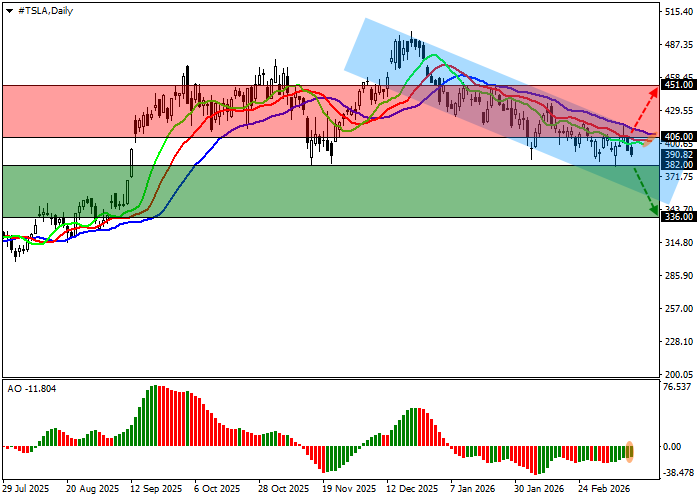
On the daily chart, the instrument remains under pressure and is moving closer to the support line of a descending channel with dynamic boundaries at 406.00–345.00.
Technical indicators continue to reinforce the bearish signal. The fast EMAs of the Alligator indicator remain below the signal line, while the AO histogram is forming corrective bars in negative territory.
Resistance levels: 406.00, 451.00.
Support levels: 382.00, 336.00.
Trading scenarios and Tesla stock forecast
Short positions may be considered after a decline and consolidation below 382.00 with a target at 336.00. Stop-loss: 400.00. Timeframe: 7 days or more.
Long positions may be considered after a move higher and consolidation above 406.00 with a target at 451.00. Stop-loss: below 395.00.
Scenario
| Timeframe | Weekly |
| Recommendation | SELL STOP |
| Entry point | 381.95 |
| Take Profit | 336.00 |
| Stop Loss | 400.00 |
| Key levels | 336.00, 382.00, 406.00, 451.00 |
Alternative scenario
| Recommendation | BUY STOP |
| Entry point | 406.05 |
| Take Profit | 451.00 |
| Stop Loss | 395.00 |
| Key levels | 336.00, 382.00, 406.00, 451.00 |
