

For the first time, a major network upgrade was approved and implemented by the community rather than being determined directly by Input Output, the engineering company behind Cardano.
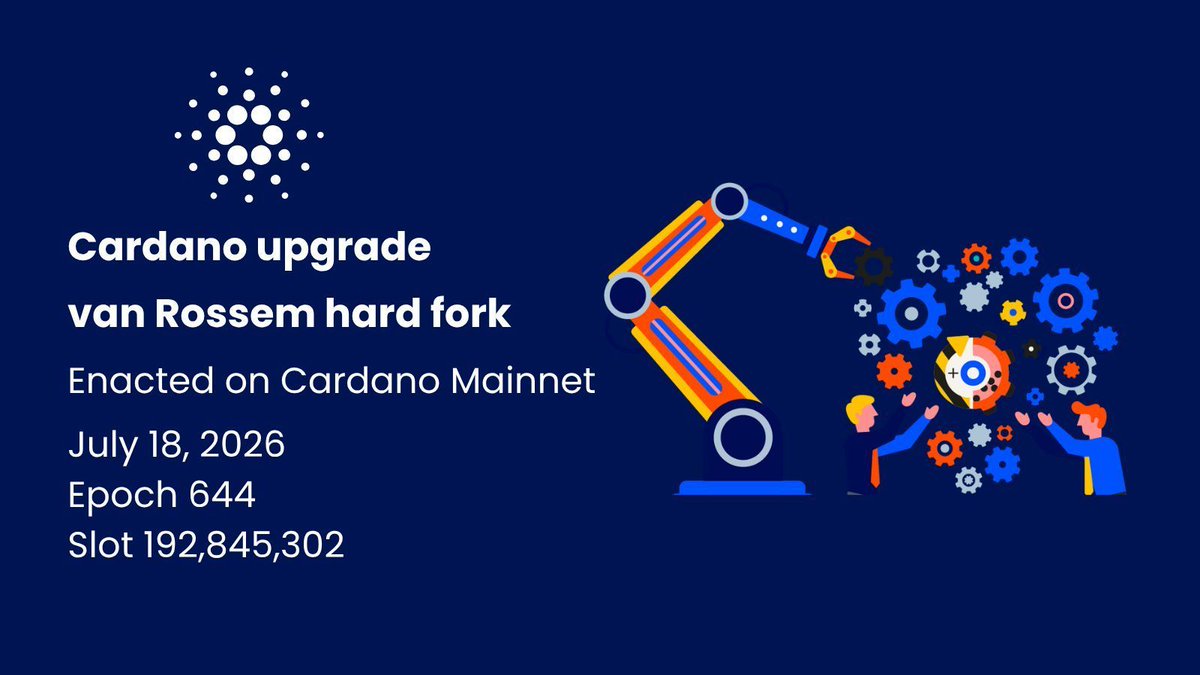
Van Rossem represents the first major test of the decentralised governance model Cardano has been developing since the Voltaire era. It marks a stage in which control over the network’s future is gradually shifting from the founding team to ADA holders and elected community representatives. According to Cardanoscan data, the upgrade proposal passed all three voting groups: delegated representatives, known as DReps, stake pool operators, or SPOs, and the Constitutional Committee.
DReps approved the proposal with 78.97% support, comfortably exceeding the required 60% threshold. All seven members of the Constitutional Committee voted in favour, while stake pool operators were the most cautious group, approving the proposal with 53.02%, slightly above the required 51%.
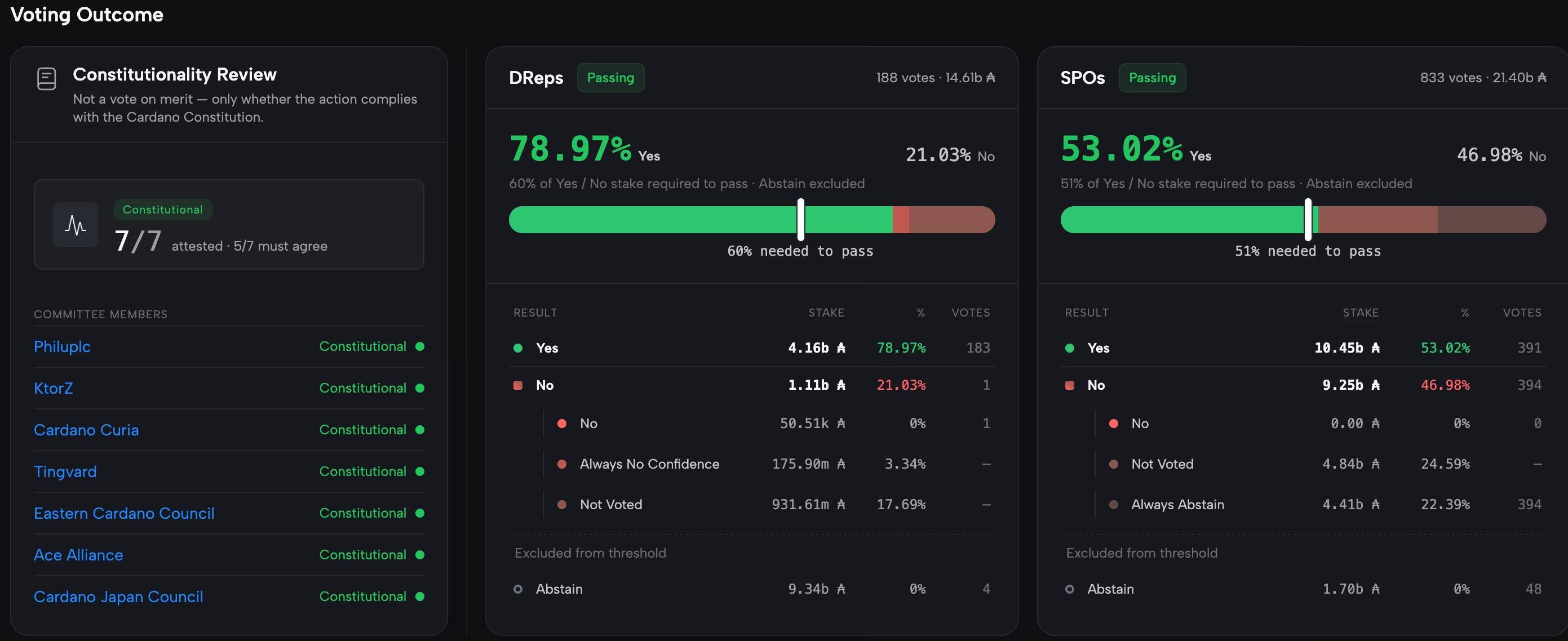
The Constitutional Committee consists of seven members responsible for determining whether upgrade proposals comply with the Cardano Constitution. It forms part of the governance system Cardano has gradually developed since the Chang hard fork in 2024, which introduced on-chain voting to the network.
The Plomin hard fork in early 2025 later gave token holders a more direct role in making decisions about the protocol’s development.
Upgrade Named After Cardano Contributor Max van Rossem
The latest hard fork was named after Max van Rossem, a Dutch Cardano contributor who died in October 2025. Van Rossem held several roles within the ecosystem, including developer, elected representative, node operator and constitutional delegate. He also helped shape the governance system that was later used to activate the upgrade carrying his name.
Van Rossem Introduces Protocol Version 11 Without Downtime
From a technical perspective, Van Rossem is an intra-era hard fork. This means it introduces targeted improvements within the Conway era without restructuring Cardano’s core architecture.
The transition was completed without network disruption, while the existing transaction structure remained unchanged. As a result, ordinary users are unlikely to notice any immediate difference. ADA can still be sent and received in the same way, wallets do not require changes to their basic operation, and standard transaction fees have not been directly adjusted.
Behind the scenes, however, the upgrade introduces a number of improvements for developers. Van Rossem includes five technical updates, including enhancements to Plutus, new cryptographic tools and a security change requiring each stake pool to use a unique cryptographic key.
The zero-downtime hard fork also demonstrated that the transition to Protocol Version 11 could be completed without interrupting normal network activity.
Lower Plutus Execution Costs Could Support Cardano DeFi
One of the main objectives of Van Rossem is to reduce execution costs for Plutus, the smart contract programming platform used by Cardano-based DeFi applications, NFT marketplaces and on-chain payment tools. Lower execution costs could allow developers to build more complex applications while consuming fewer network resources.
Over time, users may benefit from lower interaction fees. However, these savings will not appear automatically after the hard fork, as developers will still need to update or redeploy smart contracts to take advantage of the new features. Van Rossem also introduces additional cryptographic tools designed to accelerate digital signature verification.
The requirement for every stake pool to use a unique cryptographic key also closes a previously identified attack vector in the protocol’s design.
Van Rossem Prepares Cardano for Ouroboros Leios
Van Rossem is considered a mandatory technical foundation for Ouroboros Leios, Cardano’s next major upgrade, which is intended to redesign the way the network processes transactions.
According to current plans, Leios could increase Cardano’s throughput by between 30 and 65 times compared with existing levels, with a long-term objective of exceeding 1,000 transactions per second. Cardano founder Charles Hoskinson expects Leios to reach the mainnet before the end of 2026.
Meanwhile, the public Musashi Dojo testnet was launched on June 23, opening the way for further testing before the technology is deployed on the main network.
ADA Rises as Large Holders Increase Accumulation
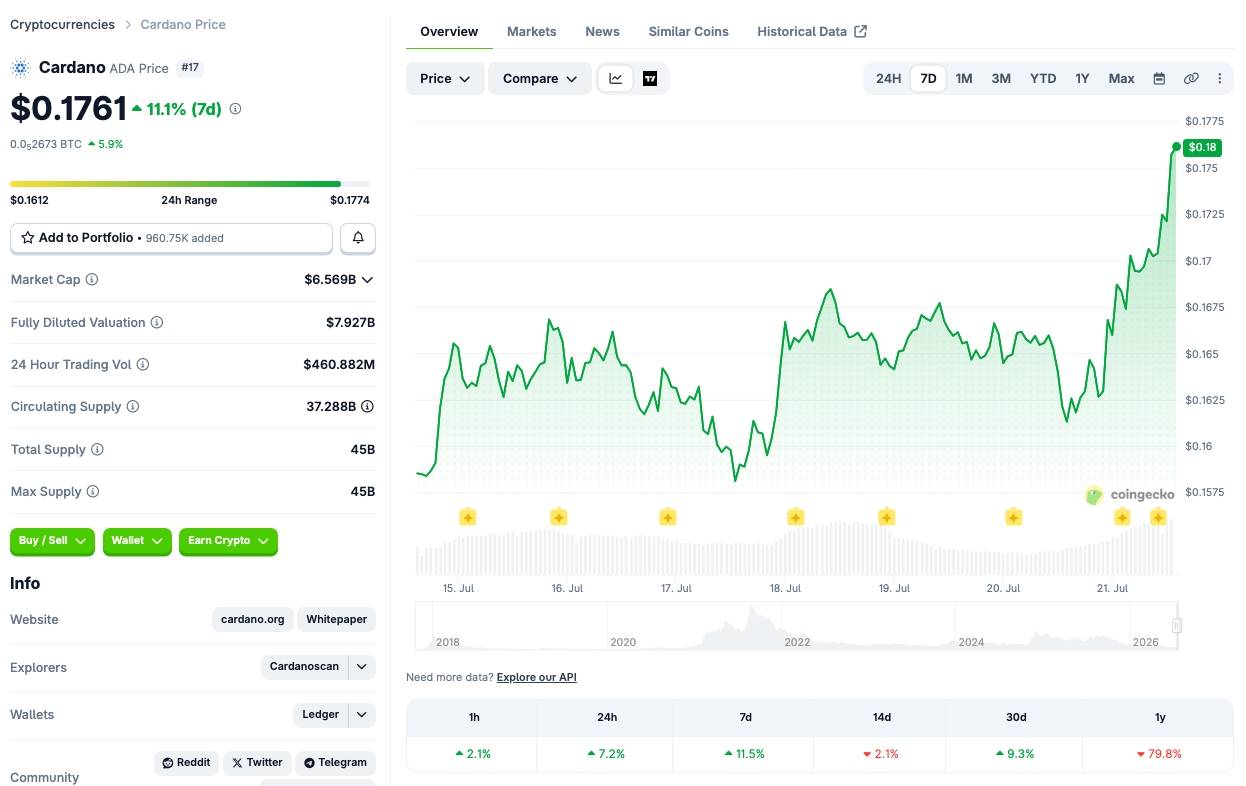
ADA responded positively around the time of the upgrade. Before the hard fork, the token gained approximately 5% to reach the 0.168-dollar area. After the upgrade went live, ADA continued higher towards 0.176 dollars, bringing its total seven-day gain to more than 10%.
According to Santiment data cited in the report, whale addresses holding between 100,000 and 100 million ADA increased their combined balances to the highest level since 2023.
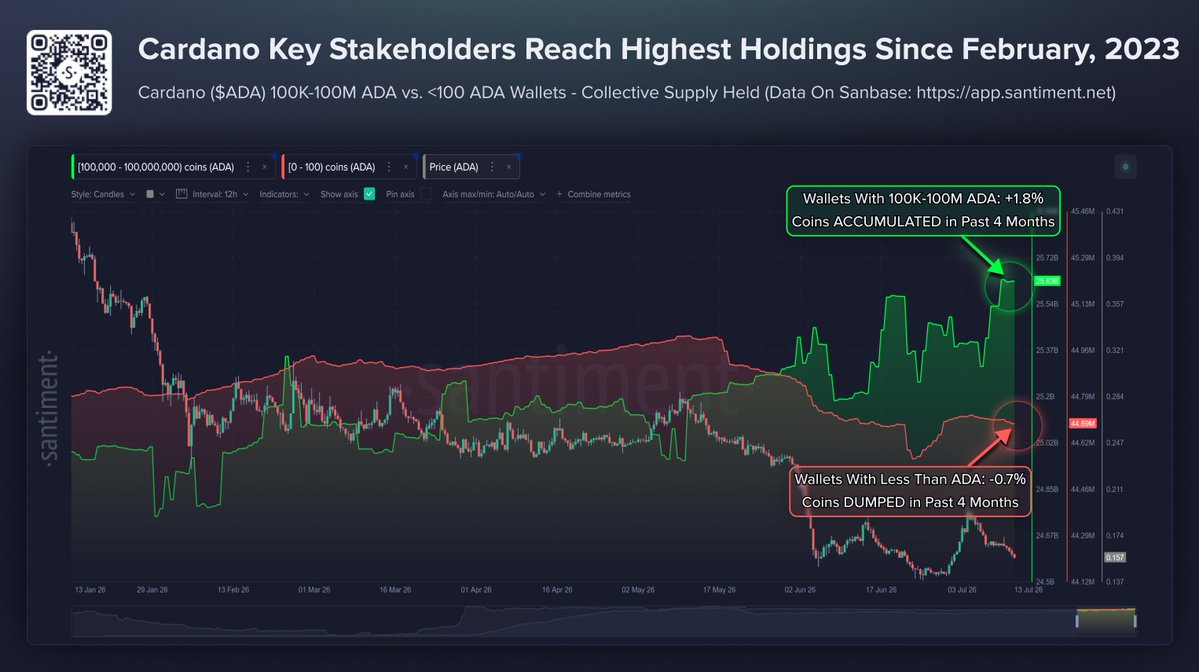
Smaller holders, by contrast, reduced their exposure. The divergence suggests that larger investors may be quietly accumulating ADA, even though broader market sentiment has not yet turned decisively bullish.
conclusion: Van Rossem strengthens Cardano’s position as a community-governed blockchain and lowers technical barriers for future DeFi and payment applications. The immediate effect on users may be limited, but cheaper Plutus execution and preparation for Leios could attract more developers and liquidity, while continued whale accumulation may support ADA if broader market sentiment improves.
