

Multicoin revealed that it has been steadily accumulating HYPE since February and that the token is now one of the largest positions in its hedge fund portfolio.
In a report published on June 25, Multicoin argued that investors still view Hyperliquid merely as a fast-growing decentralised perpetual futures exchange, while the project is actually evolving into an “everything exchange” — an on-chain financial platform capable of trading almost any type of asset.

The fund estimates that Hyperliquid could generate around USD 8 billion in annual profit by 2028. At a valuation equivalent to a price-to-earnings ratio of 20, HYPE would have a fair value of approximately USD 319.
Multicoin stressed that this valuation model does not yet include several potential growth drivers, including:
- HIP-4, which could expand the application ecosystem;
- HyperEVM, which may attract more developers;
- the Builder Code revenue-sharing mechanism;
- portfolio margin, which could improve capital efficiency for traders.
According to the fund, these factors could continue expanding Hyperliquid’s revenue in the coming years.
Multicoin’s argument comes after HYPE repeatedly reached new highs in recent weeks. The token surpassed USD 76 earlier this month before correcting with the broader market toward the USD 60–65 range.
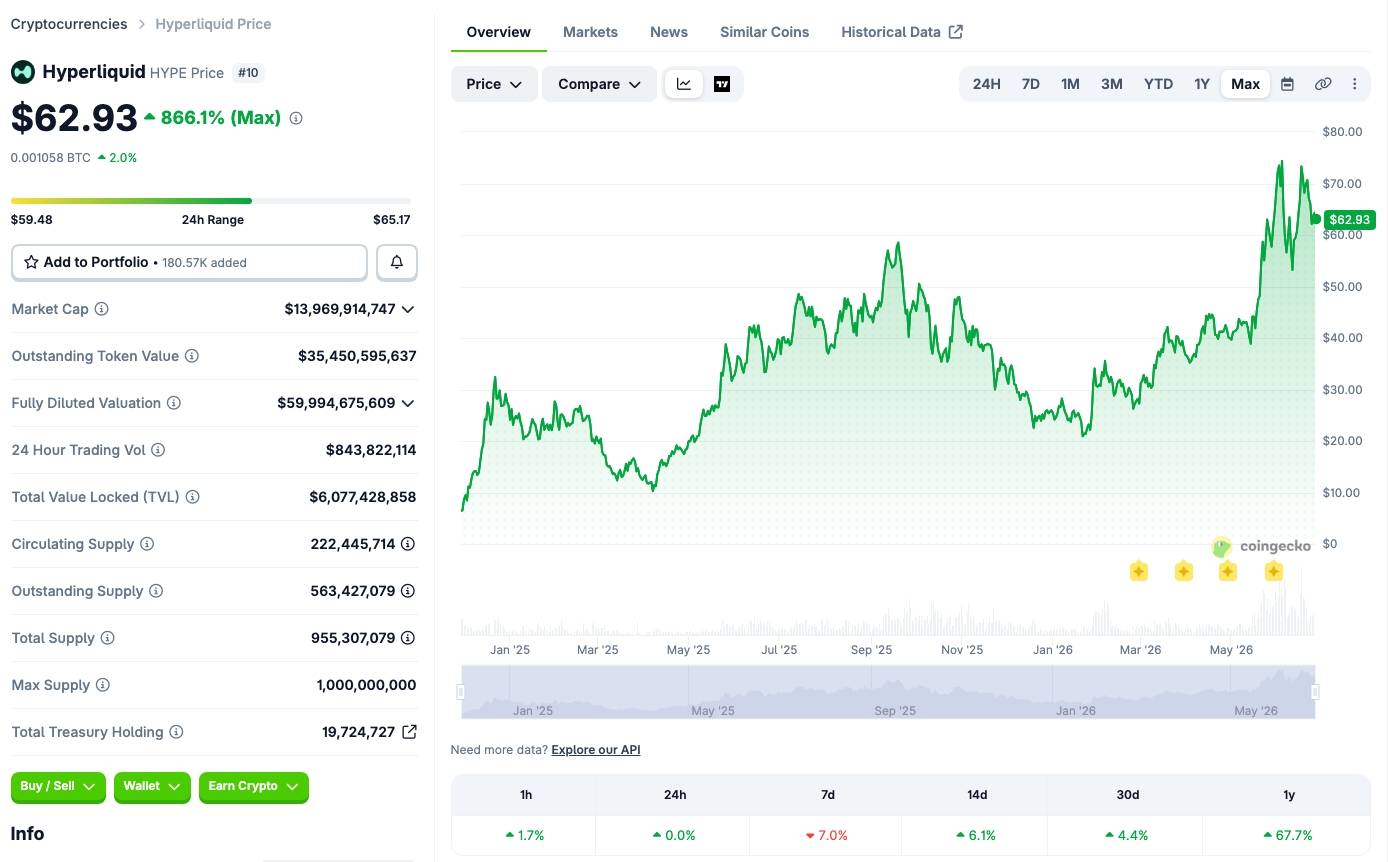
The previous rally was primarily driven by strong inflows into spot HYPE ETFs, elevated protocol revenue, and a token buyback programme funded by protocol income.
HYPE is becoming a relatively rare case in this year’s crypto ETF market. While Bitcoin and Ethereum funds have seen billions of dollars in net outflows, HYPE ETFs have continued attracting fresh capital. After only around one month of trading, three HYPE ETFs had attracted approximately USD 160–170 million, while combined assets under management and cumulative trading volume were approaching USD 900 million.
Hyperliquid Is No Longer Just a DEX
If Hyperliquid was primarily known as a decentralised perpetual futures exchange in 2024, by 2026 the project had expanded into multiple new asset categories.
One notable example is HIP-3, a platform for trading real-world assets through perpetual contracts. On the day of SpaceX’s IPO, the perpetual contract tracking SpaceX shares on Hyperliquid recorded USD 1.4 billion in trading volume, representing around 30% of all HIP-3 volume that day.
At the same time, the platform has been growing rapidly. According to Multicoin:
- The number of users increased from about 301,000 to more than 923,000 in 2025;
- Open interest rose from USD 2 billion to USD 6 billion;
- Trading volume reached USD 2.9 trillion;
- Protocol revenue reached USD 873 million.
These figures have helped Hyperliquid become the largest decentralised derivatives exchange in the market and one of the fastest-growing financial applications in crypto.
Multicoin is not alone in this view. Hyunsu Jung, CEO of Hyperion DeFi, a company building a treasury model around HYPE, also believes Hyperliquid should no longer be valued simply as a DEX.
According to him, when HYPE reached its recent peak, Hyperliquid’s fully diluted valuation approached USD 75 billion, bringing it close to the market capitalisation of major financial companies such as CME Group, Interactive Brokers, and Robinhood. In Jung’s view, Hyperliquid is evolving from a perpetual exchange into comprehensive on-chain financial infrastructure.
Citrini Research has reinforced this perspective by ranking HYPE among the most notable tokens in the market. The research firm argues that Hyperliquid has an advantage that traditional exchanges may find difficult to replicate: combining centralised-exchange-style liquidity with blockchain transparency in a single platform.
Interest in HYPE has reportedly even led Goldman Sachs to sell its entire XRP and SOL ETF positions and shift toward Hyperliquid Strategies. In addition, the chairman of the New York Stock Exchange reportedly said he had met several times with the Hyperliquid team to study the operating model of an on-chain exchange.
However, not all views are bullish. After reaching a high above USD 76, HYPE corrected sharply to around USD 62 alongside the broader market decline. Some analysts have also raised questions about Hyperliquid’s level of decentralisation, as a large share of validators and staked tokens are reportedly connected to the development team, potentially creating risks as the protocol continues to scale.
