

Bitcoin price: consolidation near $91,000
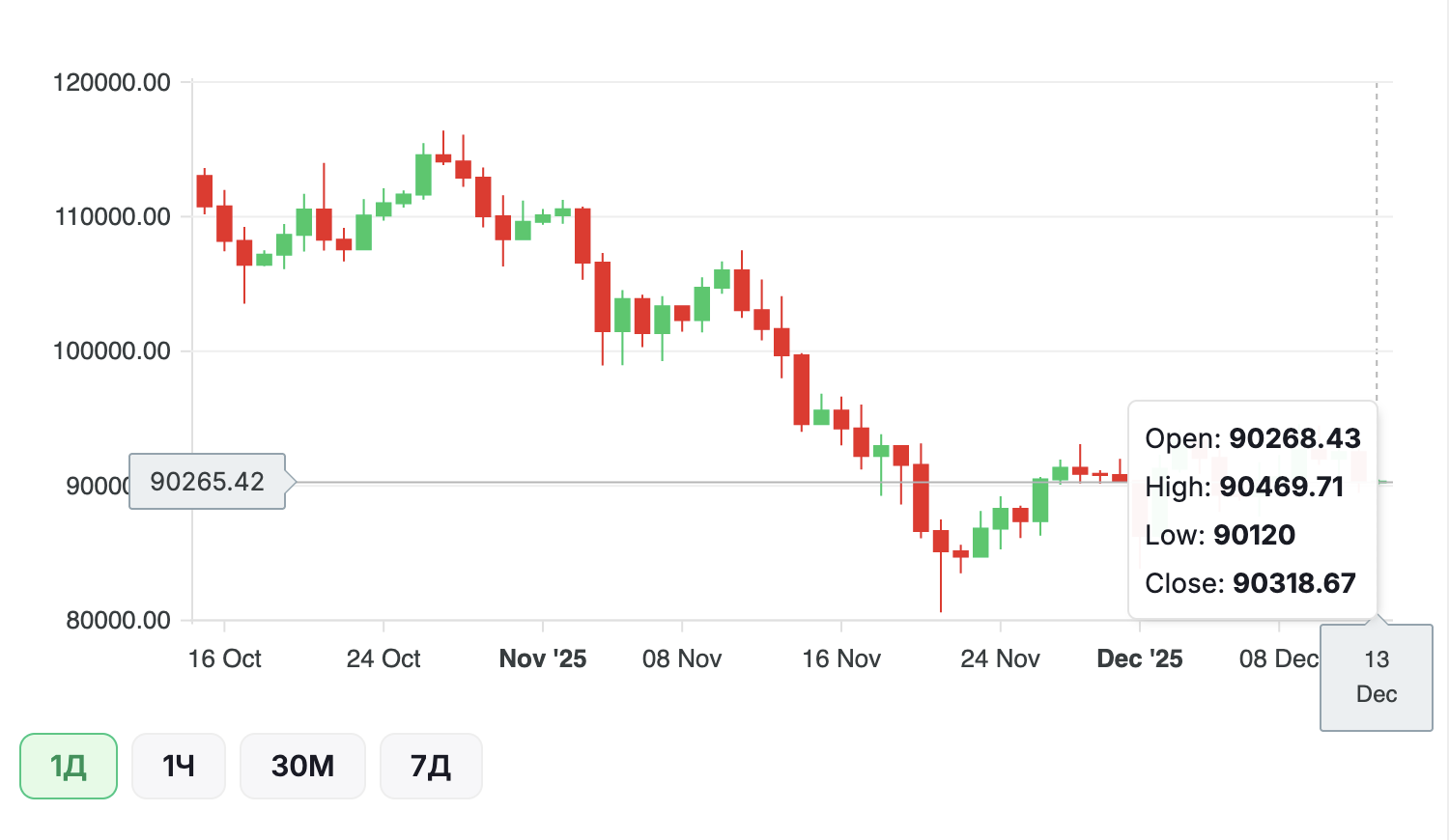
Bitcoin remains stuck in a tight trading range, hovering close to $91,000. Over recent days, the market has oscillated between $90,000 and $93,000, signalling a continued balance between buyers and sellers with no clear directional momentum.
Analysts note that institutional demand for BTC and the continued expansion of spot ETFs could provide fundamental support over the medium term. If inflows remain steady and monetary conditions ease, some still see room for Bitcoin to push toward the $120,000–$150,000 zone.
More cautious market participants argue that the long-term uptrend is still intact, with a key support area in the $70,000–$75,000 region. In the event of a deeper pullback, that zone could attract renewed demand from longer-horizon buyers.
BTC technicals remain restrained
In the near term, Bitcoin has struggled to post a convincing breakout above $93,000–$95,000. The $90,000 area continues to be defended, but without stronger volumes the market remains in a wait-and-see mode.
Trend indicators point to rising inactivity among long-term holders — a signal that has often preceded recoveries in past cycles. Still, a more durable bullish setup likely requires a confirmed turn on lower timeframes, which has not yet fully materialised.
Macro and the Fed still shape crypto sentiment
In 2025, Bitcoin has increasingly moved in step with equity indices and large-cap tech, reacting to Federal Reserve messaging and broader risk appetite. Recent concerns around valuations in the AI-linked segment of the market have temporarily reduced demand for higher-risk assets.
Against this backdrop, some major institutions have trimmed their BTC outlook, shifting expectations closer to $100,000 by year-end as a more conservative baseline scenario.

What’s next: Bitcoin outlook
Market participants will likely keep a close eye on:
-
capital flows into Bitcoin ETFs,
-
key macroeconomic releases,
-
on-chain signals and long-term holder behaviour.
A sustained break above $95,000 followed by firm closes above $100,000 could reopen the path toward fresh highs in the second half of 2025. Conversely, losing the $90,000 floor could trigger a deeper correction, with downside risk extending toward the $76,000 area.