

Over the course of the week, prices climbed from $58.52 on Monday to $60.14 by Friday. However, according to Rabobank, the rebound appears largely technical and does not signal a meaningful trend reversal.
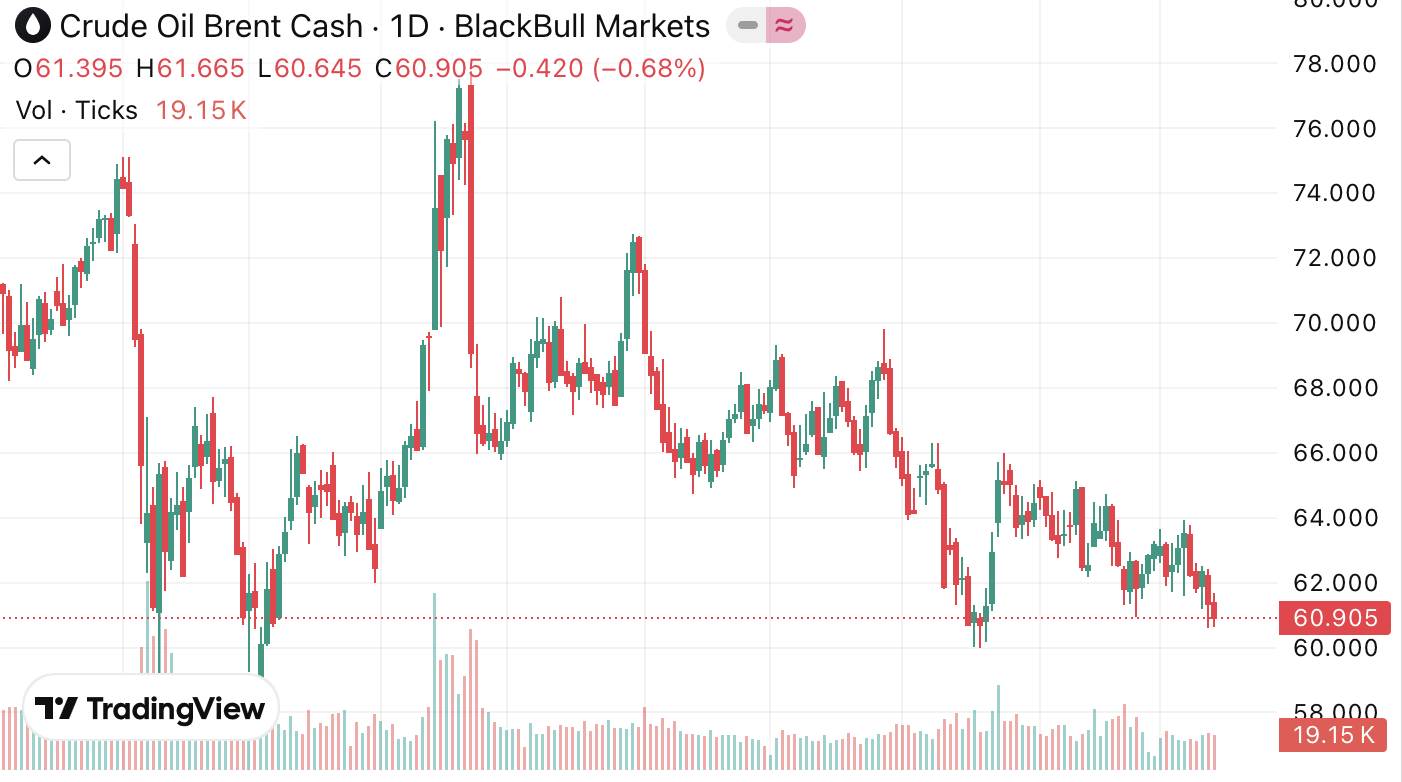
Rabobank Brent Oil Price Forecast for 2026
Rabobank maintains its Brent forecast at $62 per barrel for Q4 of this year, followed by a decline toward $60 in Q1 2026. For most of next year, the bank expects prices to trade within a $58–$60 range.
Analysts also warn of periodic dips below $55 if concerns about oversupply and rising inventories intensify.
Oversupply risks and the OPEC+ factor
Additional pressure has come from the latest outlook by the International Energy Agency (IEA), which projects a supply surplus of 3.5–4.0 million barrels per day in 2026. These estimates have reinforced bearish sentiment across the oil market.
Rabobank broadly agrees with the direction of the IEA’s assessment but views the figures as overstated, noting that most OPEC producers are already operating close to capacity. With no new production increases expected in 2026, the bank argues that the next move from OPEC+ would more likely involve output cuts should Brent prices settle firmly in the $50–$53 range.
Geopolitics and refined products
Geopolitical developments have temporarily supported refined product markets. Attacks on infrastructure and tighter sanctions have constrained Russian exports, lifting margins for diesel and gasoil, even as crude prices remain under pressure.
U.S. shale outlook
In the United States, the number of active drilling rigs has fallen to multi-year lows. This aligns with Rabobank’s view that U.S. shale output could decline by around 160,000 barrels per day in 2026, followed by a further 200,000 bpd drop in 2027. Such trends suggest that supply is responding cautiously to the current price environment.
Bottom line
Despite the recent rebound, the oil market remains under pressure. Forecasts point to a moderately bearish and volatile environment in 2026, with price dynamics driven by supply-demand balances, OPEC+ policy, U.S. shale production trends, and ongoing geopolitical risks.