

Recall that at the beginning of the month the Australian regulator kept the interest rate unchanged at 3.60%, noting in its accompanying statement that the risks of a renewed rise in inflation have increased. Inflation may prove relatively sticky and therefore requires close monitoring by policymakers, while RBA Governor Michele Bullock explicitly ruled out rate cuts in the near term, warning that authorities are ready to take decisive action if economic conditions require it. In October, the weighted CPI stood at 3.8% year over year, while the trimmed mean measure was 3.3%, both remaining above the target range of 2.0–3.0%. It is also worth noting that the Australian dollar is currently receiving local support from the entry into force of a free trade agreement between Australia and India, which should boost trade turnover and improve macroeconomic performance in both countries.
The U.S. backdrop looks somewhat different: GDP expanded by 4.3% in the third quarter, while inflation slowed to 2.7% according to November data, and the labor market is gradually cooling (unemployment rose to 4.6%), increasing the case for monetary support and raising the probability of a more dovish policy path. Traders are pricing in at least two 25-basis-point rate cuts in 2026, while the Fed’s official projections still point to just one adjustment. In any case, no active policy moves are expected in the first half of the year, and a leadership change is due in May, as Jerome Powell’s second four-year term comes to an end. Among potential candidates, analysts often mention Kevin Hassett, the White House’s economic adviser, who has criticized Powell for not shifting to a more dovish stance faster.
Support and resistance levels
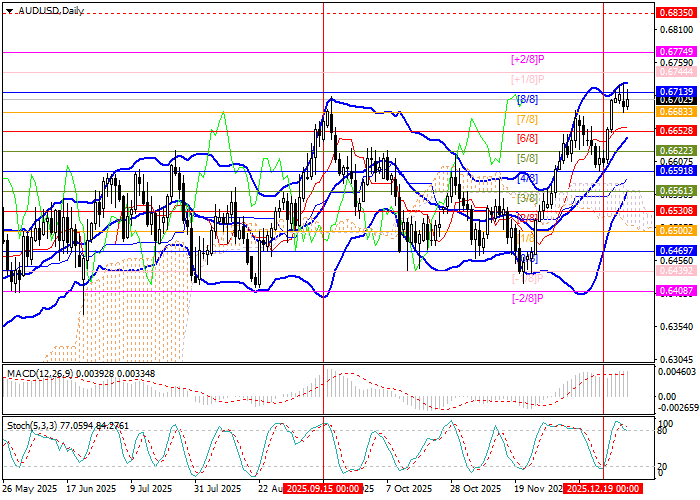
Technically, the pair is testing 0.6713 (Murrey level [8/8]). A breakout above this area would open the way for continued growth toward 0.6774 (Murrey level [+2/8]) and 0.6835 (Murrey level [8/8], W1). If the price breaks below 0.6652 (Murrey level [6/8]), reinforced by the middle Bollinger Band, downside momentum could strengthen toward 0.6561 (Murrey level [3/8]).
Technical indicators point to the continuation of the uptrend: Bollinger Bands are rising, the MACD histogram remains in positive territory, and Stochastic is leaving the overbought zone, allowing for a pullback, though its potential still appears limited.
Resistance levels: 0.6713, 0.6774, 0.6835.
Support levels: 0.6652, 0.6561.
Trading scenarios and AUD/USD forecast
Long positions can be opened above 0.6713, or on a reversal near 0.6652, with targets at 0.6774 and 0.6835 and stop-losses at 0.6670 and 0.6605, respectively. Time horizon: 5–7 days.
Scenario
| Timeframe | Weekly |
| Recommendation | BUY STOP |
| Entry point | 0.6715 |
| Take Profit | 0.6774, 0.6835 |
| Stop Loss | 0.6670 |
| Key levels | 0.6561, 0.6652, 0.6713, 0.6774, 0.6835 |
Alternative scenario
| Recommendation | BUY LIMIT |
| Entry point | 0.6652 |
| Take Profit | 0.6774, 0.6835 |
| Stop Loss | 0.6605 |
| Key levels | 0.6561, 0.6652, 0.6713, 0.6774, 0.6835 |