
This data could serve as an additional signal for the US Federal Reserve regarding the future direction of monetary easing. However, most analysts do not expect any policy changes at least until May, when the four-year term of current Fed Chair Jerome Powell comes to an end.
It is worth recalling that the Fed’s official projections, confirmed at the December meeting, imply only a single rate cut in 2026, while investors are pricing in at least two reductions of 25 basis points each. Much will depend on upcoming labor market and inflation data, as well as on the stance of the next Fed chair. One of the potential candidates is Kevin Hassett, a White House economic adviser and supporter of President Donald Trump, who has repeatedly criticized the Fed for delayed policy decisions.
Reports released yesterday provided moderate support to the US dollar. The house price index, which tracks average price changes for repeat home sales, rose by 0.4% in October after a –0.1% decline in the previous month, beating expectations of 0.1%. Meanwhile, the S&P/Case-Shiller index slowed from 1.4% to 1.3%, still exceeding forecasts of 1.1%. Market participants also focused on the Chicago PMI, which reflects survey data from manufacturing purchasing managers: in December, the index jumped from 36.3 to 43.5, well above the preliminary estimate of 39.5.
At the same time, according to Spain’s National Statistics Institute (INE), consumer prices rose by 3.0% year-on-year in December, down from 3.2% previously and fully in line with expectations. Inflation has remained around this level for four consecutive months after staying below it for more than a year, indicating a gradual acceleration and strengthening arguments for maintaining the current monetary stance of the European Central Bank (ECB).
Analysts note that the adjustment was primarily driven by fuel prices, while core inflation, excluding volatile components such as energy and food, remained unchanged at 2.6%, pointing to continued moderate price pressure in non-core sectors. This was one of the reasons the ECB decided to keep policy parameters unchanged at its last meeting.
While easing inflation in Spain creates some room for cautious policy optimization, price levels remaining above the ECB’s target suggest a careful approach to future decisions. This view was echoed by ECB Governing Council member and Bank of Greece Governor Yannis Stournaras, who stated that borrowing costs would be adjusted depending on economic conditions, adding that current parameters appear “well balanced and fully consistent with the symmetric 2.0% inflation target.”
Support and Resistance Levels
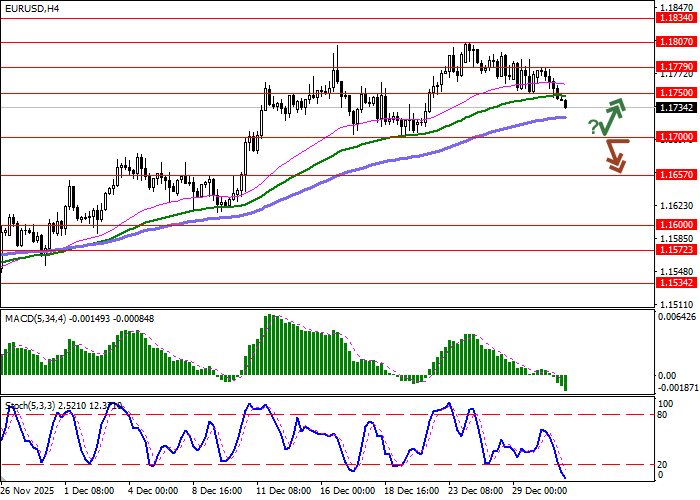
On the daily chart, Bollinger Bands continue to move higher, while the price range narrows, reflecting mixed short-term trading dynamics consistent with current market conditions. The MACD is declining, having formed a new sell signal as the histogram moves below the signal line. The Stochastic oscillator is rapidly approaching its minimum values, indicating short-term oversold risks for the euro.
Resistance levels: 1.1779, 1.1807, 1.1834, 1.1865.
Support levels: 1.1744, 1.1700, 1.1657, 1.1600.
Trading Scenarios and EUR/USD Price Forecast
Short positions may be considered after a confirmed breakout below 1.1700, with a target at 1.1600 and a stop-loss at 1.1750. Time horizon: 2–3 days.
A rebound from the 1.1700 support level followed by a breakout above 1.1750 may serve as a signal to open long positions targeting 1.1807, with a stop-loss at 1.1715.