

In addition, data on investment dynamics published on Monday helped support bullish sentiment for the pound: total business investment jumped sharply in Q3, rising from 0.7% to 2.7% year-on-year and from –0.3% to 1.5% quarter-on-quarter. The current account also improved, although it remained in deficit: the shortfall narrowed to –£12.067 billion from –£21.154 billion, while analysts had expected around –£21.3 billion.
Investors remain focused on the outcome of the Bank of England meeting where, as expected, the interest rate was cut by 25 basis points to 3.75%, and officials did not rule out further monetary easing ahead. At the same time, inflation risks in the UK remain elevated, so the decision to lower rates was approved by a margin of just one vote. Meanwhile, official figures confirming a broader slowdown in economic growth indicate that households reduced savings between July and September amid a rising tax burden and increased consumer spending. GDP rose by only 0.1%, matching the initial estimate and forecasts surveyed by Reuters, while growth for April–June was revised down to 0.2% from the previously reported 0.3%.
In turn, at 15:30 (GMT+2) today, the US will release Q3 GDP data: a fairly sharp slowdown is expected, from 3.8% to 3.2%, which could strengthen market expectations for further monetary easing by the Federal Reserve in 2026. Recall that in December, the Fed, as anticipated, lowered the interest rate by 25 basis points to 3.75% and kept its projections for next year unchanged—only one additional 25 bps cut is assumed across 2026. At the same time, GDP growth expectations were revised higher on the back of improving global prospects. The Fed also expects lower inflation over the coming years. At 15:15 (GMT+2), the market will also assess the latest four-week average employment figures from Automatic Data Processing (ADP); the previous reading showed an increase of 16.25 thousand jobs. The US labor market remains one of the key reference points for policymakers when setting the direction of monetary policy.
Support and resistance levels
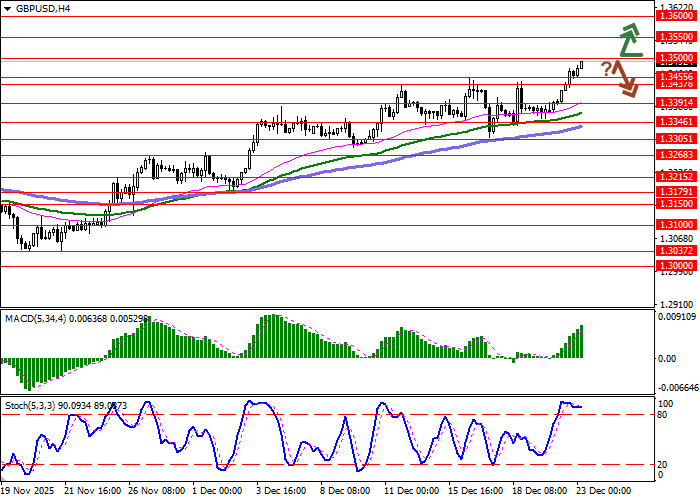
Bollinger Bands on the daily chart show confident upward movement: the price range is expanding, although it is currently lagging the recent surge in bullish sentiment. The MACD is rising and has formed a new buy signal (the histogram is above the signal line). The Stochastic is showing a similar pattern, but its line is hovering near the “80” level, indicating overbought risks for the pound in the ultra-short term.
Resistance levels: 1.3500, 1.3550, 1.3600, 1.3650.
Support levels: 1.3455, 1.3437, 1.3391, 1.3346.
Trading scenarios and GBP/USD outlook
Long positions can be opened after a confident breakout above 1.3500, targeting 1.3600. Stop-loss: 1.3455. Timeframe: 1–2 days.
A rebound from 1.3500 as resistance followed by a breakdown below 1.3455 could be a signal to open new short positions with a target at 1.3346. Stop-loss: 1.3500.
Scenario
| Timeframe | Intraday |
| Recommendation | BUY STOP |
| Entry point | 1.3505 |
| Take Profit | 1.3600 |
| Stop Loss | 1.3455 |
| Key levels | 1.3346, 1.3391, 1.3437, 1.3455, 1.3500, 1.3550, 1.3600, 1.3650 |
Alternative scenario
| Recommendation | SELL STOP |
| Entry point | 1.3450 |
| Take Profit | 1.3346 |
| Stop Loss | 1.3500 |
| Key levels | 1.3346, 1.3391, 1.3437, 1.3455, 1.3500, 1.3550, 1.3600, 1.3650 |