

Investor and forex trader attention remains focused on November consumer price index data, which showed inflation slowing from 3.0% to 2.6% in core terms versus expectations of unchanged growth, and from 3.0% to 2.7% headline versus a forecast of 3.1%. Combined with a rise in unemployment to 4.6% over the same period, the Federal Reserve’s priorities appear to be shifting toward supporting a cooling labor market, making a continuation of a dovish stance at the start of next year increasingly likely.
In an interview with Fox Business, Chicago Fed President Austan Goolsbee said that the negative inflation trend could justify further adjustments to borrowing costs, noting that the neutral rate is well below current levels. New York Fed President John Williams was more cautious, stating that a number of “technical factors” related to the government shutdown may have distorted November inflation data, and that policymakers should wait for December figures before drawing conclusions on future monetary policy.
Eurozone
The euro is strengthening against the Japanese yen but weakening against the British pound and the US dollar.
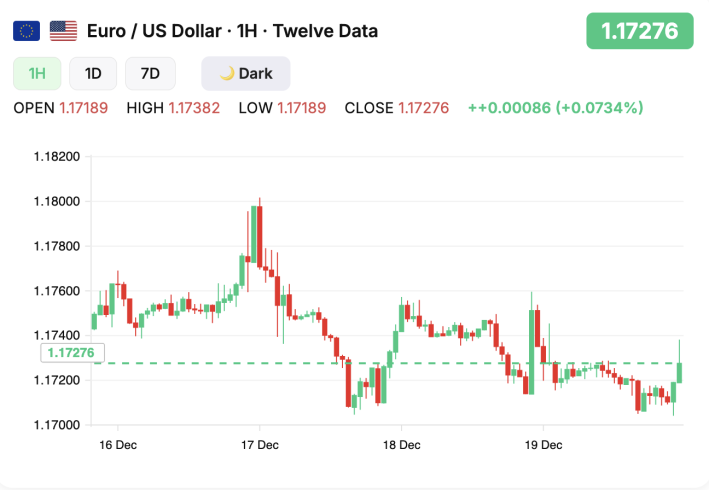
Wholesale price data released today showed Germany’s producer price index declining from 0.1% to 0.0% month-on-month, despite expectations for an unchanged reading, and falling from –1.8% to –2.3% year-on-year, slightly exceeding forecasts of –2.2%. Overall, German businesses remain under pressure amid weakening demand, forcing companies to cut prices to support sales volumes.
In addition, the January GfK consumer climate index disappointed investors, dropping from –23.4 to –26.9 points instead of improving to –23.0. Persistent uncertainty over household financial prospects may continue to weigh on domestic demand. Meanwhile, according to Reuters, most European Central Bank officials expect to keep interest rates unchanged next year, although adjustments cannot be ruled out amid ongoing economic uncertainty.
United Kingdom
The British pound is strengthening against the euro and the Japanese yen but weakening against the US dollar.
UK retail sales data released today showed monthly sales falling by 0.1% in November versus expectations of a 0.3% increase, while annual growth came in at 0.6% compared with forecasts of 1.6%. The GfK consumer confidence index in December remained in negative territory, improving slightly from –19.0 to –17.0 points, the highest level this year, amid smaller-than-expected tax increases for households under the new state budget.
However, the weak performance of key indicators could slow the recovery of the UK economy and increase the likelihood of further monetary easing by the Bank of England. Analysts currently expect up to three additional interest rate cuts in the first half of 2026.
Japan
The Japanese yen is weakening against the euro, the US dollar, and the British pound.
The currency remains under pressure despite the Bank of Japan’s decision today to raise interest rates by 25 basis points to 0.75%, the highest level in the past 30 years. Policymakers signaled their readiness to maintain a hawkish stance, citing inflation moving toward the 2.0% target on the back of rising wages.
However, BoJ Governor Kazuo Ueda disappointed investors by stating that the pace and timing of further rate adjustments would depend on how the economy responds to each policy move. In November, nationwide CPI eased from 3.0% to 2.9%, while core inflation remained unchanged at 3.0%. In its statement, the central bank said inflation is expected to approach target levels by the end of the 2027 fiscal year.
Australia
The Australian dollar is weakening against the US dollar, strengthening against the Japanese yen, and showing mixed performance versus the British pound.
Investors are assessing private sector credit growth, which slowed from 0.7% to 0.6%, and mortgage lending, which remained unchanged at 0.6%. Overall, the data suggest stable conditions, increasing the likelihood that the Reserve Bank of Australia will keep interest rates unchanged for an extended period or potentially raise borrowing costs in the first half of next year.
Oil
Oil prices are posting modest gains today on technical support, although the broader fundamental backdrop remains unfavorable. Investors continue to fear that excess global supply and a potential resolution of the Russia–Ukraine conflict—which could lead to a partial easing of sanctions on Russia’s energy sector and an increase in supply—may weigh on prices.
Additional pressure stems from uncertainty surrounding the enforcement of US President Donald Trump’s order to block sanctioned tankers traveling to and from Venezuela. The measures may prove less strict than expected, as two cargoes were reportedly shipped to China earlier this week. Venezuela currently accounts for around 1.0% of global oil supply.