

Yesterday, the Swiss National Bank (SNB) published its quarterly report on the current state of the national economy. The decision to keep the interest rate at 0.00% last week continues to restrain already near-zero inflation while supporting economic growth. According to a survey of local business executives, GDP growth may turn positive in the fourth quarter after slowing earlier, driven by acceleration in the services and construction sectors. Wage growth remains the main negative factor: next year it is expected to rise to 1.3%, down from 1.6% this year. Revenue expectations remain cautious despite the export tariff reductions agreed with the United States in November, while overall uncertainty stays extremely high. Another key issue is maintaining price growth in positive territory after inflation reached 0.00%. Overall, the report supports the Swiss franc.
The US dollar is trading near 98.10 in the USDX, reacting moderately positively to macroeconomic data. Initial jobless claims fell from 237,000 to 224,000, in line with expectations, while continuing claims increased from 1.830 million to 1.897 million, below the forecast of 1.930 million. Later today, November housing market data will be released, with analysts expecting existing home sales to rise from 4.10 million to 4.15 million, the highest level since February, when an interim peak of 4.26 million was recorded. If the fundamental backdrop does not change sharply, the dollar could return toward the 100.00 level by year-end. At the end of last week, rising yields on 10-year US Treasuries were a key factor supporting the dollar and preventing further declines, with yields reaching a peak since early September at 4.2%, following comments from several Federal Reserve officials expressing concern about further rate cuts. Kansas City Fed President Jeffrey Schmid said US inflation remains “too high” and stressed the need to maintain a moderately restrictive policy, while Chicago Fed President Austan Goolsbee added that policymakers “should wait” for additional data before making further interest rate adjustments.
Support and Resistance Levels
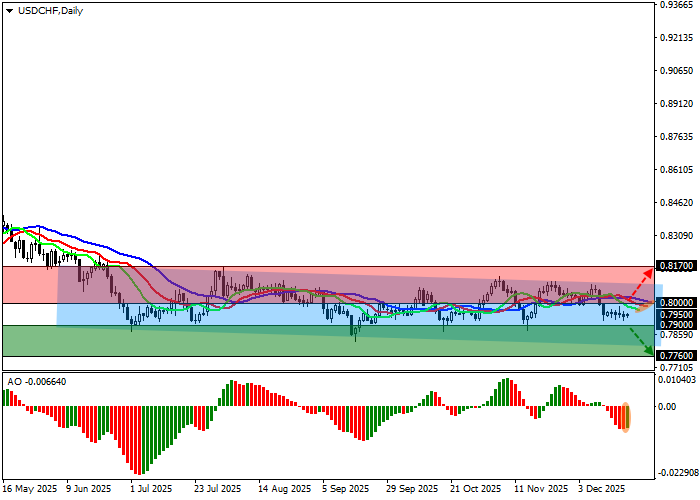
On the daily chart, the instrument is correcting while remaining below the resistance line of a descending channel with dynamic boundaries at 0.8100–0.7800.
Technical indicators are generating a weak sell signal: the fast EMAs of the Alligator indicator are positioned slightly below the signal line and continue to diverge, while the AO histogram is forming corrective bars in negative territory.
Resistance levels: 0.8000, 0.8170.
Support levels: 0.7900, 0.7760.
Trading Scenarios and USD/CHF Forecast
Short positions may be opened after a decline and firm consolidation below the 0.7900 level, with a target at 0.7760 and a stop-loss at 0.8000. Time horizon: 7 days or more.
Long positions may be opened after a rise and firm consolidation above 0.8000, with a target at 0.8170 and a stop-loss at 0.7920.
Scenario
| Timeframe | Weekly |
| Recommendation | SELL STOP |
| Entry point | 0.7895 |
| Take Profit | 0.7760 |
| Stop Loss | 0.8000 |
| Key levels | 0.7760, 0.7900, 0.8000, 0.8170 |
Alternative Scenario
| Recommendation | BUY STOP |
| Entry point | 0.8005 |
| Take Profit | 0.8170 |
| Stop Loss | 0.7920 |
| Key levels | 0.7760, 0.7900, 0.8000, 0.8170 |