

Meanwhile, the Bank of Japan is scheduled to hold its policy meeting on December 19. Analysts do not rule out the possibility of a 25 basis point rate hike to 0.75%, a move that could intensify tensions between BoJ Governor Kazuo Ueda and Japan’s current political leadership. Inflation has accelerated to 3.0%, well above the Bank’s 2.0% target, while labor market pressures and a sharp rise in 10-year government bond yields to their highest levels since 2007 add to the policy dilemma.
Prime Minister Sanae Takaichi, however, opposes tighter monetary conditions, as her government is pursuing a relatively accommodative economic policy aimed at boosting consumption through wage indexation and the restoration of social benefits. In the third quarter, gross domestic product (GDP) contracted by 2.3%, while real wages fell by 1.4% in September, extending a nine-month downward trend.
Industrial production rose by 1.5% in October, slightly above expectations of 1.4%, but still below September’s 2.6% increase. The sector remains under pressure from higher US trade tariffs, despite ongoing efforts to redirect exports toward alternative markets.
Investor attention today is also focused on fourth-quarter business sentiment data. The Tankan index for large manufacturers rose from 14.0 to 15.0 points, while the services-sector index remained unchanged at 34.0 points, missing expectations of 35.0. Meanwhile, the outlook index for large manufacturers increased from 12.0 to 15.0 points versus a forecast of 13.0, and the services activity index accelerated from 0.1% (revised down from 0.3%) to 0.9% in October.
Support and resistance levels
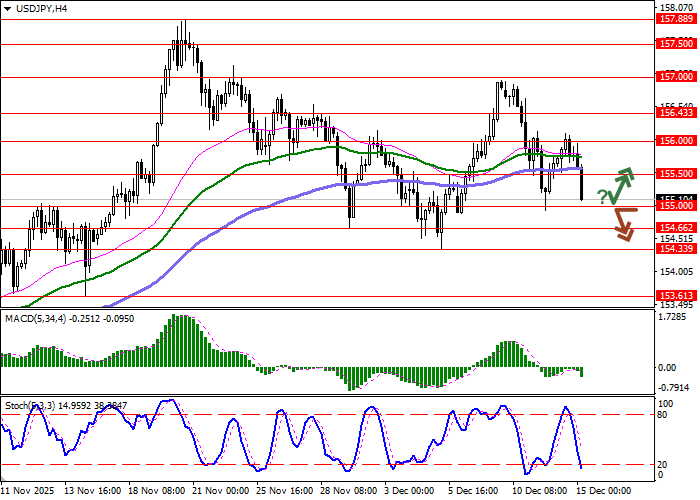
Bollinger Bands on the daily chart show hesitant downward movement, with the price range narrowing from above and limiting the potential for a strong bearish move in the near term. The MACD is declining while maintaining a relatively strong sell signal, as the histogram remains below the signal line. The Stochastic oscillator shows a similar pattern, although its line is rapidly approaching oversold territory, indicating the risk of short-term USD oversold conditions.
Resistance levels: 155.50, 156.00, 156.43, 157.00.
Support levels: 155.00, 154.66, 154.33, 153.61.
Trading scenarios and USD/JPY forecast
Short positions may be opened after a confident downside breakout below 155.00, with a target at 154.00. Stop-loss: 155.50. Time horizon: 1–2 days.
A rebound from the 155.00 support level followed by a breakout above 155.50 could signal new long positions, targeting 156.43. Stop-loss: 155.00.
Scenario
| Timeframe | Intraday |
| Recommendation | SELL STOP |
| Entry point | 155.00 |
| Take Profit | 154.00 |
| Stop Loss | 155.50 |
| Key levels | 153.61, 154.33, 154.66, 155.00, 155.50, 156.00, 156.43, 157.00 |
Alternative scenario
| Recommendation | BUY STOP |
| Entry point | 155.50 |
| Take Profit | 156.43 |
| Stop Loss | 155.00 |
| Key levels | 153.61, 154.33, 154.66, 155.00, 155.50, 156.00, 156.43, 157.00 |