

According to the latest data, Japan imports about 2.8 million barrels of oil per day, of which roughly 1.6 million barrels come from Saudi Arabia, while the rest is supplied by the United Arab Emirates, Kuwait, and Qatar. The country is also the world’s second-largest importer of liquefied natural gas (LNG), with around 11.0% of supplies coming from Qatar, Oman, and the UAE — amounting to more than 7.0 million tons of LNG annually. Rising energy prices increase pressure on the trade balance and boost demand for foreign currency to pay for imports, pushing the yen closer to the historic low near 160.00. The situation increases the likelihood of intervention by the Bank of Japan, whose representatives last month already warned about the need for strict measures if the currency weakens further. Amid such uncertainty, policymakers may postpone interest rate hikes in order to assess the economic impact of the US-Iran conflict. The only factor supporting a continued hawkish stance could be the yen approaching or breaking new historic lows.
The positive momentum of the US dollar remains intact, with the currency holding around 98.90 on the USDX index and demonstrating relative resilience, although earlier this month it traded in the 97.00–98.00 range. The inflow of investment capital during the first days of the conflict in the Persian Gulf was driven by expectations of a quick resolution of the situation, but market participants may now begin to withdraw funds. Markets continue to closely monitor signals from the US Federal Reserve, as the future trajectory of monetary policy could become a key factor for the dollar in the second half of the year. If inflationary pressure intensifies due to rising hydrocarbon prices, the regulator may delay interest rate cuts, which would support the US currency. According to the CME FedWatch Tool, the probability of keeping borrowing costs unchanged at the March meeting currently stands at 95.3%.
Support and resistance levels
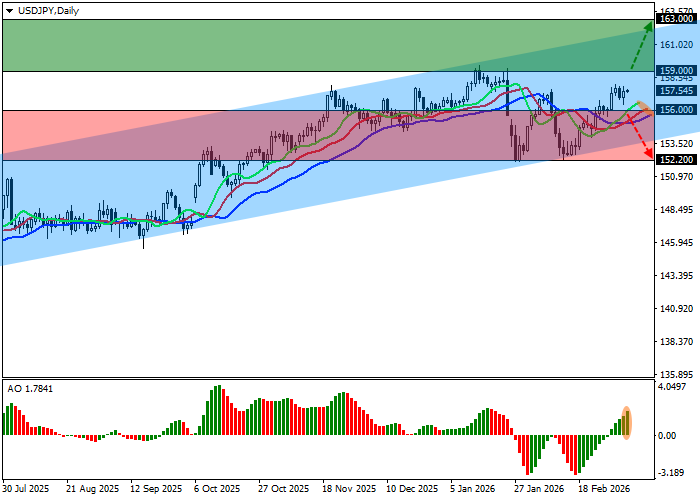
On the daily chart, the trading instrument is moving toward the resistance line of a wide long-term channel with boundaries at 163.00–153.50.
Technical indicators are strengthening an unstable buy signal: the fast EMAs of the Alligator indicator are moving away from the signal line, while the Awesome Oscillator histogram is forming corrective bars in the positive zone.
Resistance levels: 159.00, 163.00.
Support levels: 156.00, 152.20.
Trading scenarios and USD/JPY forecast
Long positions can be opened after the price rises and consolidates above the 159.00 level with a target at 163.00. Stop-loss — 158.00. Implementation period: 7 days or more.
Short positions can be opened after the price declines and consolidates below the 156.00 level with a target at 152.20. Stop-loss — 157.00.
Scenario
| Timeframe | Weekly |
| Recommendation | BUY STOP |
| Entry Point | 159.05 |
| Take Profit | 163.00 |
| Stop Loss | 158.00 |
| Key Levels | 152.20, 156.00, 159.00, 163.00 |
Alternative scenario
| Recommendation | SELL STOP |
| Entry Point | 155.95 |
| Take Profit | 152.20 |
| Stop Loss | 157.00 |
| Key Levels | 152.20, 156.00, 159.00, 163.00 |