
The key factor shaping the trajectory of many currency pairs remains the rapid escalation of the military conflict between the United States, Israel, and Iran, which has now entered its fifth day. According to statements from US President Donald Trump, the confrontation could last several weeks or even longer. The joint operation that reportedly resulted in the death of senior leadership figures in the Islamic Republic, followed by retaliatory strikes from Tehran against US military bases in the region, has increased demand for the dollar as a global reserve currency. However, analysts note that the impact on USD/JPY is mixed: on the one hand, the pair receives support from capital flows leaving risk assets, while on the other hand the Japanese yen, traditionally considered a safe-haven currency, is also attracting demand, limiting the potential for a stronger bullish move in the pair.
Against this geopolitical backdrop, signals regarding the future trajectory of monetary policy are gaining particular importance. Media reports indicate that increased market volatility has raised the probability that the Bank of Japan may refrain from raising interest rates this month. Combined with earlier remarks by Prime Minister Sanae Takaichi expressing doubts about further policy tightening, markets interpret this as a signal in favor of a more cautious stance. However, Deputy Governor Ryozo Himino maintained a hawkish tone on Monday, stating that the central bank should gradually raise borrowing costs if economic and inflation forecasts are met, highlighting internal differences among policymakers. Recent macroeconomic data from Japan published at the end of February have further increased uncertainty: Tokyo’s core consumer price index slowed to 1.8% year-on-year, falling below the Bank of Japan’s 2.0% target for the first time since October 2024, while industrial production rose by 2.2% and retail sales increased by 1.8%, exceeding expectations and signaling continued consumer activity.
Meanwhile, the Japanese government is considering the possibility of forming an additional budget for the 2026 fiscal year in case the Middle East conflict persists and disrupts energy supply chains. Prime Minister Sanae Takaichi emphasized that the short-term impact of the escalation on electricity and gas tariffs remains limited, and the issue of extending subsidies for energy bills covering the January–March period is not currently under discussion. Imports of liquefied natural gas transported through the Strait of Hormuz account for about 6.0% of Japan’s total purchases, and in the event of disruptions the country plans to ensure energy security through diversification of supply sources, including replacing volumes from other exporting countries and using spot contracts. Amid ongoing geopolitical uncertainty and the possibility of energy prices rising to 100.0–120.0$ per barrel, such measures are seen as a strategic tool to stabilize the domestic market and limit inflationary pressure. In addition to energy issues, Takaichi confirmed readiness to discuss the current crisis during the Japan-US summit scheduled for March 19.
Support and resistance levels
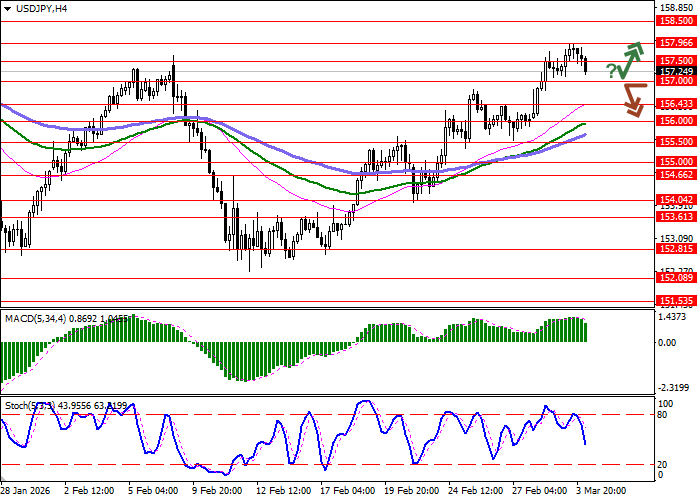
On the daily chart, Bollinger Bands show confident upward momentum as the price range expands, opening the path for bulls toward new local highs. MACD continues to grow, maintaining a strong buy signal above the signal line. Stochastic has remained near the “80” level for some time, indicating significant risks of short-term overbought conditions for the US currency.
Resistance levels: 157.50, 157.96, 158.50, 159.00.
Support levels: 157.00, 156.43, 156.00, 155.50.
Trading scenarios and USD/JPY forecast
Short positions may be considered after a confident breakout below 157.00 with a target at 156.00. Stop-loss — 157.50. Implementation period: 1–2 days.
A rebound from the 157.00 support level followed by a breakout above 157.50 may signal new long positions with a target at 158.50. Stop-loss — 157.00.
Scenario
| Timeframe | Intraday |
| Recommendation | SELL STOP |
| Entry Point | 156.95 |
| Take Profit | 156.00 |
| Stop Loss | 157.50 |
| Key Levels | 155.50, 156.00, 156.43, 157.00, 157.50, 157.96, 158.50, 159.00 |
Alternative Scenario
| Recommendation | BUY STOP |
| Entry Point | 157.55 |
| Take Profit | 158.50 |
| Stop Loss | 157.00 |
| Key Levels | 155.50, 156.00, 156.43, 157.00, 157.50, 157.96, 158.50, 159.00 |