
The ayatollah justified the decision by arguing that transferring the uranium abroad would leave Iran more vulnerable to future military strikes by the United States and Israel. According to the International Atomic Energy Agency (IAEA), before the strikes on nuclear facilities in June 2025, the Islamic Republic had accumulated reserves of more than 440.9 kilograms of uranium enriched to 60.0%. Today, the surviving portion of those stockpiles — approximately 200.0 kilograms — is held in underground tunnels in Isfahan and at the Natanz facility. Iran denies seeking to develop nuclear weapons but insists on its right to pursue a peaceful nuclear program. This issue remains the central sticking point for any peace consultations between the two sides.
The White House has put forward five conditions for a new round of negotiations: no reparation payments for damages caused, the export of enriched uranium out of the country, the retention of only one operational nuclear complex, no release of even 25.0% of frozen Iranian assets, and the linkage of a ceasefire to the negotiation process. Vice President JD Vance had previously told reporters that the possibility of transferring the uranium to Russia was discussed if all other options proved unacceptable to Tehran — but the parties were unable to reach a compromise on this point either.
On the supply side, the American Petroleum Institute reported a fresh drawdown in crude oil inventories of 9.100 million barrels — following a prior correction of –2.188 million barrels. The Energy Information Administration's weekly data showed a decline of 7.863 million barrels, compared to –4.306 million barrels the previous week.
On the investment demand side, data from leading exchanges show trading volumes in futures and options contracts remaining stable — a logical outcome given the ongoing Middle East crisis and the continued blockade of the Strait of Hormuz by the Islamic Revolutionary Guard Corps (IRGC), which has formally consolidated its control over the strategically vital waterway by establishing a dedicated structure — the Persian Gulf Strait Authority (PGSA). The strait had previously handled approximately 20.0% of global oil shipments before the conflict escalated. CME data shows 929,000 contracts traded in oil futures on May 20 — a mid-range figure comparable to earlier this month — while options volume came in at a relatively low 219,000 contracts. CFTC data shows net speculative long positions in crude oil at 169,900 — down from 178,800 the previous week.
Support and Resistance Levels
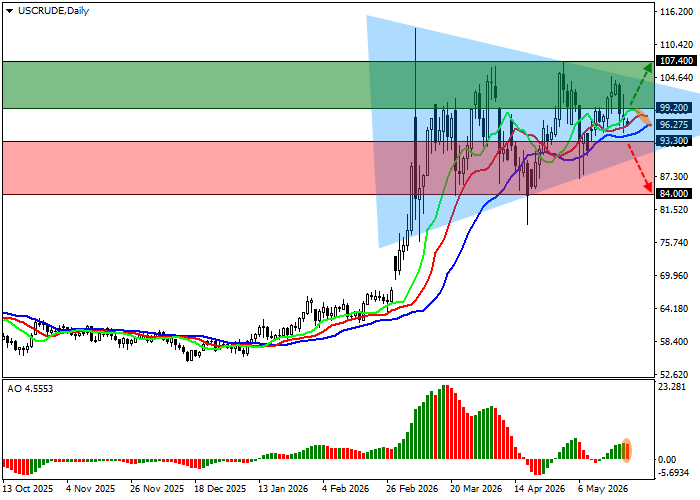
On the daily chart, the instrument is trading slightly below the resistance line of a triangle pattern with boundaries at $104.00–$87.00.
Technical indicators have not yet reversed and continue to hold a long-term buy signal: the Alligator's fast EMAs are positioned slightly above the signal line, while the Awesome Oscillator histogram is forming new corrective bars near the zero level.
Support levels: 93.30, 84.00.
Resistance levels: 99.20, 107.40.
WTI Crude Oil Trading Scenarios and Price Forecast
Long positions should be considered after the price consolidates above 99.20, targeting 107.40, with a stop-loss at 96.00. Time horizon: 7 days or more.
Short positions should be considered after the price consolidates below 93.30, targeting 84.00, with a stop-loss at 97.00.
| Scenario | |
|---|---|
| Timeframe | Weekly |
| Recommendation | BUY STOP |
| Entry Point | 99.25 |
| Take Profit | 107.40 |
| Stop Loss | 96.00 |
| Key Levels | 84.00, 93.30, 99.20, 107.40 |
| Alternative Scenario | |
|---|---|
| Recommendation | SELL STOP |
| Entry Point | 93.25 |
| Take Profit | 84.00 |
| Stop Loss | 97.00 |
| Key Levels | 84.00, 93.30, 99.20, 107.40 |
