
Recall that as a result of the confrontation, which has been ongoing since the end of February, the Strait of Hormuz was blocked, leading to higher energy costs for European consumers. Against this backdrop, the European Central Bank made its first decision in three years to raise the interest rate by 25 basis points and adjusted its inflation forecasts to 3.0% in 2026, 2.3% in 2027, and 2.0% in 2028. In May, the EU consumer price index rose to 0.1% month-on-month and from 3.0% to 3.2% year-on-year, significantly above the 2.0% target. However, investors are most concerned about the core indicator, which excludes food and fuel prices and increased to 0.3% and 2.6%, respectively. These data indicate that the persistently high cost of hydrocarbons caused by their shortage has triggered upward dynamics in other segments of the economy.
Meanwhile, ECB President Christine Lagarde stated that the rapid development of artificial intelligence technologies could create new risks to financial stability and even trigger large-scale financial crises if banks and regulators do not prepare for this in advance. The official noted that one of the key challenges is understanding how progress in AI will affect banking stability and how to protect citizens and businesses from such consequences. Recall that this year, more than 90.0 thousand jobs have already been cut in the industry, with the largest layoffs including around 8.0 thousand at Meta Platforms Inc., as well as tens of thousands at Oracle Corp. and Amazon.com Inc., which management directly links to rising costs for AI infrastructure and the redistribution of resources.
The U.S. dollar, which determines the movement of the asset, is trading at 100.00 in the USDX, maintaining a positive trend. The situation in the Middle East has moved into the background until tomorrow, and investors have turned their attention to monetary factors. At yesterday’s U.S. Federal Reserve meeting, the interest rate, as expected, remained in the 3.50–3.75% range, but the “dot plot” forecasts became much more hawkish: in the accompanying statement, officials noted that they expect gross domestic product growth to slow from 2.4% to 2.2% year-on-year, while the median inflation forecast for this year was 3.6%, far above the 2.7% expected in March. The decision on borrowing costs was made unanimously, but eight of the eighteen members of the Federal Open Market Committee believe that the rate should not be adjusted before the end of the year, while five insist on raising it.
Support and resistance levels
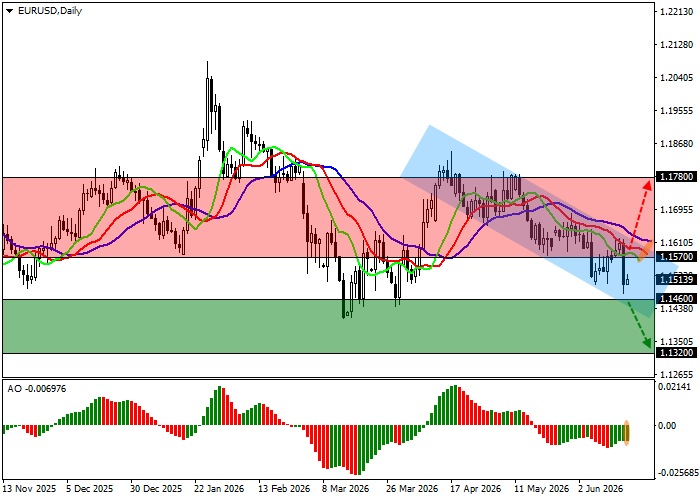
On the daily chart, the trading instrument is trying to move as far as possible away from the resistance line of the descending channel with boundaries at 1.1600–1.1400.
Technical indicators maintain the sell signal received at the end of May: the fast EMAs of the Alligator indicator are below the signal line, expanding the fluctuation range, while the AO histogram is forming corrective bars, declining in the negative zone.
Resistance levels: 1.1570, 1.1790.
Support levels: 1.1460, 1.1320.
 EUR/USD trading scenarios and forecast
Short positions may be opened after the price declines and consolidates below 1.1460, with a target at 1.1320. Stop-loss — 1.1550. Expected timeframe: 7 days or more.
Long positions may be opened after the price rises and consolidates above 1.1570, with a target at 1.1790. Stop-loss — 1.1430.
Scenario
| Timeframe | Weekly |
| Recommendation | SELL STOP |
| Entry point | 1.1455 |
| Take Profit | 1.1320 |
| Stop Loss | 1.1550 |
| Key levels | 1.1320, 1.1460, 1.1570, 1.1790 |
Alternative scenario
| Recommendation | BUY STOP |
| Entry point | 1.1575 |
| Take Profit | 1.1790 |
| Stop Loss | 1.1430 |
| Key levels | 1.1320, 1.1460, 1.1570, 1.1790 |
