

Thus, the British May consumer price index remained at 2.8% year-on-year: the core indicator accelerated from 2.5% to 2.6%, while the services indicator rose from 3.2% to 3.7%. The strongest increase was recorded in the transport sector, while the growth rate of food prices slowed to 2.2%. Labor market data supported the national currency: unemployment declined from 5.0% to 4.9%, while regular wages rose by 3.4% year-on-year against forecasts of 3.2%. Thus, overall inflation dynamics remain unchanged, but growth in the services sector and wages persists, limiting the Bank of England’s ability to quickly lower the interest rate. Earlier, the head of the Bank suggested that more time may be needed to determine whether the rise in hydrocarbon prices will lead to sustained pressure, adding that the previous pause in adjusting borrowing costs contributed to tighter monetary policy compared with market expectations.
The upward dynamics are being restrained by the strengthening of the dollar after the U.S. Federal Reserve decided to keep the interest rate in the 3.50–3.75% range, but the tone of officials turned out to be extremely hawkish: in particular, they noted stable growth in the national economy and a steady labor market situation, while inflation still remains above the 2.0% target, including due to the consequences of the energy crisis caused by the escalation of the Middle East conflict. The market has already reacted with a correction in government bond yields: for example, 2-year securities reached 4.207%, and therefore, among other things, the Chicago Mercantile Exchange (CME) FedWatch Tool indicates an increased probability of tighter monetary conditions later this year.
Consequently, the GBP/USD pair will consolidate near strong support levels, but for a bullish impulse to develop, signals from macroeconomic statistics or from the Bank of England are needed, indicating that lowering the interest rate is currently impossible.
Within the long-term upward trend, the trading instrument is testing the key support level of 1.3315, and if it holds, growth will resume toward 1.3508 and 1.3636. Otherwise, the trend will shift downward, and short positions with targets at 1.3173 and 1.3037, the November low, will become relevant. The price is trading below EMA (21) and EMA (190), reflecting short-term and long-term downward trends, while the RSI (14) indicator is in the neutral zone, allowing both buy and sell trades to be considered.
The medium-term trend remains upward, but quotes are testing the key support area of 1.3353–1.3323, after consolidation below which the trend will reverse downward, and a decline toward zone 2 (1.3049–1.3019) is expected. Otherwise, long positions with targets at 1.3490 and 1.3657 will become relevant.
Support and resistance levels
Resistance levels: 1.3508, 1.3636.
Support levels: 1.3315, 1.3173, 1.3037.
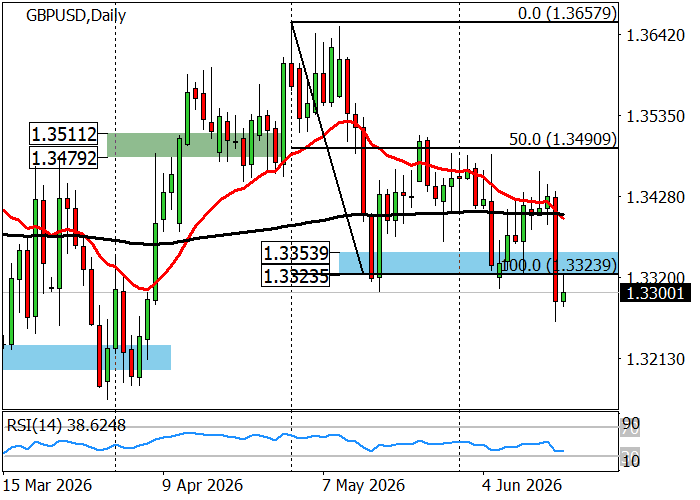
GBP/USD trading scenarios and forecast
Long positions may be opened above 1.3315, with a target at 1.3508 and a stop-loss at 1.3250. Expected timeframe: 9–12 days.
Short positions may be opened below 1.3240, with a target at 1.3037 and a stop-loss at 1.3315.
Scenario
| Timeframe | Weekly |
| Recommendation | BUY STOP |
| Entry point | 1.3320 |
| Take Profit | 1.3508 |
| Stop Loss | 1.3250 |
| Key levels | 1.3037, 1.3173, 1.3315, 1.3508, 1.3636 |
Alternative scenario
| Recommendation | SELL |
| Entry point | 1.3228 |
| Take Profit | 1.3037 |
| Stop Loss | 1.3315 |
| Key levels | 1.3037, 1.3173, 1.3315, 1.3508, 1.3636 |
