

Management has officially refused to apply for participation in the U.S. Navy program to create a new system for initial and advanced jet pilot training as part of the replacement and modernization of the existing training fleet, in order to focus on the current contract and delivery program for the T–7A Red Hawk aircraft, developed jointly with Saab AB. The key reason for this decision is that, according to the corporation’s experts, the current configuration of the T–7A aircraft and its basic architecture are optimized for the requirements of the Air Force rather than the specific standards of the U.S. Navy, which traditionally require stricter characteristics for carrier-based and near-carrier training, including increased airframe loads during maneuvering, different landing profiles, and integration into a pilot training system focused on carrier aviation. The program from which the company withdrew is related to the replacement of the Northrop T–45 Goshawk training aircraft, which has been in operation since the 1990s and is gradually approaching the end of its service life. At the same time, the U.S. Navy estimates the need for dozens of new training aircraft, while open estimates usually mention a range of around 100–200 units in the long term, and the total budget of the pilot training program could reach several billion dollars, taking into account procurement, maintenance, and modernization of training infrastructure and simulators.
The financial report for the second quarter will be published on July 29: according to forecasts, revenue may increase from 22.20 billion dollars to 23.94 billion dollars, above 22.75 billion dollars in the same period last year, while the loss per share may adjust from –0.200 dollars to –0.279 dollars compared with –1.24 dollars a year earlier. The last dividend payments were made in 2020, and after the start of the COVID-19 pandemic they were suspended. Until last quarter, the obstacle to their resumption was the loss that the corporation had recorded every quarter for more than four years, and given the negative forecast for the first half of 2026, the likelihood of this is absent.
Support and resistance levels
On the daily chart, the trading instrument is significantly above the resistance line of the ascending channel with boundaries at 250.00–215.00.
Technical indicators are weakening the unstable sell signal: the EMA fluctuation range of the Alligator indicator remains rather narrow, while the AO histogram is forming corrective bars, rising in the negative zone.
Resistance levels: 233.00, 252.00.
Support levels: 220.00, 200.00.
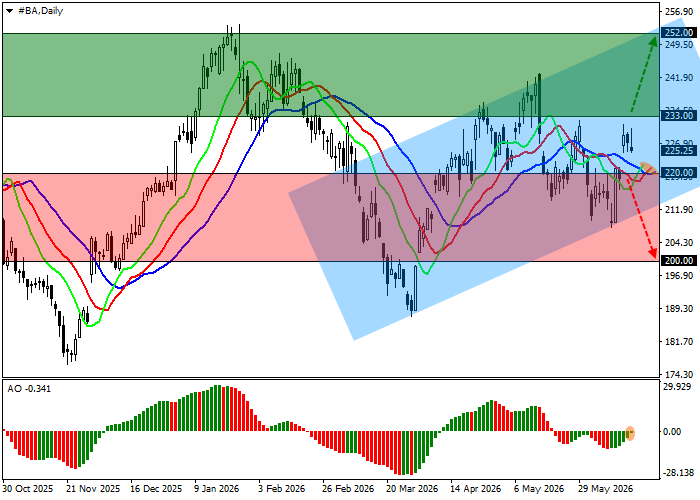
The Boeing Co. trading scenarios and forecast
Long positions may be opened after the price rises and consolidates above 233.00, with a target at 252.00 and a stop-loss at 223.00. Expected timeframe: 7 days or more. Short positions may be opened after the price declines and consolidates below 220.00, with a target at 200.00. Stop-loss — above 230.00.
Scenario
| Timeframe | Weekly |
| Recommendation | BUY STOP |
| Entry point | 233.05 |
| Take Profit | 252.00 |
| Stop Loss | 223.00 |
| Key levels | 200.00, 220.00, 233.00, 252.00 |
Alternative scenario
| Recommendation | SELL STOP |
| Entry point | 219.95 |
| Take Profit | 200.00 |
| Stop Loss | 230.00 |
| Key levels | 200.00, 220.00, 233.00, 252.00 |
