

The preliminary eurozone services Purchasing Managers' Index (PMI) fell from 53.0 to 51.7, while the manufacturing PMI declined from 52.9 to 52.4 and the composite index eased from 53.1 to 51.9. Germany, the bloc's largest economy, showed a somewhat more resilient performance: its manufacturing PMI rose from 53.9 to 54.2, although the services index fell from 52.9 to 51.7, bringing the composite reading down from 53.8 to 52.8. Eurozone business activity expanded at its slowest pace in four months, with high energy costs and political instability in France weighing on growth. French risks were also discussed in our previous EUR/USD forecast. The European Central Bank's Survey on the Access to Finance of Enterprises, published on October 26, added to concerns about the economic outlook. Firms reported higher borrowing costs and reduced bank loan availability, while elevated energy and other input costs continued to squeeze profits. Among companies participating in both the second- and third-quarter surveys, expected increases in their own selling prices over the next 12 months averaged 3.6%, up from 2.5% previously. Together, these findings point to persistent cost pressures alongside slower economic growth.
Further losses are being limited by cautious positioning ahead of the Federal Reserve's policy decision on October 28 at 20:00 (GMT+2), followed by the press conference at 20:30. Analysts widely expect the central bank to maintain its target range at 3.75–4.00%, while investors will look for signals about a possible increase in December. Inflation remains elevated: consumer prices rose by 3.7% year on year in September, while the Producer Price Index for final demand increased by 6.3%. The labour market remains relatively stable, leaving further monetary tightening in focus, although the December decision will depend on incoming data.
Overall, EUR/USD retains the potential for further declines over the medium term.
Support and Resistance Levels
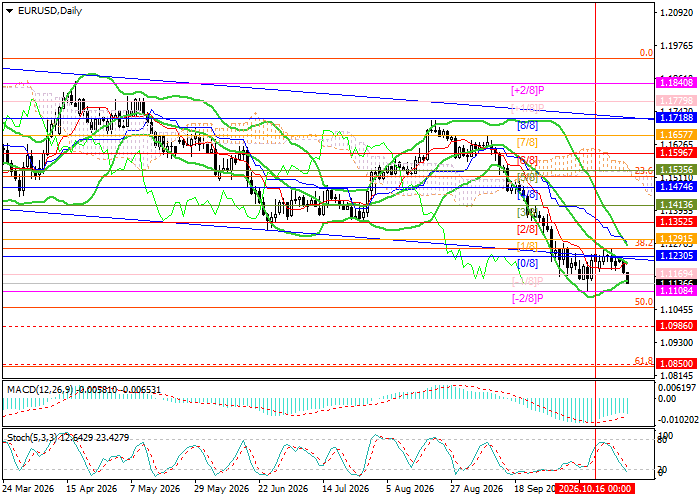
The pair has broken below the lower boundary of its long-term descending channel and is approaching 1.1108 (Murray level [–2/8]). A break below this level could open the way towards 1.0986 (Murray level [–2/8] on the weekly chart) and 1.0850 (61.8% Fibonacci retracement). Conversely, a sustained move above 1.1352 (Murray level [2/8]) could lead to a recovery towards 1.1535 (Murray level [5/8], 23.6% Fibonacci retracement), 1.1718 (Murray level [8/8], the upper boundary of the descending channel) and 1.1840 (Murray level [+2/8]).
Technical indicators maintain a sell signal: Bollinger Bands are turning down, and the MACD histogram's negative bars are expanding. However, the Stochastic oscillator has reached oversold territory, leaving room for a limited corrective rebound.
Resistance levels: 1.1352, 1.1535, 1.1718, 1.1840.
Support levels: 1.1108, 1.0986, 1.0850.
Trading Scenarios and EUR/USD Forecast
Short positions may be considered below 1.1108, targeting 1.0986 and 1.0850, with a Stop Loss at 1.1190. Expected holding period: 5–7 days.
Long positions may be considered above 1.1352, targeting 1.1535, 1.1718 and 1.1840, with a Stop Loss at 1.1240.
Primary Scenario
| Timeframe | Weekly |
| Recommendation | SELL STOP |
| Entry Point | 1.1108 |
| Take Profit | 1.0986, 1.0850 |
| Stop Loss | 1.1190 |
| Key Levels | 1.0850, 1.0986, 1.1108, 1.1352, 1.1535, 1.1718, 1.1840 |
Alternative Scenario
| Recommendation | BUY STOP |
| Entry Point | 1.1352 |
| Take Profit | 1.1535, 1.1718, 1.1840 |
| Stop Loss | 1.1240 |
| Key Levels | 1.0850, 1.0986, 1.1108, 1.1352, 1.1535, 1.1718, 1.1840 |
