
Investors are expecting the start of a new round of US-Iran peace talks, announced yesterday by US President Donald Trump. According to sources cited by the Associated Press, the parties have reached a preliminary agreement to extend the two-week truce for further consultations, raising traders’ hopes for a ceasefire agreement and reducing the risks of a global slowdown, while also stimulating demand for alternatives to the US dollar. Meanwhile, eurozone industrial production in February adjusted by 0.4% month-on-month, exceeding the forecast of 0.3%, and by –0.6% year-on-year versus the expected –1.0%, confirming the sector’s resilience. It is worth noting that these figures do not yet reflect the negative consequences of rising hydrocarbon prices, and experts do not rule out a significant deterioration later on.
Despite the generally positive market backdrop, the asset’s growth is being somewhat restrained today by increasing uncertainty over the future monetary policy of the US Federal Reserve and the European Central Bank (ECB). In an interview with Bloomberg TV yesterday, ECB President Christine Lagarde said that the future direction of credit conditions remains unclear, as much depends on the economic consequences of the conflict with Iran for the bloc, with the outlook ranging between the baseline and adverse scenarios. A similar view was expressed by Bank of Estonia Governor Madis Müller, who stated that the ECB does not yet have enough data to adjust interest rates this month, while most traders are expecting tighter policy to offset the effects of rising hydrocarbon prices. At the same time, US Treasury Secretary Scott Bessent, following the release of March wholesale inflation data showing only weak growth, urged the regulator to move away from its wait-and-see stance in favor of a more dovish approach, while President Donald Trump once again reiterated his intention to dismiss current Fed Chair Jerome Powell, expressing confidence that his successor Kevin Warsh, whose nomination has not yet been approved by Congress, would begin implementing the monetary easing desired by the administration.
Overall, despite the current slowdown in momentum, the probability of further strengthening in EUR/USD remains intact.
Support and resistance levels
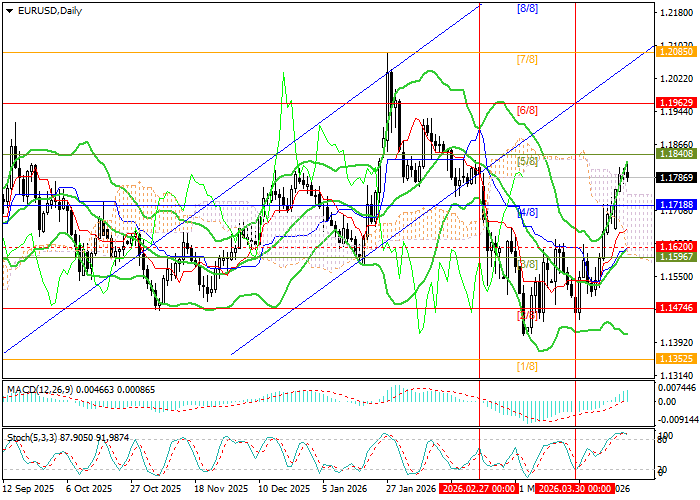
The instrument is moving within an uptrend and is approaching the 1.1840 mark (Murray [5/8]), a breakout of which would trigger further growth toward 1.1962 (Murray [6/8]) and 1.2085 (Murray [7/8]). However, if the pair consolidates below the middle Bollinger Band at 1.1620, a decline toward 1.1474 (Murray [2/8]) and 1.1352 (Murray [1/8]) is expected.
Technical indicators continue to maintain a buy signal: Bollinger Bands are turning upward, the MACD histogram is expanding in positive territory, and Stochastic may leave the overbought zone, which does not rule out a limited correction.
Resistance levels: 1.1840, 1.1962, 1.2085.
Support levels: 1.1620, 1.1474, 1.1352.
Trading scenarios and EUR/USD forecast
Long positions may be opened above 1.1840 with targets at 1.1962 and 1.2085, with a stop-loss at 1.1750. Timeframe: 5–7 days.
Short positions may be opened below 1.1620 with targets at 1.1474 and 1.1352, with a stop-loss at 1.1700.
Scenario
| Timeframe | Weekly |
| Recommendation | BUY STOP |
| Entry Point | 1.1845 |
| Take Profit | 1.1962, 1.2085 |
| Stop Loss | 1.1750 |
| Key levels | 1.1352, 1.1474, 1.1620, 1.1840, 1.1962, 1.2085 |
Alternative Scenario
| Recommendation | SELL STOP |
| Entry Point | 1.1615 |
| Take Profit | 1.1474, 1.1352 |
| Stop Loss | 1.1700 |
| Key levels | 1.1352, 1.1474, 1.1620, 1.1840, 1.1962, 1.2085 |
