

Rising energy costs for European consumers are accelerating inflation, which has already exceeded 3.0% in the leading EU economies, prompting the financial authorities of the bloc’s countries to adjust their budgets for next year. In Germany, the plan provides for a net borrowing requirement of 196.5 billion euros, or 4.3% of gross domestic product (GDP), which is 15.0 billion euros higher than this year’s figure and 23.0 billion euros above analysts’ medium-term forecasts. Tomorrow at 11:00 (GMT+2), investors will focus on EU GDP for the first quarter, which only partially covers the period of the US-Iran confrontation, and the reading may come in at 0.1% quarter-on-quarter and 0.8% year-on-year, matching last year’s level. Meanwhile, European Central Bank (ECB) Governing Council member Martin Kocher said that the regulator would move toward tightening monetary policy if the inflation outlook does not improve significantly. Although the decision to refrain from adjusting the interest rate in April was justified, further rate increases remain possible. According to the official, the possibility of stagflation in the eurozone cannot be ruled out despite the stability of the labor market, while the duration of the US-Iran conflict will be decisive.
The US dollar, which determines the dynamics of the asset, is at 98.00 in the USDX and may continue its negative trend. Hopes for a peaceful settlement of the situation in the Persian Gulf remain, but the parties have still not reached a consensus. On Sunday, US President Donald Trump rejected official Tehran’s proposal, insisting on Iran’s complete refusal to enrich uranium and the transfer of its uranium stockpiles. The current draft agreement provides for the lifting of US sanctions and the blockade of the Strait of Hormuz, as well as an immediate cessation of hostilities with guarantees that the agreements will be fulfilled. The Islamic Republic proposes reducing the moratorium on work with nuclear components not for 20 years, as the White House insists, but for 5 years, as well as exporting part of its reserves to third countries rather than completely destroying them and dismantling nuclear energy facilities.
Meanwhile, existing home sales in the United States amounted to 4.02 million in April, below preliminary estimates of 4.05 million, indicating a possible cooling of the real estate sector. Today at 14:30 (GMT+2), consumer price index data for the same period will be published, which may show a slowdown from 0.9% to 0.6% month-on-month and an acceleration from 3.3% to 3.7% year-on-year.
Support and Resistance Levels
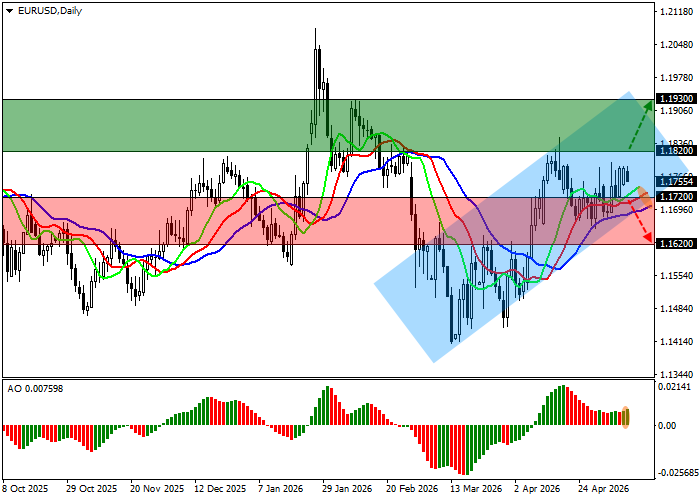
On the daily chart, the trading instrument is retreating from the support line of the ascending channel with boundaries at 1.1950–1.1720.
Technical indicators maintain the buy signal received in early April: the fast EMAs of the Alligator indicator remain above the signal line, widening the fluctuation range, while the AO histogram is forming corrective bars and rising in the positive zone.
Resistance levels: 1.1820, 1.1930.
Support levels: 1.1720, 1.1620.
Trading Scenarios and EUR/USD Forecast
Long positions may be opened after the price rises and consolidates above 1.1820, with a target of 1.1930. Stop-loss — 1.1750. Timeframe: 7 days or more.
Short positions may be opened after the price declines and consolidates below 1.1720, with a target of 1.1620. Stop-loss — 1.1800.
Scenario
| Timeframe | Weekly |
| Recommendation | BUY STOP |
| Entry Point | 1.1825 |
| Take Profit | 1.1930 |
| Stop Loss | 1.1750 |
| Key Levels | 1.1620, 1.1720, 1.1820, 1.1930 |
Alternative Scenario
| Recommendation | SELL STOP |
| Entry Point | 1.1715 |
| Take Profit | 1.1620 |
| Stop Loss | 1.1800 |
| Key Levels | 1.1620, 1.1720, 1.1820, 1.1930 |
