
European Commissioner for Economy Valdis Dombrovskis stated that stagflationary pressures are developing amid a sharp rise in energy prices caused by supply disruptions following the blockade of the Strait of Hormuz. This is having a systemic impact on both the industrial sector and consumer activity, increasing price pressure while economic growth slows. Before the Middle East conflict began, the European Commission had forecast gross domestic product (GDP) growth of 1.4% this year and 1.5% in 2027, with inflation slightly above 2.0%.
According to revised calculations, the consumer price index may increase by a full percentage point this year, while under the second scenario it could rise by as much as 1.5 percentage points. The European economy is also under additional pressure due to the region’s high dependence on imported energy resources: external oil supplies account for more than 95.0%, while natural gas imports make up around 80.0%.
Against this backdrop, the European Central Bank (ECB) views the currently implemented measures aimed at developing alternative energy as one of the key elements for strengthening the region’s macroeconomic resilience. However, ECB President Christine Lagarde believes that the current measures taken by European governments are still not sufficient given the scale of the climate and economic challenges.
According to the statistical office Eurostat, after the start of the Russia-Ukraine conflict and amid the Middle East crisis, household spending on electricity and heating in a number of eurozone countries increased by more than 30.0%, while energy-intensive industries faced declining profitability and weakening competitive positions in the global market. Under these conditions, it is necessary to accelerate investment in renewable energy, the modernization of power grid infrastructure, and the improvement of energy efficiency across the economy. According to European Commission estimates, the annual volume of capital investment required to implement the climate strategy and reduce dependence on external energy supplies should amount to around €660.0 billion until 2030.
At the same time, Eurostat reports that around 93.0 million people are at risk of poverty or social exclusion, with young people aged 16 to 29 and single-parent families remaining among the most vulnerable groups. European Commission Vice-President Roxana Mînzatu noted that ongoing geopolitical and economic crises will continue to put pressure on household welfare and the region’s social infrastructure. In these conditions, official Brussels plans to reduce the number of people exposed to such risks by at least 15.0 million by 2030 by expanding access to education, healthcare, and support programs.
Particular attention is also being paid to financing mental health initiatives and addressing the housing shortage, as around 1.0 million EU residents remain without permanent housing. The next multiannual budget provides for at least €100.0 billion in support programs, reflecting the European authorities’ intention to soften the consequences of slowing economic growth, the rising cost of living, and persistent inflationary pressure.
Meanwhile, April data on nonfarm employment from Automatic Data Processing (ADP), based on a survey of around 400,000 business sources, fell short of forecasts: the indicator increased by only 109,000 against preliminary estimates of 118,000, although it still exceeded March’s 61,000. Despite the generally positive trend, the growth was highly uneven across sectors: more than half of the new jobs came from healthcare and education, while trade and transport also made a noticeable contribution.
Today at 14:30 (GMT+2), labor market statistics will be released. If the situation remains stable, as suggested by the latest preliminary estimates — with unemployment expected to stay around 4.3% and employment projected to rise by 73,000 — the position of those within the U.S. Federal Reserve who support keeping current monetary policy in place for longer may strengthen significantly.
Support and resistance levels
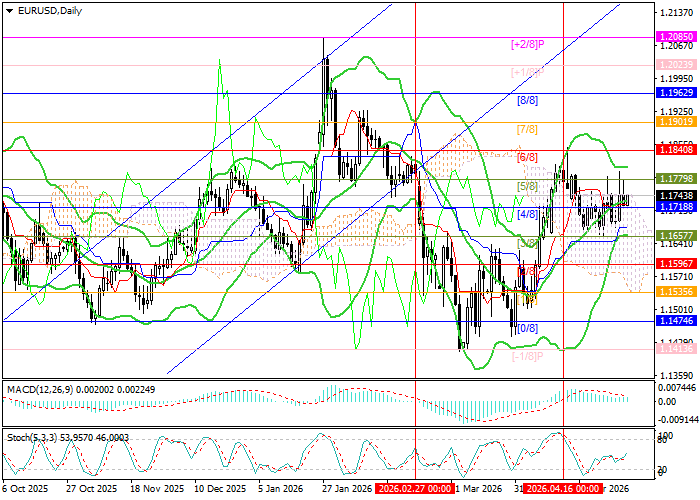
Since the middle of last month, the instrument has been trading within the sideways range of 1.1779–1.1657, corresponding to the Murray levels [5/8]–[3/8], and has so far been unable to leave it amid mixed geopolitical signals. If the upper boundary is broken, growth may continue toward 1.1962, the Murray level [8/8], and 1.2085, the Murray level [+2/8]. Consolidation below the lower boundary would allow the pair to test 1.1474, the Murray level [0/8], and 1.1413, the Murray level [–1/8].
Technical indicators do not provide a unified signal: Bollinger Bands are shifting into horizontal movement, the MACD histogram remains stable in positive territory, while the Stochastic indicator is turning upward.
Resistance levels: 1.1779, 1.1962, 1.2085.
Support levels: 1.1657, 1.1474, 1.1413.
Trading scenarios and EUR/USD forecast
Long positions may be opened above 1.1779 with targets at 1.1962, 1.2085 and a stop-loss at 1.1690. The expected implementation period is 5–7 days.
Short positions may be opened below 1.1657 with targets at 1.1474, 1.1413 and a stop-loss at 1.1755.
Scenario
| Timeframe | Weekly |
| Recommendation | BUY STOP |
| Entry point | 1.1780 |
| Take Profit | 1.1962, 1.2085 |
| Stop Loss | 1.1690 |
| Key levels | 1.1413, 1.1474, 1.1657, 1.1779, 1.1962, 1.2085 |
Alternative scenario
| Recommendation | SELL STOP |
| Entry point | 1.1655 |
| Take Profit | 1.1474, 1.1413 |
| Stop Loss | 1.1755 |
| Key levels | 1.1413, 1.1474, 1.1657, 1.1779, 1.1962, 1.2085 |
