
In particular, April inflation data will be in focus tomorrow at 14:30 (GMT+2). Current forecasts suggest that the annual rate may accelerate from 3.3% to 3.4%, while the monthly figure could slow from 0.9% to 0.6%. At the same time, the core indicator, which excludes food and energy prices, is expected to remain around 2.6% in annual terms and rise from 0.2% to 0.4% month-on-month, respectively. Such figures could strengthen expectations of further monetary tightening by the U.S. Federal Reserve. As a reminder, following its two-day meeting on April 28–29, the U.S. regulator, as expected, kept the interest rate unchanged in the 3.50–3.75% range, marking the fourth consecutive pause in policy adjustments.
Macroeconomic releases from the U.S. published at the end of April strengthened the position of the “hawks”. According to the preliminary estimate from the Bureau of Economic Analysis, gross domestic product (GDP) expanded by 2.0% annualized in the first quarter, a sharp acceleration after growth of only 0.5% in the fourth quarter of last year. The improvement was supported by a recovery in investment, exports, and government spending, although the figure came in slightly below the consensus forecast of 2.2%. Inflationary pressure also continues to build. The core Personal Consumption Expenditures Price Index, a key gauge for the Fed, accelerated to 3.2% year-on-year from 3.0% a month earlier, while the headline indicator reached 3.5%, its highest level since October 2023. The main driver of the negative trend was a record 20.9% surge in gasoline prices amid the escalation of the Middle East conflict. At the same time, the Employment Cost Index reached 0.9% in the first quarter, while initial jobless claims fell to 189.0 thousand, the lowest level since September 1969, confirming that labor market conditions remain tight.
Meanwhile, the Japanese government reported an agreement with partners from the United Arab Emirates (UAE) on additional oil supplies totaling 20.0 million barrels. Deliveries will be carried out through the port of Fujairah, located in the Gulf of Oman, which serves as a key alternative logistics hub and allows crude exports to bypass the currently blocked Strait of Hormuz. Its infrastructure advantage lies in a direct pipeline connection with UAE oil fields, reducing dependence on sea routes exposed to heightened geopolitical volatility. However, disruption risks remain. Earlier this month, reports emerged of drone attacks on the Fujairah Oil Industry Zone (FOIZ), which resulted in a major fire. According to Nikkei, around 40.0% of Japan’s total oil imports come from the UAE, making the stability of this supply route critically important for the country. On average, Japan purchased about 2.4 million barrels per day last year, with most volumes coming from the Middle East, around 90.0% of which were delivered through the Strait of Hormuz.
Support and resistance levels
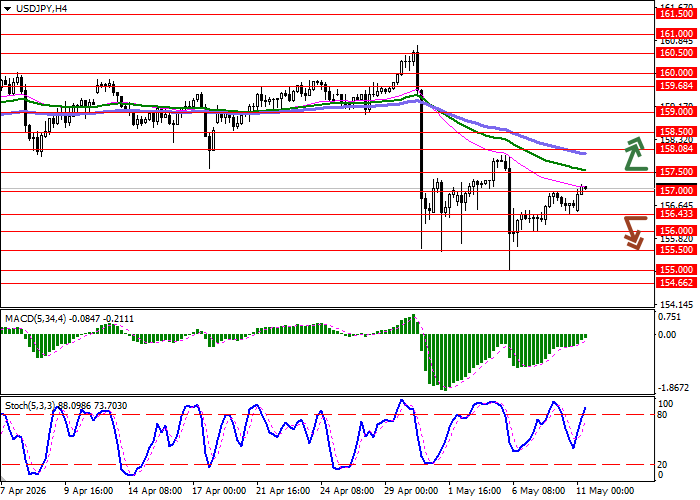
On the daily chart, Bollinger Bands continue to decline steadily. The price range is widening from below, giving bears room to target new lows. The MACD maintains a fairly strong sell signal, holding below the signal line. The Stochastic oscillator, after moving away from the “20” level last week, is flattening, indicating an unstable balance in the ultra-short term.
Resistance levels: 157.00, 157.50, 158.08, 158.50.
Support levels: 156.43, 156.00, 155.50, 155.00.
Trading scenarios and USD/JPY forecast
Long positions may be opened after a confident breakout above 157.50, with the target at 158.50. Stop-loss — 157.00. Timeframe: 2–3 days.
A return of bearish momentum followed by a breakdown below 156.43 may signal the opening of new short positions with the target at 155.50. Stop-loss — 157.00.
Scenario
| Timeframe | Intraday |
| Recommendation | BUY STOP |
| Entry point | 157.55 |
| Take Profit | 158.50 |
| Stop Loss | 157.00 |
| Key levels | 155.00, 155.50, 156.00, 156.43, 157.00, 157.50, 158.08, 158.50 |
Alternative scenario
| Recommendation | SELL STOP |
| Entry point | 156.40 |
| Take Profit | 155.50 |
| Stop Loss | 157.00 |
| Key levels | 155.00, 155.50, 156.00, 156.43, 157.00, 157.50, 158.08, 158.50 |
