

Producer price data painted a somewhat different picture. Annual PPI slowed from 2.7% to 2.3%, while the core measure fell from 3.2% to 2.6%. Since these figures mainly reflect prices within the domestic economy and do not yet capture the full impact of tariffs on imported goods, the market response was limited. Even so, persistent inflation is giving the Federal Reserve little reason to rush into monetary easing. Expectations are increasingly shifting toward a first rate cut near the end of the year or possibly in early 2026.
The dollar also received support from comments by President Trump, who played down reports that he was considering removing Federal Reserve Chair Jerome Powell. Trump described such a step as highly unlikely, easing concerns that a sudden change in Fed leadership could disrupt the current direction of monetary policy.
Euro Remains Vulnerable as Tariff Risks and ECB Expectations Build
The euro is facing its own set of challenges. Investors remain concerned about the possibility of a 30% US tariff on imports from the European Union, which could put additional pressure on the region’s already fragile growth outlook. At the same time, June inflation figures showed that price growth in the eurozone has stabilised. Headline CPI remained at the European Central Bank’s 2.0% target, while core inflation held at 2.3%.
Although inflation is no longer falling rapidly, the data leaves the door open for another ECB rate cut in the autumn. The prospect of further policy easing continues to limit demand for the euro, especially while US interest rates are expected to remain elevated for longer.
Technical Analysis: EUR/USD Tests 1.1597 as Buyers Defend the Uptrend
EUR/USD is currently testing support around 1.1597. A sustained move below this area would weaken the technical outlook and could send the pair toward 1.1475, followed by 1.1230.
Buyers have not completely lost control, however. A recovery above 1.1719, where the Murray [8/8] level meets the middle line of the Bollinger Bands, would improve the short-term outlook. In that case, the pair could resume its advance toward 1.1963 and then 1.2207.
The indicators continue to give mixed signals. The Bollinger Bands remain tilted upwards, suggesting that the broader bullish structure is still intact. The MACD histogram is below zero but gradually narrowing, while the Stochastic oscillator is turning higher after moving out of oversold territory. Together, these signals point to the possibility of a rebound, although confirmation is still needed.
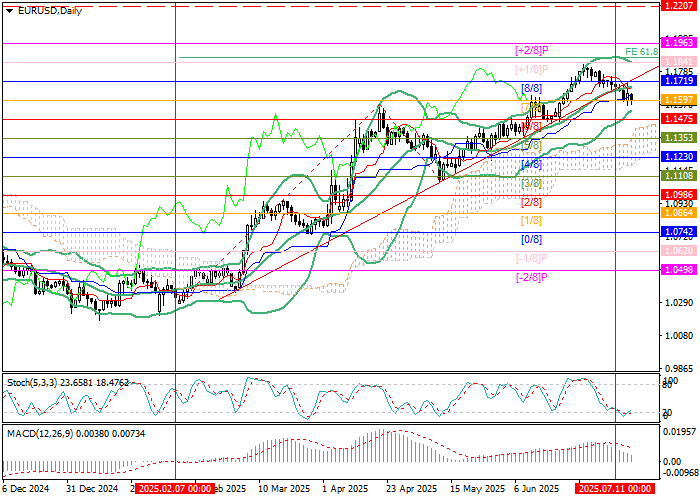 EUR/USD tests support near 1.1597
Key Resistance Levels
- 1.1719
- 1.1963
- 1.2207
Key Support Levels
- 1.1597
- 1.1475
- 1.1230
Trading Strategies for the Week
- Buy Stop: Long positions may be considered after a confirmed breakout above 1.1719, with targets at 1.1963 and 1.2207. A stop-loss may be placed near 1.1560. Estimated timeframe: 5–7 days.
- Buy Limit: Long positions may also be considered if the pair reverses higher from the 1.1475 area. The upside targets remain 1.1963 and 1.2207, with a stop-loss near 1.1330.
Key levels: 1.1230, 1.1475, 1.1597, 1.1719, 1.1963, 1.2207
