

Late last week, market attention turned to comments from Reserve Bank of Australia Assistant Governor (Financial Markets) Christopher Kent. In an August 13 discussion on financial conditions, Kent said Australian monetary policy is currently somewhat restrictive and that the three cash-rate increases delivered earlier this year are having their intended effect.
Higher borrowing costs have pushed scheduled mortgage payments close to their 2024 peak as a share of household disposable income, while housing credit growth and new mortgage lending have slowed. Housing prices have also weakened in Sydney and Melbourne. At the same time, the Australian dollar has appreciated on a trade-weighted basis since the beginning of the year, helping reduce the domestic cost of imported goods and adding to the disinflationary impact of tighter policy.
However, the RBA is not signalling that its tightening cycle is necessarily complete. The Monetary Policy Board left the cash rate unchanged at 4.35% on August 11 after three increases earlier in 2026, but Governor Michele Bullock and Kent both highlighted upside risks to inflation. Kent said further rate increases remain possible if energy prices stay elevated, productivity disappoints or global demand proves stronger than expected.
The changing balance between Australian monetary policy and U.S. interest-rate expectations has been an important driver of AUD/USD throughout the year. FORECK.INFO previously examined these forces in its AUD/USD outlook as the pair tested significantly lower levels earlier in 2026.
The U.S. dollar is meanwhile being influenced primarily by domestic macroeconomic data. July retail sales provided the latest weak signal, with the U.S. Census Bureau reporting a 0.6% month-over-month decline after a 0.2% increase in June. The result points to softer consumer demand at the beginning of the third quarter.
Other indicators provide a more mixed picture. U.S. personal consumption expenditures increased by 0.3% in nominal terms and by 0.4% in real terms in June, while the personal saving rate fell to 2.7%. This suggests that household spending had remained relatively resilient before the July retail-sales decline, although consumers were saving a smaller share of disposable income.
The recent data have nevertheless reduced the immediate case for another Federal Reserve rate increase. Inflation also moderated in July, while the labor market has shown signs of cooling. However, policymakers have not ruled out additional tightening: at the July FOMC meeting, the federal funds target range was maintained at 3.50%–3.75%, but three Committee members preferred an immediate 25-basis-point increase.
As a result, the short-term AUD/USD outlook remains dependent on the relative policy paths of the two central banks. Continued evidence that the RBA may need to maintain restrictive conditions could support the Australian dollar, while renewed U.S. inflation pressure or stronger economic activity could revive expectations for additional Federal Reserve tightening and strengthen the greenback.
Support and Resistance Levels
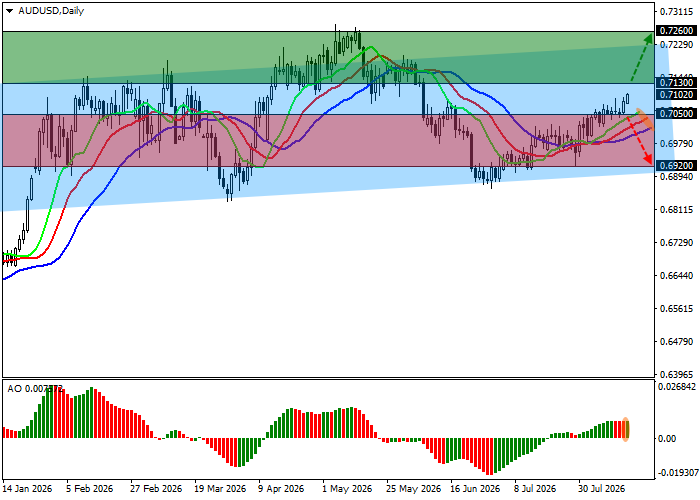
On the daily chart, AUD/USD remains below the resistance line of an ascending channel with dynamic boundaries around 0.7220–0.6900.
Technical indicators are preparing to strengthen the bullish signal: the faster moving averages of the Alligator indicator are pointing higher, although they have not yet moved significantly away from the slower line, while the Awesome Oscillator histogram has formed new bars in positive territory.
Resistance levels: 0.7130, 0.7260.
Support levels: 0.7050, 0.6920.
AUD/USD Trading Scenarios and Forecast
Long positions may be considered after a rise and consolidation above 0.7130, with a target at 0.7260 and a stop-loss at 0.7060. Time horizon: seven days or more.
Short positions may be considered after a decline and consolidation below 0.7050, with a target at 0.6920 and a stop-loss at 0.7120.
