

According to the U.S. Bureau of Labor Statistics, headline consumer inflation slowed from 3.5% to 3.4% year over year in July, while the core CPI eased from 2.6% to 2.5%. Both measures moved lower, although underlying inflation remains above the Federal Reserve's 2.0% objective. At the same time, July nonfarm payrolls declined by 23.0 thousand, adding to signs that labor-market momentum is cooling.
Taken together, the latest inflation and employment figures could reduce the urgency for additional monetary tightening in the near term while the Federal Reserve evaluates incoming data. However, policymakers have not declared the inflation battle complete, and markets continue to price some probability of further tightening later this year. CME FedWatch probabilities remain sensitive to incoming inflation, employment and activity data and can change significantly during the trading session.
Eurozone industrial data have provided only limited support to the single currency. Eurostat reported that industrial production was unchanged in June compared with May, following a revised 0.3% increase in the previous month. On an annual basis, output increased by 0.1% after a revised 0.1% decline in May. The figures were stronger than earlier expectations for contractions in both monthly and annual terms and suggest that the industrial sector remains relatively resilient despite difficult economic conditions.
Nevertheless, the data failed to generate a sustained strengthening of the euro as geopolitical uncertainty in the Persian Gulf remains an important source of risk. A comprehensive settlement of the U.S.-Iran confrontation has yet to be reached, while technical consultations involving Iran and Oman over navigation through the Strait of Hormuz continue. Prolonged disruption to major energy shipping routes could keep energy costs elevated and place additional pressure on the European economy. At the same time, periods of heightened geopolitical uncertainty can increase demand for the U.S. dollar as a traditional safe-haven currency.
Support and Resistance Levels
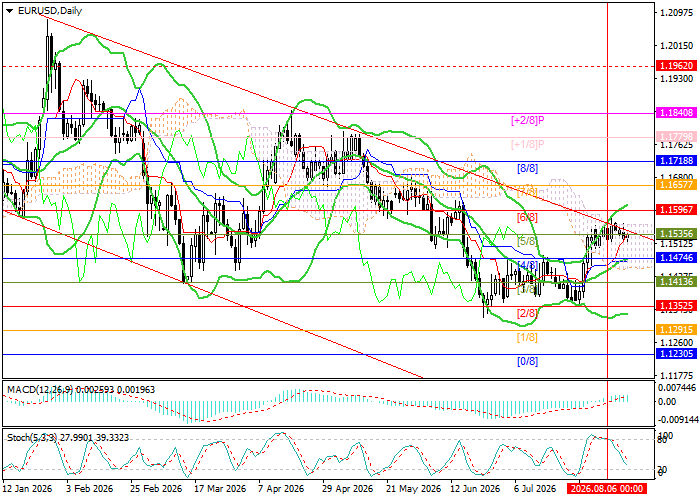
EUR/USD is attempting to break out of the descending channel through its upper boundary. A confirmed move above this area and 1.1596, the Murrey [6/8] level, could support further gains toward 1.1718, the Murrey [8/8] level, followed by 1.1840, the Murrey [+2/8] level, and 1.1962, the Murrey [6/8] level on the weekly time frame.
Conversely, consolidation below the middle Bollinger Band at 1.1474, corresponding to the Murrey [4/8] level, could lead to renewed downside pressure toward 1.1352, the Murrey [2/8] level, and 1.1230, the Murrey [0/8] level.
Technical indicators remain mixed. The Bollinger Bands are pointing higher and the MACD histogram has moved into positive territory, while the Stochastic Oscillator has turned lower from the overbought zone. On the weekly chart, the Bollinger Bands are beginning to turn downward, indicating that longer-term bearish pressure has not yet been fully eliminated.
Resistance levels: 1.1596, 1.1718, 1.1840, 1.1962.
Support levels: 1.1474, 1.1352, 1.1230.
EUR/USD Trading Scenarios and Forecast
Short positions may be considered after a decline and consolidation below 1.1474, with targets at 1.1352 and 1.1230 and a stop-loss at 1.1555. Time horizon: 5–7 days.
Long positions may be considered after a rise and consolidation above 1.1596, with targets at 1.1718, 1.1840 and 1.1962 and a stop-loss at 1.1520.
