

The pair is currently being influenced by several opposing fundamental factors, limiting its ability to establish a clear directional trend. The U.S. dollar came under pressure after July retail sales unexpectedly fell 0.6% month over month, following a 0.2% increase in June. The decline provided another indication that consumer demand is losing momentum.
The latest retail data followed a broader moderation in U.S. inflation. Headline consumer inflation slowed from 3.5% to 3.4% year over year in July, while core CPI eased from 2.6% to 2.5%. At the same time, the labor market showed further signs of cooling, with nonfarm payroll employment declining by 23,000 and the unemployment rate edging down to 4.1%.
Taken together, these figures have reduced the urgency for additional Federal Reserve tightening at the September meeting. However, the possibility of another rate increase has not disappeared entirely. At the July 28–29 FOMC meeting, policymakers kept the federal funds target range unchanged at 3.50%–3.75%, although three members preferred an immediate 25-basis-point increase. Market-implied expectations therefore remain highly sensitive to incoming inflation and employment data.
On the Japanese side, the latest economic figures provided a more mixed signal for the yen. According to the Cabinet Office's preliminary GDP estimates, Japan's real economy expanded by 0.3% quarter over quarter in the second quarter, equivalent to an annualized growth rate of 1.1%.
The headline expansion masked weakness in domestic demand. Real private consumption was essentially unchanged, while household consumption declined by 0.1%. Private non-residential investment fell by 1.2%, extending the previous quarter's 1.0% decline. Overall domestic demand subtracted 0.2 percentage points from real GDP growth, while net exports contributed 0.5 percentage points.
The figures could make the timing of the Bank of Japan's next policy adjustment more difficult to assess, but they do not necessarily signal the end of monetary normalization. The BOJ kept its policy rate around 1.0% at the July 31 meeting by an 8–1 vote, with one board member arguing for an increase to 1.25%. The subsequent Summary of Opinions also showed that several policymakers continue to see further rate increases as appropriate if economic activity, inflation and financial conditions develop as expected.
The changing balance between BOJ tightening expectations, U.S. monetary policy and intervention risks has been a key driver of the pair throughout the summer. FORECK.INFO previously examined these factors in its USD/JPY forecast, when the pair was trading close to 162.00.
In fact, some BOJ members argued that the pace of rate hikes could eventually be faster than markets anticipate because underlying inflation is approaching the 2% target and upside price risks remain significant. Weak domestic demand therefore creates a counterweight to the Bank's tightening bias rather than eliminating it.
Two major events will now be in focus this week. On Wednesday at 20:00 (GMT+2), the Federal Reserve will publish the minutes of its July 28–29 meeting, providing more detail on the disagreement between policymakers who favored keeping rates unchanged and those who supported another increase.
Japan's national consumer inflation report for July is scheduled for Friday, August 21. The figures will be particularly important after the BOJ highlighted underlying inflation and upside price risks as key factors determining the timing and pace of further monetary-policy normalization.
Support and Resistance Levels
USD/JPY is trading near 159.37, the Murrey [4/8] level. A confirmed breakout above the middle Bollinger Band at 160.15, corresponding to the Murrey [5/8] level, could support a renewed advance toward 162.50, the Murrey [8/8] level, followed by 164.06, the Murrey [+2/8] level. Conversely, a break and consolidation below 157.81, the Murrey [2/8] level, could lead to renewed downside pressure toward 156.25, the Murrey [0/8] level, and 154.68, the Murrey [–2/8] level.
Technical indicators continue to provide a bearish signal: the Bollinger Bands are moving lower, the MACD histogram remains stable in negative territory, while the Stochastic Oscillator has reached the overbought zone and could turn downward.
Resistance levels: 160.15, 162.50, 164.06.
Support levels: 157.81, 156.25, 154.68.
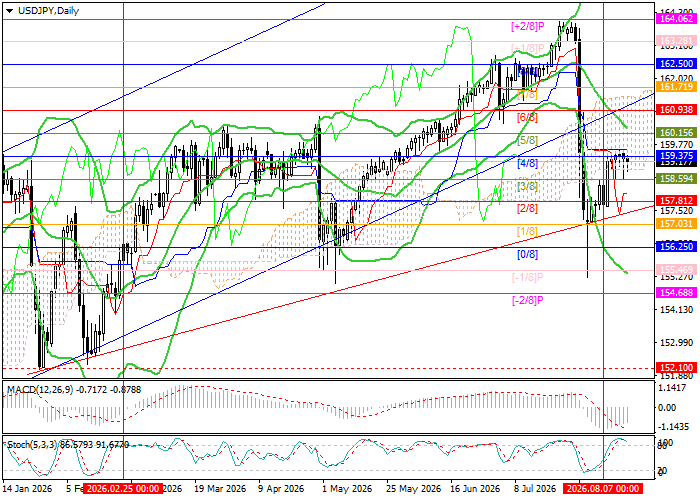
USD/JPY Trading Scenarios and Forecast
Short positions may be considered after a decline and consolidation below 157.81, with targets at 156.25 and 154.68 and a stop-loss at 158.80. Time horizon: 5–7 days.
Long positions may be considered after a rise and consolidation above 160.15, with targets at 162.50 and 164.06 and a stop-loss at 158.80.
