

The decision was approved by an 8–1 majority vote, with Hajime Takata once again dissenting and calling for an immediate increase in borrowing costs to 1.0%, arguing that the consumer price index has sustainably returned to the 2.0% target and may continue rising amid intensifying geopolitical tensions in the Middle East. BOJ Governor Kazuo Ueda maintained a hawkish tone, confirming in a follow-up statement that monetary tightening would continue if forecasts for economic activity and inflation materialize, even if the slowdown caused by higher energy prices due to a closure of the Strait of Hormuz proves temporary and has no major impact on key indicators. Officials also noted that despite weak exports and global headwinds, gross domestic product (GDP) remains in positive territory, supporting the yen in the medium term.
The escalation of the US-Iran conflict remains a key source of uncertainty and directly affected the agenda of Prime Minister Sanae Takaichi’s visit to Washington, where she met with US President Donald Trump. The talks were initially expected to focus on China’s expansionist actions, but Washington later asked Tokyo to dispatch ships to escort tankers in the Persian Gulf. For the Japanese government, this is an extremely sensitive issue, as any discussion must take into account constitutional restrictions rooted in post-war pacifism as well as domestic political risks. Following the переговорations, the two sides reached agreements to expand purchases of US oil and cooperate on the development of rare earth metals, which are strategically important for electric vehicle production and the defense industry. Meanwhile, in January, core machinery orders rose by 13.7% year-on-year versus a forecast of 10.5%, while the monthly reading came in at –5.5% compared with the expected –9.6%, reflecting a recovery in the sector and reinforcing the national currency.
The US dollar has declined by about 1.0% in the USDX over the week due to stabilization in the Middle East, as well as after the US Federal Reserve decided to keep its interest rate unchanged at 3.75% amid global economic uncertainty. It is worth noting that officials continue to favor a wait-and-see approach rather than shifting toward tighter monetary policy: according to the CME FedWatch Tool, markets are pricing in a 91.7% probability that borrowing costs will remain unchanged at the April 29 meeting.
Support and resistance levels
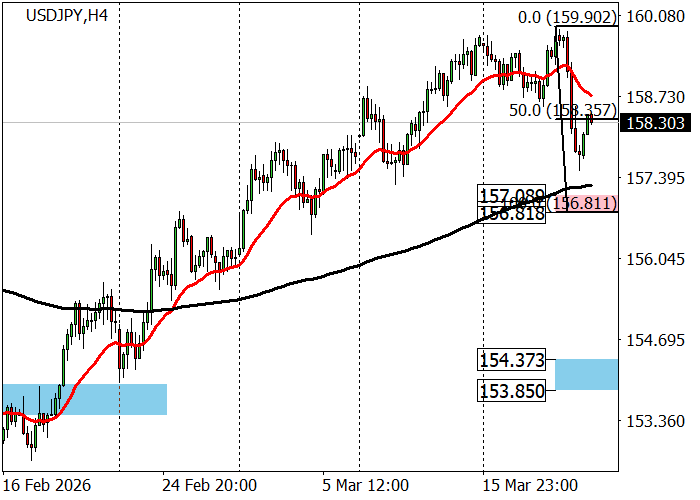
The long-term trend remains bullish: last week, the price renewed the January high of 159.47 but failed to consolidate above it and moved into a correction toward the support level of 157.32. Japan is on holiday today, so low trading volatility is expected, but the pair could reach this level on Monday. After a rebound, long positions will become relevant again with a target at 159.47, while in the event of a breakdown, short positions may be considered with a target at 153.75.
The medium-term upward trend remains intact, and the asset tested the 159.45 area after rising from the support zone of 153.95–153.43 before entering a correction toward the 157.08–156.81 area. If this zone holds, bullish positions may be considered with targets at 158.35 and 159.90. However, if the asset breaks below it, the decline may extend toward the trend boundary at 154.37–153.85.
Resistance levels: 159.47, 161.78, 164.07.
Support levels: 157.32, 153.76, 152.55.
Trading scenarios and USD/JPY forecast
Long positions can be opened from 157.32 with a target at 159.47 and a stop-loss at 156.62. Implementation period: 9–12 days.
Short positions can be opened below 156.62 with a target at 153.76 and a stop-loss at 158.00.
Scenario
| Timeframe | Weekly |
| Recommendation | BUY LIMIT |
| Entry point | 157.32 |
| Take Profit | 159.47 |
| Stop Loss | 156.62 |
| Key levels | 152.55, 153.76, 157.32, 159.47, 161.78, 164.07 |
Alternative scenario
| Recommendation | SELL STOP |
| Entry point | 156.60 |
| Take Profit | 153.76 |
| Stop Loss | 158.00 |
| Key levels | 152.55, 153.76, 157.32, 159.47, 161.78, 164.07 |
