
On April 30, the European Central Bank (ECB) kept borrowing costs unchanged at 2.15%, noting that preliminary estimates show the consumer price index rising from 2.6% to 3.0% in April, with energy prices surging 10.9% — limiting policymakers' room to maintain an accommodative stance while simultaneously weighing on the bloc's recovery. The Ifo Institute has also warned of potential negative consequences for Germany's growth this year if the EU imposes tariffs on US goods in response to American duties. Ifo President Clemens Fuest said that an escalation of the trade war could tip Germany into recession this year, as the tariff increases on European vehicles announced by President Donald Trump are putting pressure on German industry, which is already showing signs of cooling. Meanwhile, an adviser to Germany's Finance Ministry, Jens Südekum, said the EU should consider retaliatory measures only if the tariffs are actually implemented. On May 1, Trump announced an increase in duties on passenger and commercial vehicles to 25.0%, arguing that the bloc has failed to comply with previously agreed trade terms, though the tariffs will not apply to vehicles manufactured at US plants. The specific violations Trump is citing remain unclear.
At present, EUR/USD reflects a balance between buyers and sellers: the euro is supported by the ECB's pause on monetary easing and elevated eurozone inflation, while the dollar draws backing from the Fed's hawkish rhetoric and the 3.5% PCE reading. Markets are now waiting for fresh catalysts to drive the next move.
Support and Resistance Levels
The long-term trend remains upward: in April, the price reached the resistance level at 1.1790 before reversing toward the support level at 1.1650, from which long positions targeting 1.1790 and 1.1927 (the February high) will become relevant.
The medium-term trend is also upward: this month, the price reversed in zone 2 (1.1864–1.1842), subsequently tested the EMA (190) during the pullback, and returned to positive momentum last week. A consolidation above the April peak of 1.1849 would likely open the way toward zone 3 (1.2054–1.2034); however, a decline could see the pair test the trend support area at 1.1633–1.1611, from which long positions targeting 1.1730 and 1.1849 would become relevant.
Resistance levels: 1.1790, 1.1927, 1.2045.
Support levels: 1.1650, 1.1583, 1.1414.
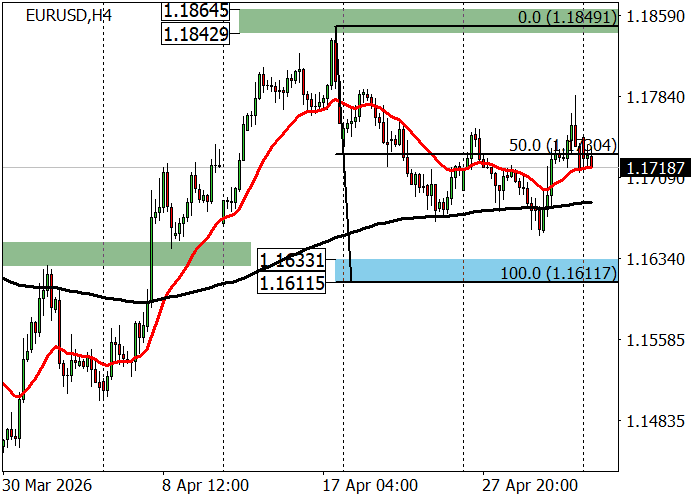
EUR/USD Trading Scenarios and Forecast
Long positions may be opened from 1.1650, targeting 1.1790, with a stop-loss at 1.1598. Time horizon: 9–12 days.
Short positions may be opened below 1.1583, targeting 1.1414, with a stop-loss at 1.1659.
Scenario
| Timeframe | Weekly |
| Recommendation | BUY LIMIT |
| Entry Point | 1.1650 |
| Take Profit | 1.1790 |
| Stop Loss | 1.1598 |
| Key Levels | 1.1414, 1.1583, 1.1650, 1.1790, 1.1927, 1.2045 |
Alternative Scenario
| Recommendation | SELL STOP |
| Entry Point | 1.1580 |
| Take Profit | 1.1414 |
| Stop Loss | 1.1659 |
| Key Levels | 1.1414, 1.1583, 1.1650, 1.1790, 1.1927, 1.2045 |
