

Officials who had for weeks confined themselves to verbal warnings this time moved to directUSD/JPY Forecast: Dollar Mixed After Japan's $34.5B Intervention Sparks Sharpest Yen Rally Since 2022 action, purchasing an estimated $34.5 billion worth of yen — triggering the steepest single-week decline in USD/JPY since 2022, from a peak of 160.80 down to 155.55. Speaking to journalists in Samarkand, Japanese Finance Minister Satsuki Katayama acknowledged that "speculative moves have been continuing for some time," but declined to comment on whether intervention had taken place.
According to US regulatory data, market participants currently hold the largest short position in the yen since July 2024, totaling nearly $7.5 billion. Katayama emphasized that she is in close coordination with the White House: the intervention mechanism was pre-agreed with the American side, and both countries have signaled openness to further steps depending on how the situation develops.
The dollar received a bullish boost following the release of the outcome of the Fed's two-day monetary policy meeting — the last chaired by Jerome Powell before his term expires on May 15. As expected, the regulator held borrowing costs in the 3.50–3.75% range for the third consecutive time, but unlike in previous months, the decision was accompanied by a notable shift in sentiment within the Federal Open Market Committee (FOMC). Eight board members voted to hold rates, though three of them did so only conditionally, effectively opposing any further easing.
The FOMC statement noted that inflation remains "elevated, partly reflecting recent increases in global energy prices," and that the Middle East conflict is creating uncertainty for the economic outlook. The Bank of Japan's April 28 meeting also concluded as expected with rates held at 0.75% — a level not seen in over 30 years — though the tone of the decision proved to be the most hawkish of the year so far and triggered a brief but powerful dollar rally.
Three BoJ board members — Hajime Takata, Naoki Tamura, and Junko Nakagawa — voted for an immediate hike to 1.00%, marking the most significant internal disagreement in three years and signaling growing domestic pressure in favor of further tightening. The bank also raised its core inflation forecast for fiscal year 2026 from 1.9% to 2.8%, while substantially revising its GDP projection down from 1.1% to 0.5%, acknowledging that the Middle East crisis is inflicting serious damage on the export sector and domestic demand. Meanwhile, Friday's data showed Tokyo's consumer price index ticking up from 1.4% to 1.5%, with the core reading slipping from 1.7% to 1.5%, while the manufacturing PMI accelerated from 51.6 to 55.1 — though none of these proved sufficient to support the yen.
Support and Resistance Levels
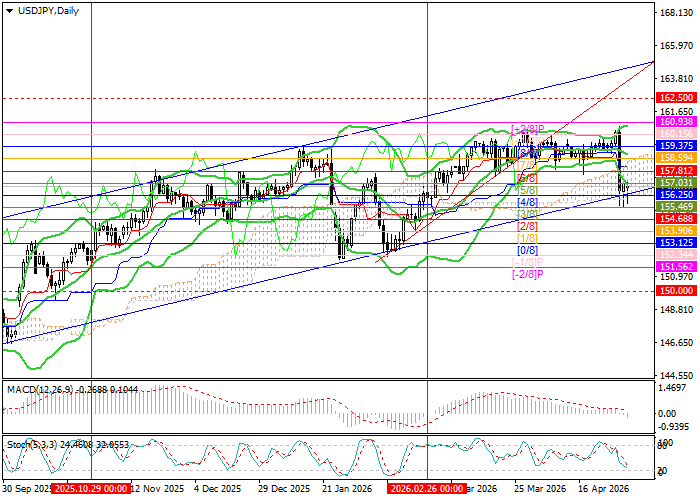
Technically, the pair continues to trade within a long-term ascending channel: last week, the price pulled back to its lower boundary but has so far failed to break below it. A move through 156.25 (Murray level [4/8]) would open the door for bears to test 154.68 (Murray [2/8]) and 153.12 (Murray [0/8]). Conversely, a breakout above 157.81 (Murray [6/8]) would accelerate the move toward 159.37 (Murray [8/8]), 160.93 (Murray [+2/8]), and 162.50 (Murray [8/8], W1).
Technical indicators are sending mixed signals: Bollinger Bands are turning downward, but the price has exited the lower band, leaving room for a corrective bounce. The MACD histogram has crossed into negative territory, while the Stochastic is pointing lower but approaching oversold territory — also suggesting a potential reversal may be near.
Resistance levels: 157.81, 159.37, 160.93, 162.50.
Support levels: 156.25, 154.68, 153.12.
USD/JPY Trading Scenarios and Forecast
Long positions should be opened above 157.81, targeting 159.37, 160.93, and 162.50, with a stop-loss at 156.70. Time horizon: 5–7 days.
Short positions should be opened below 156.25, targeting 154.68 and 153.12, with a stop-loss at 157.40.
Scenario
| Timeframe | Weekly |
| Recommendation | BUY STOP |
| Entry Point | 157.85 |
| Take Profit | 159.37, 160.93, 162.50 |
| Stop Loss | 156.70 |
| Key Levels | 153.12, 154.68, 156.25, 157.81, 159.37, 160.93, 162.50 |
Alternative Scenario
| Recommendation | SELL STOP |
| Entry Point | 156.20 |
| Take Profit | 154.68, 153.12 |
| Stop Loss | 157.40 |
| Key Levels | 153.12, 154.68, 156.25, 157.81, 159.37, 160.93, 162.50 |
