

The yen remains under pressure due to rising hydrocarbon prices after the Strait of Hormuz was blocked by the Islamic Revolutionary Guard Corps (IRGC), which may cause inflation to rise to 2.0% in the first half of the year. The negative trend is developing despite comments from Bank of Japan officials about their readiness to conduct currency interventions to support the exchange rate: experts suggest that these measures will be taken once the rate reaches the 160.00-161.00 area. In addition, the regulator is aiming for further monetary tightening in April, a view now supported by more than 80.0% of analysts. According to the results of a meeting of the heads of the central bank’s nine regional branches at its headquarters in Tokyo, regional economies are recovering moderately, although companies are already experiencing the negative impact of rising costs and disruptions in raw material supplies due to the US-Iran conflict. Nevertheless, management representatives confirm that the planned wage increases will be similar to last year’s indexation. Moreover, personal consumption in the food service and tourism sectors, including accommodation, remains stable thanks to higher wages. Furthermore, the day before, the International Monetary Fund (IMF) urged the Bank of Japan to return to a hawkish stance, as the weak yen is hindering stable international trade.
The US dollar is trading at 99.90 in the USDX while high volatility persists in financial markets, and the US currency is acting as a safe-haven asset pending further developments in the Middle East. Yesterday, during a conversation with journalists at the White House, President Donald Trump once again changed his rhetoric, saying that negotiations with Iran were progressing successfully and that the sides were approaching a diplomatic agreement. Official Tehran has already denied these comments, stating that it is not considering any temporary truce and is demanding guarantees of a ceasefire and reparations. Meanwhile, the deadline of the ultimatum Trump issued on Sunday expires tonight, in which he demanded that the Strait of Hormuz be reopened, stating that otherwise the energy and transport infrastructure of the Islamic republic would be destroyed.
Support and resistance levels
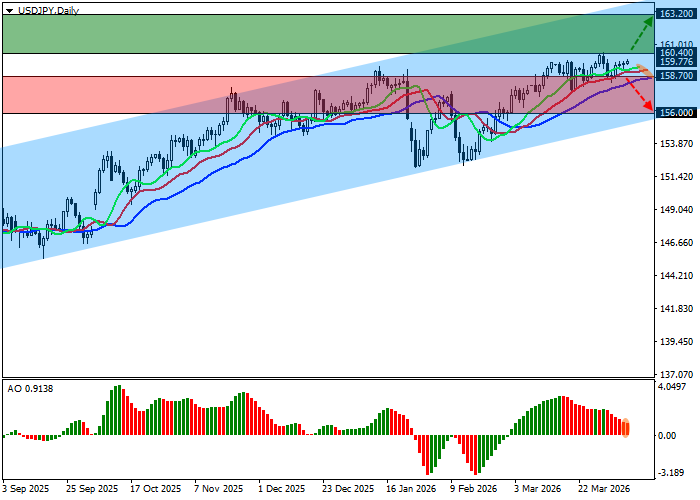
On the daily chart, the trading instrument is attempting to reach the resistance line of a wide long-term channel with boundaries at 164.00-155.50.
Technical indicators are reinforcing a steady buy signal: the fast EMAs of the Alligator indicator are located near the signal line, while the AO histogram is forming corrective bars in positive territory.
Resistance levels: 160.40, 163.20.
Support levels: 158.70, 156.00.
Trading scenarios and USD/JPY forecast
Long positions may be opened after the price rises and consolidates above the 160.40 level, with a target at 163.20. Stop-loss - 159.00. Timeframe for implementation: 7 days or more.
Short positions may be opened after the price declines and consolidates below the 158.70 level, with a target at 156.00. Stop-loss - 159.50.
Scenario
| Timeframe | Weekly |
| Recommendation | BUY STOP |
| Entry point | 160.40 |
| Take Profit | 163.20 |
| Stop Loss | 159.00 |
| Key levels | 156.00, 158.70, 160.40, 163.20 |
Alternative scenario
| Recommendation | SELL STOP |
| Entry point | 158.70 |
| Take Profit | 156.00 |
| Stop Loss | 159.50 |
| Key levels | 156.00, 158.70, 160.40, 163.20 |
