


Best Value

- Tight spreads & fast execution
- Multiple account types
- MT4/MT5 + copy-trading

United States of America. The US dollar is strengthening against the pound and the yen, while showing mixed performance against the euro.
 By Sagar Dua
 The euro is posting a modest decline against the US dollar during the Asian session on today, testing the 1.1600 level for a downside breakout and updating local lows from April 8, as market participants focus on German April inflation data. The Producer Price Index in the eurozone's largest economy rose 1.7% year-on-year — 0.2% above market expectations — after declining 0.2% in March, while the monthly reading eased from 2.5% to 1.2%, coming in slightly above the 1.0% forecast.
 By Sagar Dua
 USD/CHF has been in a downtrend for the second consecutive month, but after hitting a three-month low of 0.7760, the pair reversed higher, recovered a portion of its losses, and is now testing the 0.7873 level (Murray [5/8]) against a backdrop of new monetary and geopolitical developments.
 By Sagar Dua
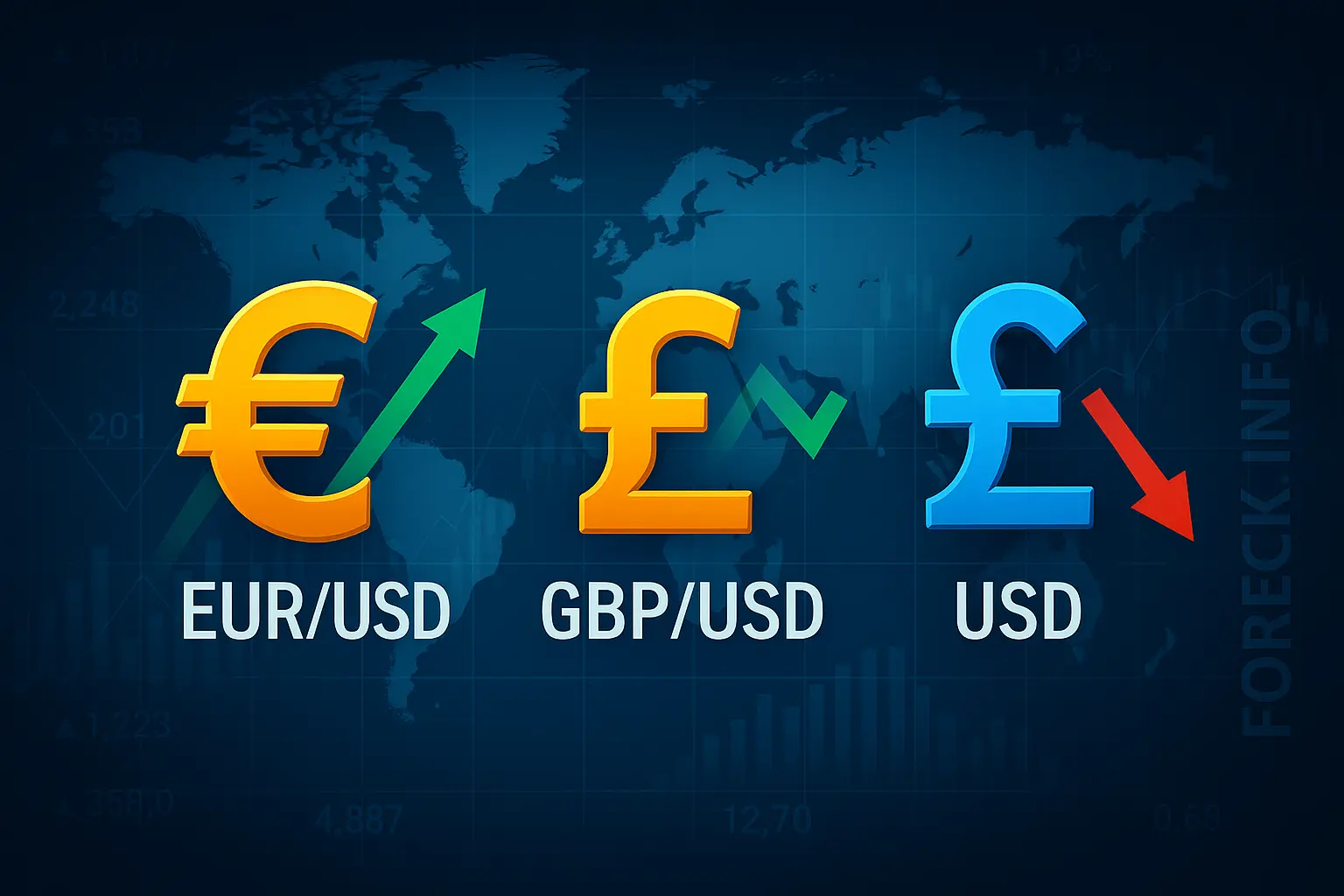
 United States. The US dollar is strengthening against its major peers — the euro, the pound, and the yen.
 By Sagar Dua
 United States. The US dollar is weakening against the euro and the pound, while showing mixed performance against the yen.
 By Sagar Dua
 During the morning session, USD/JPY is heading toward the April high of 160.71, supported by a run of strong US macroeconomic data.
 By Sagar Dua
 EUR/USD has been in a steady decline this week, hitting seven-week lows around 1.1610 as the US dollar strengthens on the back of monetary and geopolitical factors.
 By Sagar Dua
 During the morning session, EUR/TRY is testing the 53.0800 level for a downside breakout, as investors and forex traders digest incoming macroeconomic data.
 By Sagar Dua
 During the morning session, USD/CAD is developing a confident bullish trend in the ultra-short-term outlook, updating the April 15 high and testing the 1.3750 level for an upside breakout, as market participants await incoming macroeconomic data.
By Sagar Dua During the Asian session, USD/CHF is trading in a corrective trend near 0.7850: the franc is holding relatively stable after managing to pull back from February lows around 0.7700, though analysts continue to see limited prospects for a more decisive move in the Swiss currency — meaning the risk of intervention by the Swiss National Bank remains present.
 By Sagar Dua
 GBP/USD has been in a sustained decline this week, hitting six-week lows around 1.3327 as escalating political tensions within the United Kingdom weigh heavily on sterling.
By Sagar Dua USD/JPY is trading sideways around 158.50, slowly drifting toward the key 160.00 level amid broad US dollar strength and fresh commentary from Bank of Japan officials.
By Sagar Dua Against a backdrop of broad dollar strength driven by stronger-than-expected US macroeconomic data, EUR/USD has pulled back into the support zone of 1.1650–1.1583, from which a recovery could emerge.

Forex analysis helps traders figure out where a currency pair might move next and guides their trading decisions. It’s a daily tool for planning entries and exits, based on two main approaches. Fundamental analysis looks at the broader economy: growth, inflation, and especially central bank policy on interest rates. Technical analysis studies past price movements, chart patterns, and signals that tend to repeat over time. Together, these methods give traders a clearer picture of the market and improve decision-making.