
As expected, Federal Reserve officials kept the interest rate unchanged within the 3.50–3.75% range, marking the second consecutive pause following a series of rate cuts at the end of 2025. Notably, the decision was unanimous, with policymakers emphasizing the need for a more cautious approach to adjusting credit conditions amid rapidly rising energy prices driven by escalating tensions between the US and Iran. According to the CME FedWatch Tool, the probability of maintaining current borrowing costs at the April meeting has reached nearly 85%, while expectations for rate cuts later this year have declined significantly.
The Swiss National Bank also left its key interest rate unchanged at 0.00%, in line with market expectations. However, updated macroeconomic forecasts and a more hawkish tone regarding currency interventions had a greater impact on the franc. The regulator raised its inflation outlook for 2026 from 0.0% to 0.5%, directly citing the influence of Middle East tensions on energy prices. At the same time, officials stressed that overall price levels remain well below the target range, allowing for continued ultra-loose monetary policy. Combined with repeated signals of readiness to counter excessive franc appreciation, this significantly limits upside potential for the currency. SNB Chairman Martin Schlegel noted that policymakers are considering various tools, including interventions, to ensure economic stability. Analysts at UBS Group AG believe the likelihood of intervention remains high, as the alternative could involve returning to unpopular negative interest rates, which were in place until 2022.
This week, traders will monitor a series of macroeconomic releases that could influence price dynamics. In particular, Switzerland will publish the ZEW Economic Expectations Index on Wednesday at 10:00 (GMT+2), while speeches by Martin Schlegel and his deputy Antoine Martin are scheduled for Tuesday at 19:00 (GMT+2). Market participants will look for additional signals regarding the central bank’s policy outlook and its assessment of geopolitical and inflation risks. Any hints of increased readiness to intervene could put downward pressure on the franc.
Support and resistance levels
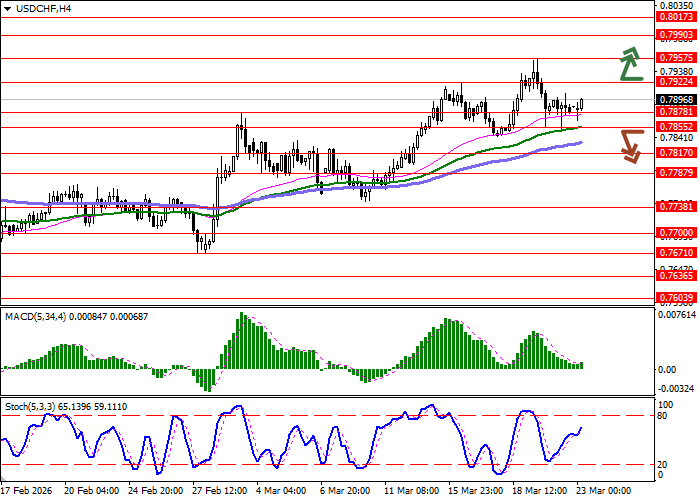
On the daily chart, Bollinger Bands are expanding upward, while the price range narrows, reflecting mixed short-term trading conditions. The MACD indicator is attempting to generate a buy signal, with the histogram approaching the signal line, while the Stochastic oscillator is turning upward from oversold territory.
Resistance levels: 0.7922, 0.7957, 0.7990, 0.8017.
Support levels: 0.7878, 0.7855, 0.7817, 0.7787.
Trading scenarios and USD/CHF forecast
Long positions may be considered after a breakout above 0.7922, with a target at 0.8017. Stop-loss — 0.7878. Implementation period: 2–3 days. Short positions may be considered after a breakout below 0.7855, with a target at 0.7787. Stop-loss — 0.7890.
Scenario
| Timeframe | Intraday |
| Recommendation | BUY STOP |
| Entry point | 0.7925 |
| Take Profit | 0.8017 |
| Stop Loss | 0.7878 |
| Key levels | 0.7787, 0.7817, 0.7855, 0.7878, 0.7922, 0.7957, 0.7990, 0.8017 |
Alternative scenario
| Recommendation | SELL STOP |
| Entry point | 0.7850 |
| Take Profit | 0.7787 |
| Stop Loss | 0.7890 |
| Key levels | 0.7787, 0.7817, 0.7855, 0.7878, 0.7922, 0.7957, 0.7990, 0.8017 |
