

For now, the focus of traders and forex participants remains on the outcome of the Bank of England meeting. Contrary to analysts’ expectations, which pointed to a 7:2 vote split in favor of keeping the interest rate unchanged, all nine members of the Monetary Policy Committee unanimously supported holding it at 3.75% for the first time since September 2021. This sharply contrasts with the previous meeting, where the vote was split 5:4. The reason for this shift was outlined in the meeting minutes: the conflict in the Middle East and the effective blockade of the Strait of Hormuz by Iran’s Islamic Revolutionary Guard Corps caused a sharp rise in energy prices, fundamentally changing the inflation outlook. Brent crude oil prices were trading above $100.0 per barrel ahead of the meeting, up 60.0% from levels seen before the previous session. Naturally, such major changes forced a revision of earlier estimates: while the regulator had expected inflation to fall to the 2.0% target by mid-year back in February, it is now projected to hold near 3.5% in the first quarter. Moreover, given the direct impact of a potential fuel crisis and indirect effects from companies passing costs on to consumers, inflation could accelerate further to 4.0% in the third quarter.
Meanwhile, on Friday, UK government borrowing costs surged sharply, reaching their highest levels since the 2008 global financial crisis. The yield on 10-year gilts confidently moved above 5.0%, reflecting a market reassessment toward a longer period of tight monetary policy. Since the escalation of geopolitical tensions in the Middle East began, the rate has risen by around 68 basis points, marking one of the steepest moves in recent years. The short end of the curve showed even more aggressive dynamics: yields on 2-year bonds increased by 97 basis points over the same period and added another 19 basis points on Friday alone, reaching around 4.60%, the highest level in more than a year. It is worth noting that the British debt market remains especially vulnerable to external inflation shocks, largely due to the economy’s strong dependence on imported energy. The US-Israeli confrontation, which disrupted shipments through the Strait of Hormuz, one of the key routes for global oil exports, triggered a sharp rise in prices. Notably, even before the current escalation, the UK already had the highest borrowing costs among G7 countries: yields on long-term 20- and 30-year bonds remained firmly above the psychologically important 5.0% level, reflecting structural investor concerns over fiscal sustainability.
In addition, weekly US labor market data published last week showed that initial jobless claims came in at 205.0K, below both the forecast of 215.0K and the previous reading of 213.0K. The four-week average also declined from 211.5K to 210.7K, although continuing claims rose to 1.857M compared with the expected 1.850M. The labor market continues to show signs of stability, unlike inflation, which reached 2.4% in February, while the core reading stood at 2.5%, and producer prices remained at 3.4% and 3.9%, respectively. Under these conditions, the probability of the Federal Reserve keeping interest rates in the 3.50–3.75% range for an extended period is increasing. The updated dot plot showed that most policymakers now expect only one rate cut by the end of the year, while the number of officials who do not expect any easing at all has risen.
Support and resistance levels
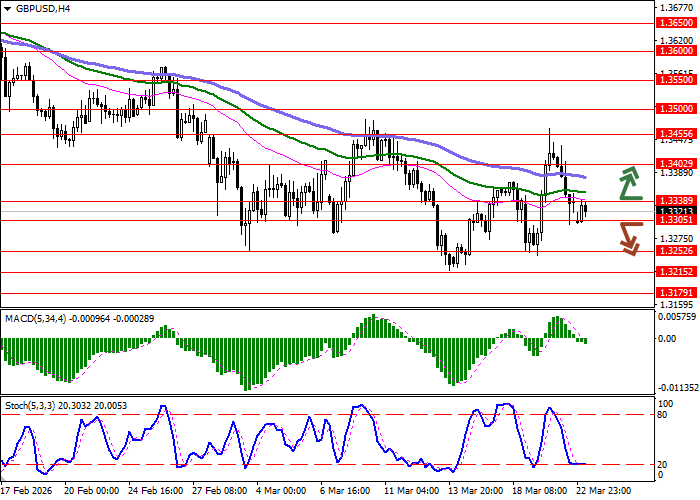
On the daily chart, Bollinger Bands are attempting to flatten horizontally: the trading range is hardly changing, while remaining wide enough for the current level of activity. MACD is rising, trying to restore its previous buy signal and move above the signal line. Stochastic, having reacted to Friday’s sharp decline, has turned lower, signaling the possible development of a full correctional trend in the near term.
Resistance levels: 1.3338, 1.3402, 1.3455, 1.3500.
Support levels: 1.3305, 1.3252, 1.3215, 1.3179.
Trading scenarios and GBP/USD forecast
Short positions may be considered after a confident breakout below 1.3305, with a target at 1.3215. Stop-loss — 1.3345. Implementation period: 1–2 days.
A corrective recovery followed by a breakout above 1.3338 could become a signal for opening long positions with a target at 1.3455. Stop-loss — 1.3280.
Scenario
| Timeframe | Intraday |
| Recommendation | SELL |
| Entry point | 1.3293 |
| Take Profit | 1.3215 |
| Stop Loss | 1.3345 |
| Key levels | 1.3179, 1.3215, 1.3252, 1.3305, 1.3338, 1.3402, 1.3455, 1.3500 |
Alternative scenario
| Recommendation | BUY STOP |
| Entry point | 1.3340 |
| Take Profit | 1.3455 |
| Stop Loss | 1.3280 |
| Key levels | 1.3179, 1.3215, 1.3252, 1.3305, 1.3338, 1.3402, 1.3455, 1.3500 |
