

The yen remains under pressure due to rising energy prices driven by escalating tensions in the Middle East. At the same time, the likelihood of market intervention by the Bank of Japan remains high, as officials have repeatedly signaled the need to control excessive weakness in the national currency. Although the key rate was left unchanged at last week’s meeting, the broader policy target for this year is well above the current 0.75% level. BOJ Governor Kazuo Ueda indicated that policymakers are increasingly focused on the risk of renewed inflation acceleration and are prepared to respond quickly using all available tools. As a result, sustained negative price pressures, amplified by commodity market dynamics and yen weakness, have shifted attention away from immediate energy concerns, while hawkish sentiment within the central bank is strengthening. Analysts do not rule out that, if inflation and wage growth remain stable, the Bank of Japan could move borrowing costs closer to 1.00% at one of its upcoming meetings.
Meanwhile, supported by strong capital inflows during the early phase of the conflict in the Persian Gulf, the US dollar is holding near 99.40 in the USDX index, although confidence in a quick resolution is fading. President Donald Trump stated that Iran has 48 hours to unblock the Strait of Hormuz, warning of potential strikes on power infrastructure if the demand is not met. However, analysts largely doubt that such rhetoric will lead to a resolution. In this environment, oil remains the preferred asset for investors, while the dollar and gold continue to serve as alternative safe-haven options. At the same time, members of the US administration, including negotiators Steve Witkoff and Jared Kushner, are reportedly working on a potential framework for peace talks with Tehran, according to Axios. The proposed agreement may include restoring shipping routes, addressing Iran’s enriched uranium stockpiles, and reaching long-term arrangements on nuclear policy, ballistic missiles, and regional alliances.
Support and resistance levels
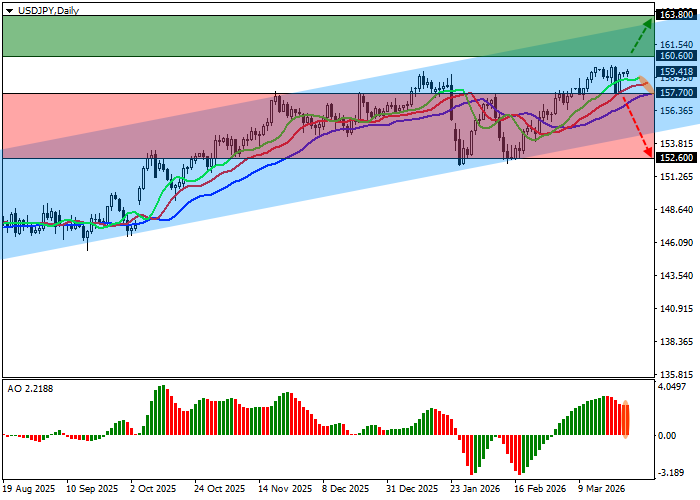
On the daily chart, the instrument is correcting within an uptrend, attempting to reach the resistance line of a broad long-term channel with boundaries at 163.50–154.00.
Technical indicators reinforce a bullish signal: fast EMAs of the Alligator indicator are diverging from the signal line, while the AO histogram forms corrective bars in positive territory.
Resistance levels: 160.60, 163.80.
Support levels: 157.70, 152.60.
Trading scenarios and USD/JPY forecast
Long positions may be considered after a breakout and consolidation above 160.60, with a target at 163.80. Stop-loss — 159.00. Implementation period: 7 days or more.
Short positions may be considered after a breakout and consolidation below 157.70, with a target at 152.60. Stop-loss — 160.00.
Scenario
| Timeframe | Weekly |
| Recommendation | BUY STOP |
| Entry point | 160.65 |
| Take Profit | 163.80 |
| Stop Loss | 159.00 |
| Key levels | 152.60, 157.70, 160.60, 163.80 |
Alternative scenario
| Recommendation | SELL STOP |
| Entry point | 157.65 |
| Take Profit | 152.60 |
| Stop Loss | 160.00 |
| Key levels | 152.60, 157.70, 160.60, 163.80 |
