
Analysts Name Their Preferred Altcoins
Ethereum’s recovery toward $3,000 encouraged traders to look beyond Bitcoin for assets that could benefit from a broader market rotation. However, ETH was still trading close to this level rather than holding firmly above it, making the strength of the breakout an important factor to watch.
Ran Neuner, investor and founder of Crypto Banter, shared what he described as his preferred ten-asset portfolio: BTC, ETH, SOL, HYPE, SUI, JTO, RAY, AERO, TAO and S.
Alongside Bitcoin, Ethereum and Solana, the list included several projects tied to decentralized trading, artificial intelligence and fast-growing blockchain ecosystems:
- Hyperliquid (HYPE)
- Sui (SUI)
- Jito (JTO)
- Raydium (RAY)
- Aerodrome Finance (AERO)
- Bittensor (TAO)
- Sonic (S)
Aerodrome is one of the main decentralized exchanges on Base, while Jito and Raydium are closely connected to the Solana ecosystem. Hyperliquid focuses on decentralized derivatives trading, Bittensor combines blockchain incentives with artificial intelligence, and Sui and Sonic compete in the Layer-1 market.
The appearance of SUI and TAO in several analyst watchlists showed growing interest in scalable blockchain infrastructure and AI-related crypto projects. Still, inclusion in a public portfolio does not guarantee that a token will outperform the wider market.
#Altcoins are pushing for a breakout from the massive cup & handle!
— Jelle (@CryptoJelleNL) July 11, 2025
Pattern almost completed - break above $1T again and I doubt this train stops moving anytime soon.
Higher! pic.twitter.com/6ERefLcWaW
Altcoin Daily also highlighted Solana, Sui and Bittensor, together with projects from other market segments. These included Ondo Finance (ONDO), which focuses on tokenized real-world assets, Chainlink (LINK), which provides oracle infrastructure, and Cardano (ADA).
The selections reflected several of the main crypto narratives in 2025: artificial intelligence, real-world asset tokenization, decentralized trading and scalable Layer-1 networks.
Altcoin Momentum Improves, but Altseason Is Not Confirmed
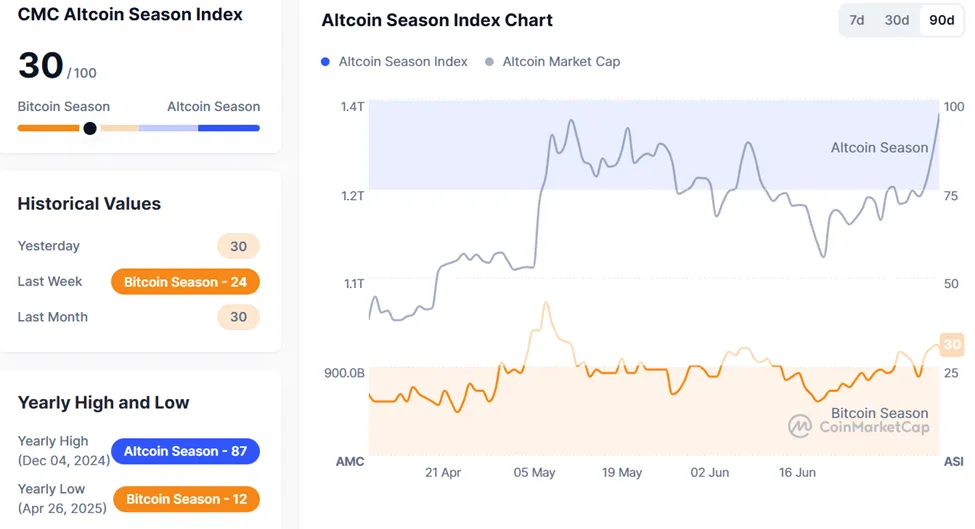
Altcoin season generally refers to a period in which a large share of leading cryptocurrencies outperform Bitcoin over several months. BlockchainCenter, for example, considers altseason confirmed when at least 75% of the top 50 eligible coins outperform BTC over a 90-day period.
By July 12, altcoin indicators had recovered from their recent lows and reached their strongest levels in roughly three months. However, they remained below the threshold normally associated with a confirmed altcoin season.
Bitcoin dominance also remained elevated. Although several altcoins were beginning to outperform over shorter periods, there was not yet enough evidence of a broad and sustained movement of capital away from Bitcoin.
Falling Bitcoin dominance can support the case for an altcoin rotation, but a short-term decline does not confirm that the entire market has entered altseason.
The distinction matters because the July rally may have reflected new capital entering the cryptocurrency market rather than investors simply selling Bitcoin to buy smaller tokens. In that scenario, BTC and selected altcoins can rise at the same time without producing a traditional altseason.
Which Market Narratives Are Attracting Attention?
The recent watchlists were not built around a single sector. Instead, analysts were following several themes that could influence the next stage of the market cycle.
- Artificial intelligence: Bittensor and other AI-related protocols remain popular among investors looking for blockchain projects connected to machine learning and decentralized computing.
- Real-world assets: Ondo Finance and similar platforms aim to bring traditional financial instruments, including government securities, onto public blockchains.
- Decentralized trading: Hyperliquid, Aerodrome, Raydium and Jito benefit from growing demand for on-chain trading, liquidity and staking infrastructure.
- Scalable Layer-1 networks: Solana, Sui and Sonic compete for developers and users who need fast transactions and relatively low fees.
- Oracle infrastructure: Chainlink continues to connect blockchain applications with external financial and market data.
Strong narratives can attract capital quickly, but they do not replace basic analysis. Token supply, upcoming unlocks, protocol revenue, network activity and the relationship between a project’s growth and its token value remain important.
What Would Confirm a Broader Altcoin Rally?
A stronger altcoin cycle would require more than a short price increase in several popular tokens. Market participants would normally look for a combination of signals:
- a sustained decline in Bitcoin dominance;
- Ethereum consistently outperforming Bitcoin;
- a larger share of leading altcoins beating BTC over 90 days;
- rising trading volumes and liquidity outside the two largest cryptocurrencies;
- growth in active users, fees and total value locked across major networks;
- market strength extending beyond a small number of speculative tokens.
At the time of publication, some of these conditions were beginning to improve, but the market had not yet produced broad confirmation.
Bottom Line
Bitcoin’s record high and Ethereum’s return toward $3,000 created a more supportive environment for altcoins. Analysts were increasingly watching Solana, Sui, Bittensor, Hyperliquid, Ondo Finance and several DeFi infrastructure tokens, but the market was still in an early and uncertain phase of rotation.
Rather than treating every altcoin as an automatic beneficiary, investors were becoming more selective. Network adoption, liquidity, token economics and real usage offered a better basis for comparison than social media forecasts or promises of extreme returns.
A later FORECK.INFO review takes a closer look at the technology and use cases behind Ethereum, Solana, XRP, Avalanche and Sui.
The July rally strengthened the argument that altcoins were regaining momentum, but calling it a confirmed altseason was still premature.
