

On August 12, SEC staff said it would not recommend enforcement action against U.S.-registered open-end and closed-end investment companies within the Franklin Templeton family if they invest in shares of the Franklin OnChain U.S. Government Money Fund without complying with certain custody requirements under Section 17(f) and paragraphs (b), (e) and (f) of Rule 17f-2 of the Investment Company Act of 1940, provided that the specified conditions are met.
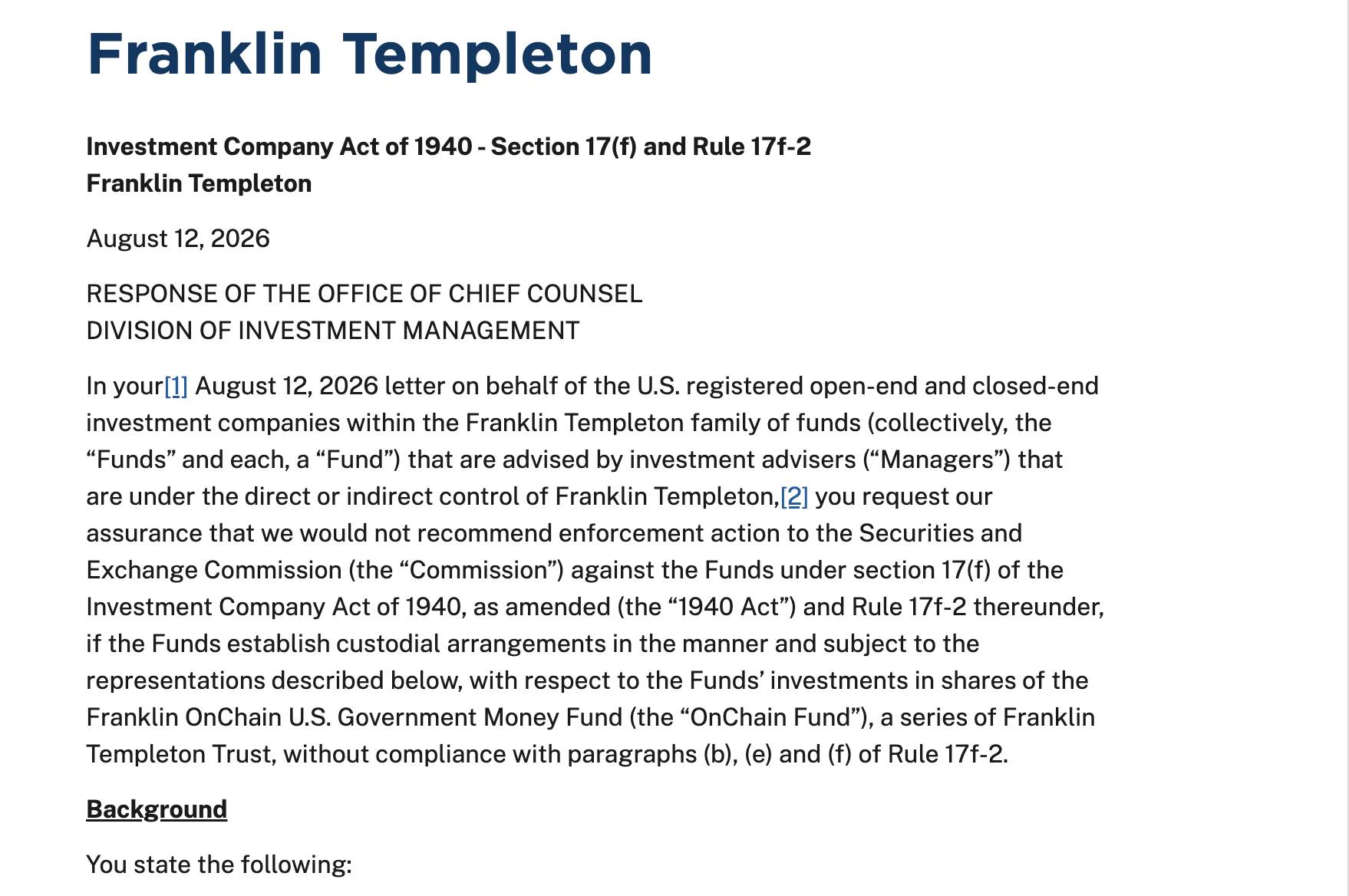
The SEC no-action letter effectively gives Franklin Templeton's registered funds greater flexibility to use the OnChain Fund for cash management, including investing cash balances and securities-lending collateral.
Bloomberg ETF analyst James Seyffart noted that the decision effectively opens the door for Franklin Templeton's registered funds, including mutual funds and ETFs, to hold the firm's OnChain Fund despite the arrangement not fitting some of the physical-custody procedures contained in the 1940 Act rules. According to Franklin Templeton's submission to the SEC, the OnChain Fund offers several operational features that are not available through the funds' existing cash-management vehicle, including hourly net asset value (NAV) calculations, intraday trading, faster transaction processing, the potential for lower costs and enhanced data security.
The SEC staff's position largely reflects the way the BENJI infrastructure is structured. Franklin Templeton Investor Services LLC (FTIS), a registered transfer agent, maintains the official record of share ownership through an integrated recordkeeping system combining an internal book-entry system with blockchain records.
The internal system stores private shareholder information, while one or more blockchains record transaction-related information such as purchases, redemptions, dividend rates, distributions, NAVs and trade dates. FTIS links these records in real time to maintain the official master securityholder file.
For Franklin Templeton funds investing under the arrangement described in the letter, FTIS will create a blockchain wallet on the Stellar network and maintain and secure the corresponding private key. FTIS also retains administrative control over the system, allowing it to correct errors or unauthorized transactions, freeze or migrate wallet records, create replacement wallets and restore the official ownership record when necessary.
As a result, blockchain records do not replace FTIS's authority as transfer agent or its official ownership records. SEC staff considered the arrangement sufficiently similar, for purposes of the specific custody provisions at issue, to earlier book-entry structures in which fund shares were maintained electronically rather than held as physical certificates in a vault.
However, the regulatory relief is subject to a series of safeguards. Franklin Templeton must maintain controls designed to prevent unauthorized instructions, establish a separate blockchain wallet for each investing fund, restrict who can transmit instructions, use authentication and cryptographic controls, provide transaction confirmations and reconcile transactions against fund authorizations on a daily basis. Each investing fund's board must also approve the arrangement and review it at least annually. In addition, independent public accountants must conduct at least three verifications of each fund's investments during every fiscal year, at least two of which must take place without prior notice.
The SEC stressed that the letter represents a staff position on enforcement action only. It does not constitute a rule, regulation or statement of the Commission, does not provide a legal conclusion and has no independent legal force or effect.
BENJI was launched by Franklin Templeton in 2021 as the blockchain-based representation of shares in the Franklin OnChain U.S. Government Money Fund. The fund invests at least 99.5% of its assets in U.S. government securities, cash and repurchase agreements fully collateralized by government securities or cash, while seeking to maintain a stable NAV of $1.00 per share. The broader growth of tokenized financial assets on Stellar is discussed in FORECK.INFO's Stellar and RWA market analysis.
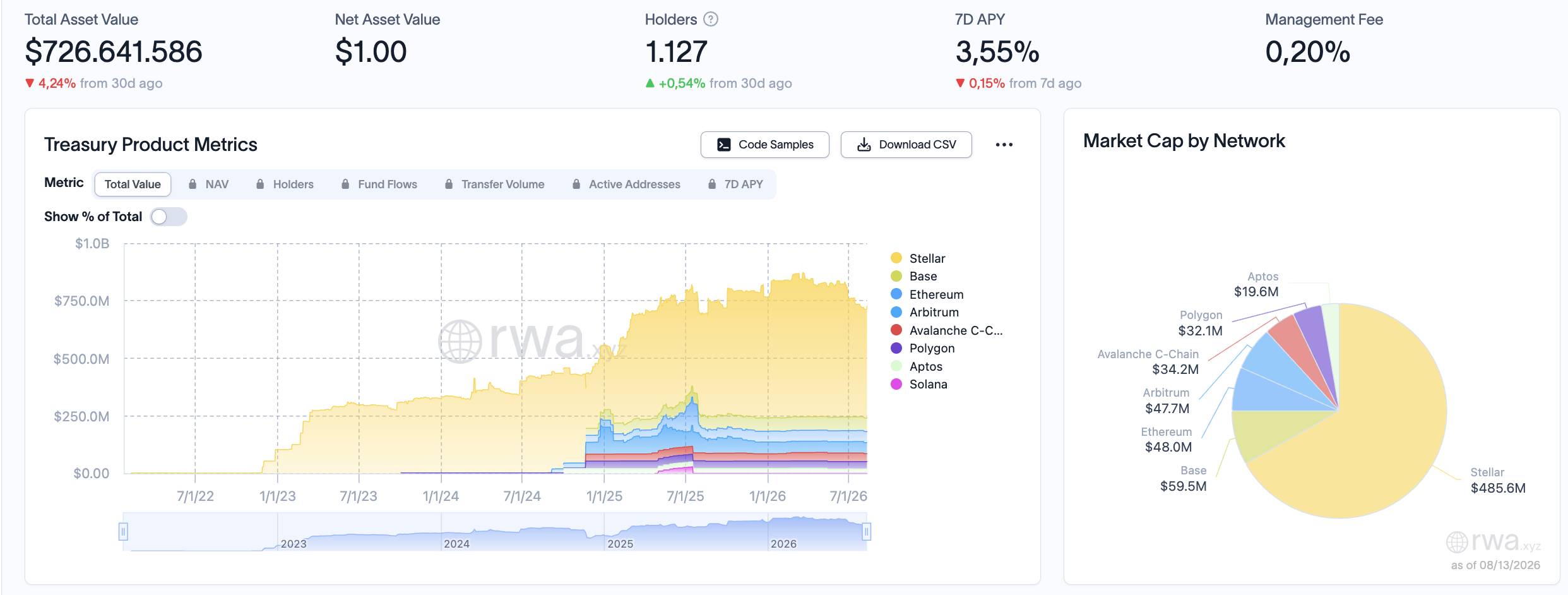
The fund originally launched using Stellar and has since expanded its blockchain infrastructure to additional networks, including Ethereum and Solana. According to RWA.xyz, BENJI had approximately $726.6 million in total asset value as of August 13, 2026, with a 7-day APY of 3.55%. Stellar remains the largest network for BENJI by token supply.
The SEC staff’s no-action position removes a key custody obstacle for Franklin Templeton funds using BENJI for cash management. The decision could support broader institutional adoption of tokenized money market funds while keeping traditional transfer-agent controls and investor protections in place.
