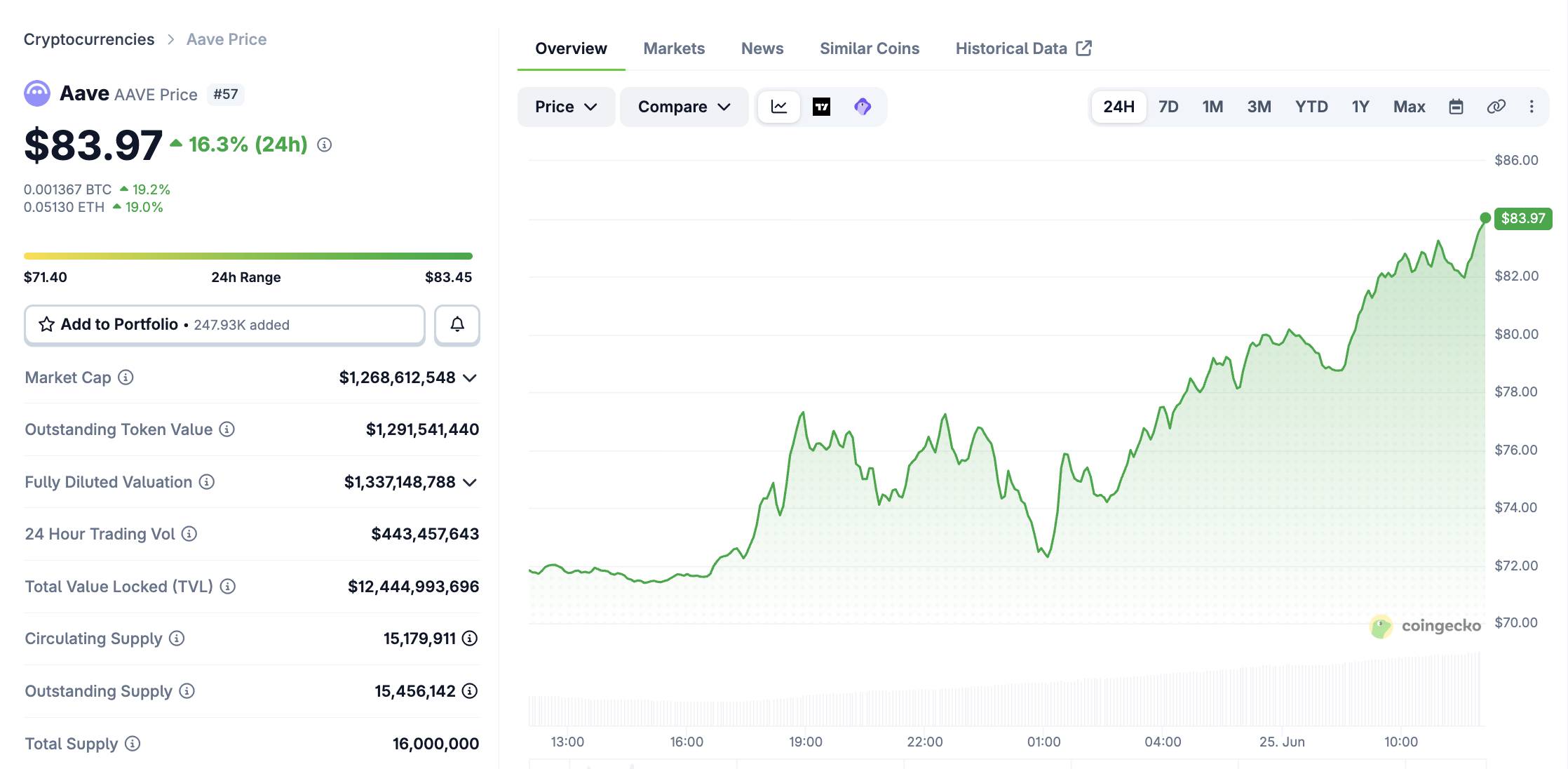

In a research report published on June 25, Geoff Kendrick, Global Head of Digital Assets Research at Standard Chartered, presented the following AAVE price targets:
- End of 2026: $180
- End of 2027: $600
- End of 2028: $1,200
- End of 2029: $2,200
- End of 2030: $3,500
If this scenario materialises, AAVE would rise nearly 50 times from the approximately $70 level at the time of the report’s publication.
Notably, this target is far above AAVE’s previous all-time high of $661, reached during the 2021 bull market. Although the token later recovered to nearly $400 after Donald Trump’s election victory in late 2024, it then corrected sharply and fell below $100 in March 2026.
Why Standard Chartered Expects Strong AAVE Growth
Standard Chartered believes Aave’s outlook depends heavily on the expansion of the broader DeFi market. The bank forecasts that the total value of assets deployed across DeFi protocols could grow around 37 times to $2.7 trillion by 2030.
According to the bank, DeFi growth in the coming years could be driven by the broader adoption of stablecoins, rapid development of tokenised real-world assets, migration of traditional financial products onto blockchain infrastructure, and long-term appreciation in token prices.
In this context, Aave is viewed as one of the protocols best positioned to benefit because most of its revenue comes from the interest-rate spread between depositors and borrowers. In other words, the more assets that enter DeFi and the greater the borrowing demand, the higher Aave’s revenue potential and the stronger the foundation for AAVE token value growth.
Over the past 12 months, around 90% of Aave’s revenue has come from this lending spread. Standard Chartered therefore expects that if DeFi continues to expand, AAVE could rise alongside the protocol’s growth.
The positive outlook comes only months after Aave experienced a volatile period. In April, a $291 million attack targeting KelpDAO had a direct impact on Aave, undermining investor confidence and triggering capital outflows from several DeFi platforms, including Aave.
According to Standard Chartered, total deposits on Aave nearly halved from around $44 billion to $23 billion. Outstanding loans declined from roughly $18 billion to $9.5 billion, while Aave’s share of the lending market fell from an average of 59% to around 38%.
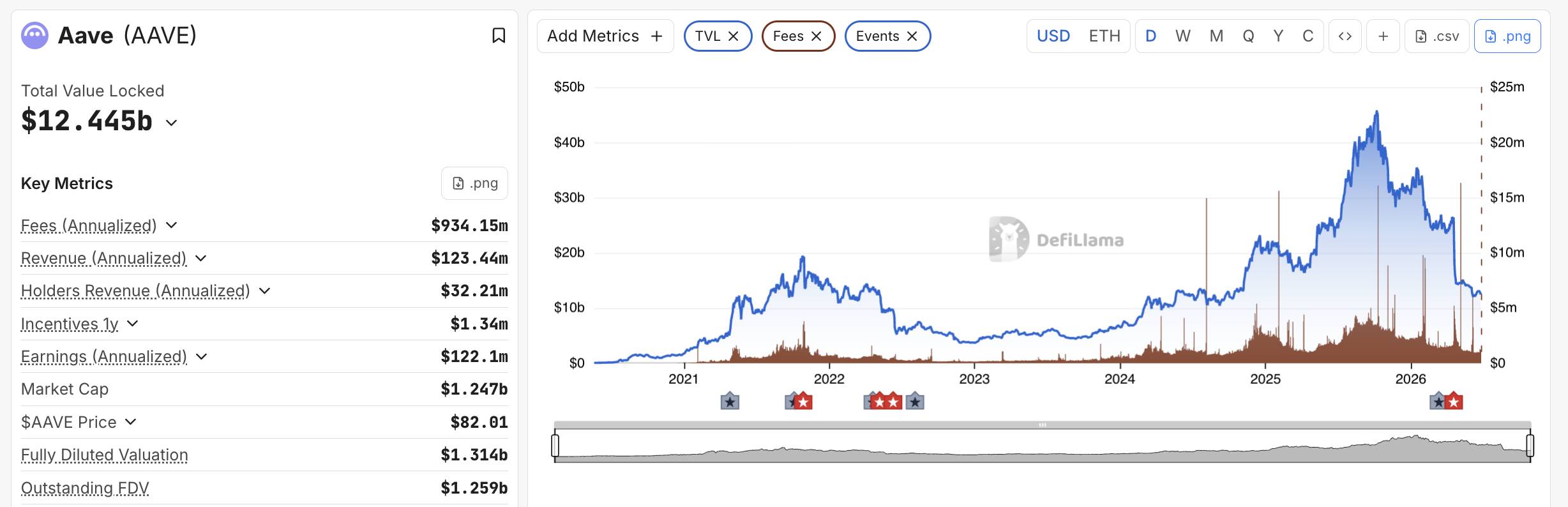
However, Standard Chartered believes the worst phase may be over. The project is building a new risk-management framework to improve protocol security, while deposits on Aave have begun recovering from the lows recorded in June. The bank views this as an early signal that user confidence is gradually returning and that Aave could regain growth momentum.
The bank also highlighted Aave DAO’s token buyback programme, launched in April 2025. Before it was paused following the KelpDAO incident, the protocol had repurchased around 205,000 AAVE tokens, equal to 1.3% of total supply. Standard Chartered believes restarting the programme could create additional support for the token price.
Aave V4 and the GHO stablecoin are also expected to become key growth drivers in the coming years. Aave V4’s new architecture enables liquidity sharing between Layer-2 networks without the need for bridges, potentially reducing security risks similar to those exposed during the KelpDAO incident. Meanwhile, all revenue from the GHO stablecoin belongs to the protocol rather than being shared with liquidity providers, which could improve long-term revenue efficiency.
Despite the very ambitious target, Standard Chartered acknowledges that the forecast involves substantial risks. One key assumption is the successful rollout of Aave Horizon, an institutional stablecoin lending platform designed to accept tokenised real-world assets, such as US Treasury bonds, as direct collateral.
Horizon currently has only around $163 million in outstanding loans, while the tokenised real-world asset market has reached approximately $30 billion. This highlights the significant growth potential but also shows that expansion into the institutional client segment will need more time to prove its effectiveness.