

On August 6, Layer-1 blockchain Sui announced a new post-quantum security roadmap built around two signature schemes standardized by the US National Institute of Standards and Technology (NIST), marking another step in the network's preparations for the era of cryptographically relevant quantum computers.
According to the roadmap, quantum-safe vaults are targeted for deployment on Mainnet during 2026. Native accounts using ML-DSA-65 are expected to reach Testnet by the end of 2026, followed by native account authentication on Mainnet in the first quarter of 2027. Sui stressed that these dates remain targets rather than fixed launch deadlines, as independent security audits and Testnet feedback are still ongoing.
Importantly, existing users will not be forced to create a new recovery phrase or transfer their tokens and NFTs to a different address. Sui says an ML-DSA-65 private key can be derived from the recovery phrase a user already holds through a new derivation path. Its Address Alias feature, which is already live, can then allow an existing account to update its authorization key while keeping the same address and assets in place. The upgrade will be introduced as an opt-in capability, following a rollout model similar to zkLogin and Passkeys. Existing accounts, applications and smart contracts therefore do not need to make immediate changes. Wallet, SDK and CLI support for the new authentication mechanism is expected to arrive alongside the rollout.
More specifically, Sui plans to add ML-DSA-65 under FIPS 204 as a native protocol signature scheme for everyday accounts. For high-value assets, the network plans to support SLH-DSA-SHA2-128s under FIPS 205 inside Move smart contracts used for quantum-safe vaults.
The two schemes are based on different mathematical foundations. ML-DSA uses module-lattice cryptography, while SLH-DSA is hash-based. Using two different families reduces reliance on a single cryptographic assumption: a weakness discovered in one would not automatically undermine the security assumptions of the other.
Sui says one reason blockchains need to prepare early for quantum computing is the long-term exposure of public keys. Once an account transacts and its public key becomes visible on-chain, that information can remain publicly available indefinitely. This creates a potential "harvest now, forge later" threat. An attacker does not need a quantum computer today to collect exposed public keys. If sufficiently capable quantum hardware becomes available in the future, Shor's algorithm could theoretically be used against the elliptic-curve cryptography protecting many blockchain accounts, allowing an attacker to derive private-key information and forge signatures.
Sui cited a March 2026 estimate from Google Quantum AI suggesting that recovering a private key from an exposed public key could potentially be performed within minutes on a fault-tolerant quantum computer using fewer than half a million physical qubits. Such hardware does not currently exist at the required scale, but the estimate illustrates why blockchain developers are preparing years in advance.
The transition to post-quantum cryptography also comes with trade-offs. Post-quantum public keys and signatures are substantially larger than the Ed25519 equivalents commonly used today, meaning transactions using the new scheme will require more data.
However, Sui says its benchmarks show that ML-DSA-65 signature verification is close enough to Ed25519 that the per-signature network cost should not increase. The primary overhead therefore comes from larger transaction sizes rather than a major increase in verification cost.
The roadmap moves Sui from post-quantum research toward concrete deployment targets, although the network itself is not yet fully quantum-resistant. The Sui Foundation explicitly describes the work as an ongoing implementation that has not yet completed independent audits or full production rollout.
Other major blockchain ecosystems are also preparing for similar risks. BNB Chain's H2 2026 roadmap says developers are testing hybrid quantum-resistant approaches and exploring how account abstraction could allow users to upgrade security without changing existing addresses.
Ethereum has likewise elevated post-quantum cryptography within its longer-term protocol development plans, as previously covered in FORECK.INFO's Ethereum roadmap.
Zcash is taking a different approach. Its proposed ZIP 2005 introduces quantum-recoverable notes for the Ironwood pool to make a future post-quantum migration safer. Importantly, the proposal itself states that this change would not make Zcash fully secure against quantum adversaries on its own, but would provide an important step toward a future transition.
Sui's decision to begin implementing quantum-safe accounts and vaults reflects a broader shift across the blockchain industry from treating quantum computing as a theoretical research topic toward preparing concrete migration paths before cryptographically relevant quantum machines become practical.
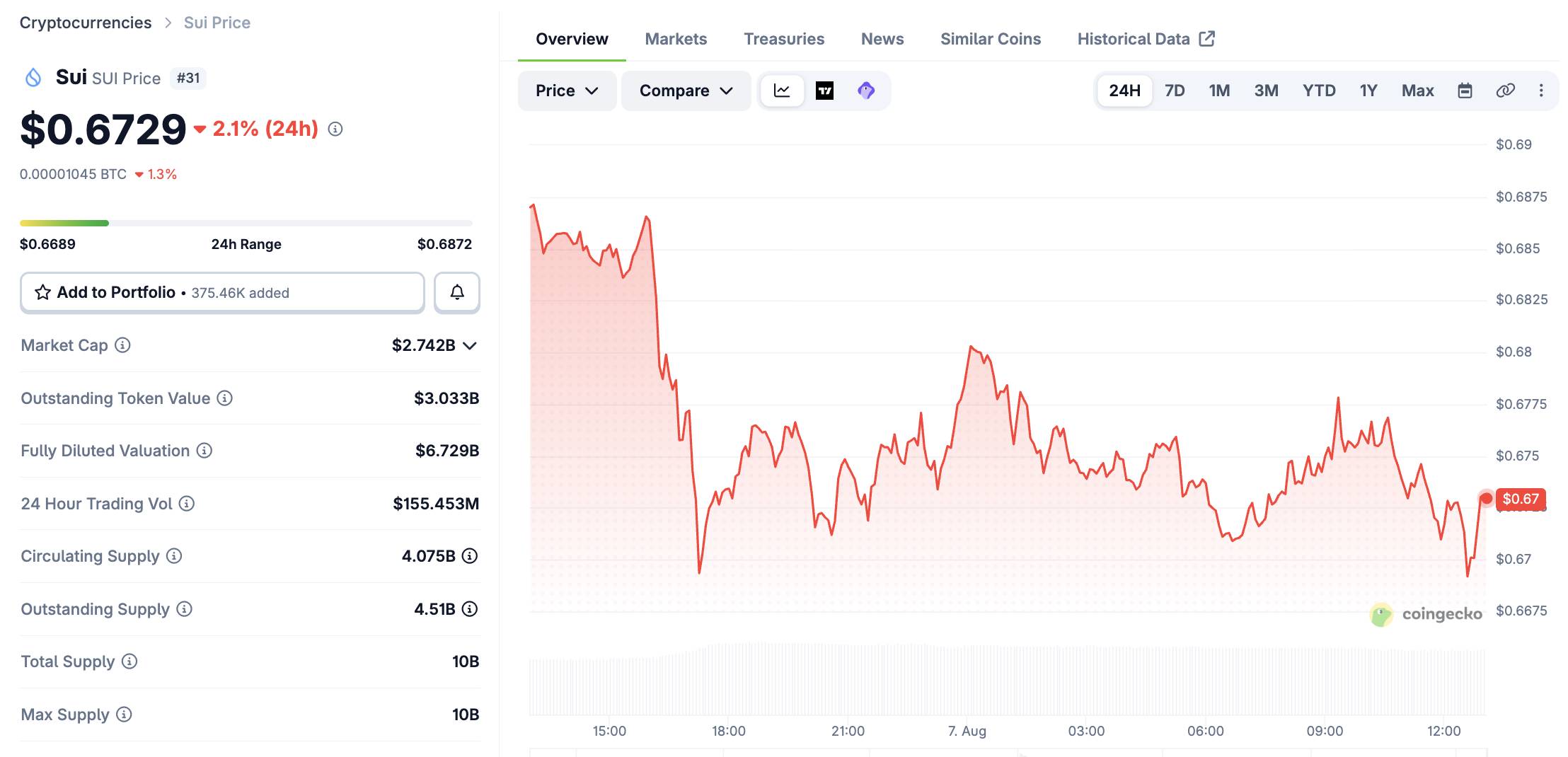
SUI showed limited immediate reaction to the announcement. A CoinGecko screenshot taken at 1:00 PM on August 7, 2026 showed the token trading at approximately $0.67, with the 24-hour move around -2.5% at the time
Expert:
Sui is moving post-quantum security from research toward implementation, while keeping the upgrade optional for existing users. The key point is that the network is preparing for future quantum threats without requiring users to change wallet addresses or move their assets.
