



Top Pick

- Fully licensed and regulated US exchange
- Strong focus on security and compliance
- User-friendly interface for beginners
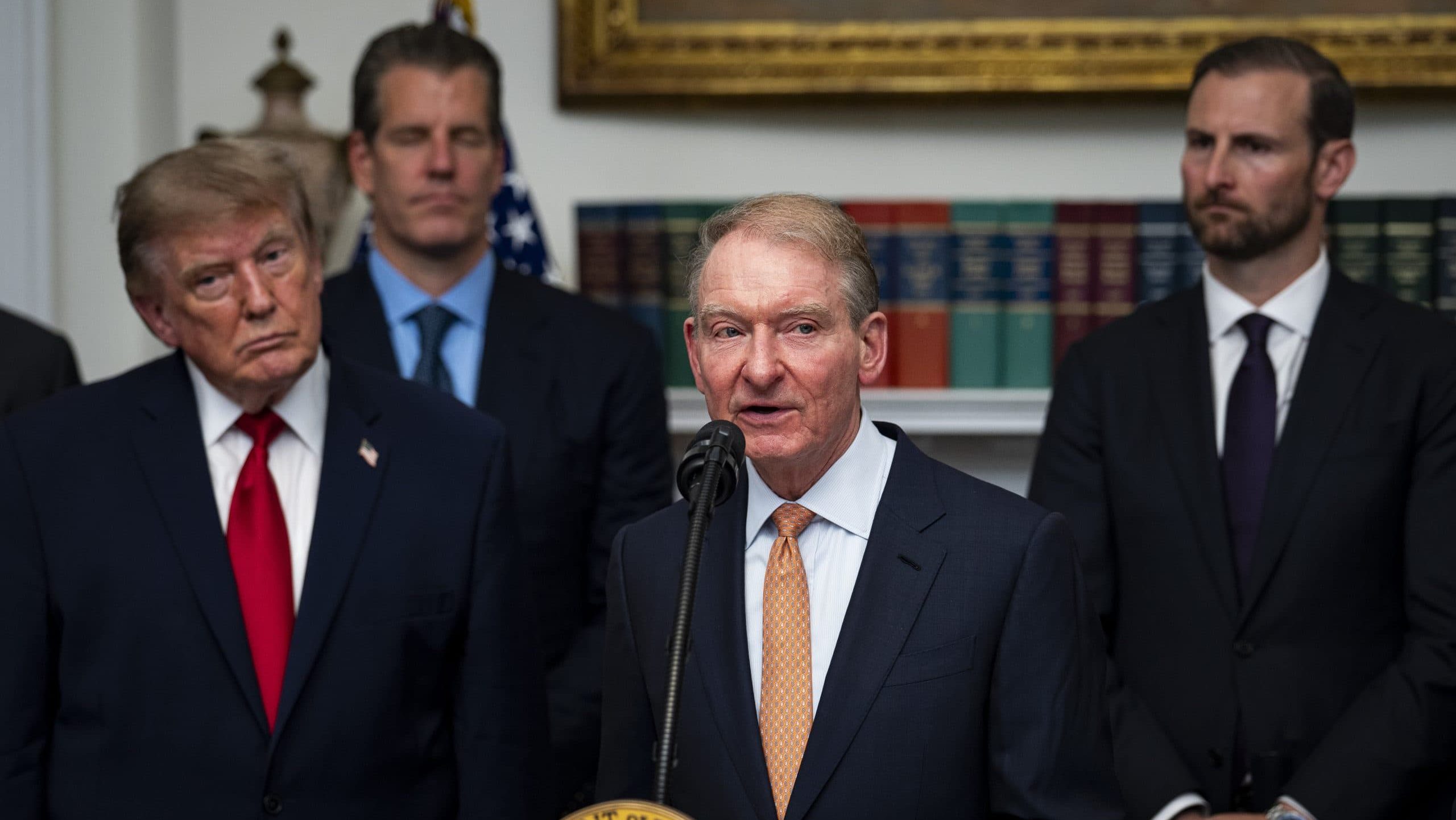
Six major blockchain organizations are calling on the US Securities and Exchange Commission (SEC) to make its classification of digital commodities part of binding crypto regulations. The proposal could affect how exchanges and investors handle tokens such as LINK, ADA, HBAR, APT, AVAX and XLM, particularly when these assets are traded on secondary markets.

 By John Isige
SLINK reached an estimated $80 million market capitalization after Elon Musk replied to a post from Neuralink executive Shivon Zilis's X account, which had reportedly been compromised. The memecoin then lost more than 97% of its value within minutes.
 By John Isige
Most major digital assets strengthened this week. Bitcoin traded near $81,000, up 3.2%, while Ether was around $2,500 (+0.6%), Tether at $1.0000 (–0.02%), BNB at $715 (+2.6%) and XRP at $1.44 (+3.3%). Total crypto market capitalization rose to approximately $2.71 trillion, while Bitcoin dominance eased to 59.6%. U.S. spot Bitcoin ETFs recorded $812.1 million in weekly net inflows, while spot Ether ETFs attracted $189.4 million.
 By John Isige
The U.S. Securities and Exchange Commission is advancing three initiatives that could reshape the relationship between traditional securities and digital assets: preparations for round-the-clock trading, modernization of transfer-agent rules to account for blockchain technology, and a review of how new investment products, including crypto-linked ETFs, should be regulated.
 By John Isige
Until mid-August, XRP/USD traded steadily lower within a long-term downtrend. Two weeks ago, the pair staged a strong corrective rebound after the US Treasury announced that it would increase the maximum size of long-end liquidity-support buybacks from $2.0 billion to at least $4.0 billion per operation, effective September 9. The measure is intended to improve Treasury-market liquidity rather than inject capital directly into cryptocurrencies. However, the initial decline in long-term yields supported a broader risk-on move, examined by FORECK.INFO in its recent analysis of the market reaction. XRP/USD reached the 1.6970 area before reversing lower. The pair is now approaching the 1.3060–1.2695 support zone, formed by the middle Bollinger Band and Murrey [5/8] level. A break below 1.2695 could open the way toward 1.1718, the Murrey [4/8] level, followed by 0.9765, the Murrey [2/8] level, and 0.7812, the Murrey [0/8] level. Conversely, consolidation above 1.5625, the Murrey [8/8] level, could support a recovery toward 1.7578, the Murrey [+2/8] level, and 1.9980, the 50.0% Fibonacci retracement.

 By Andrew Bennett
Ethena has launched Ethena Pay, a self-custodial money app that brings digital-dollar balances, transfers and card spending into a neobank-style interface. Built on Avalanche, the product offers promotional annual rewards of up to 6% on eligible balances and up to 5% cashback in AVAX on qualifying purchases.
 By John Isige
More than $1.2 billion in scheduled token releases could enter circulation during September 2026. RAIN accounts for the largest estimated dollar value, while Plasma’s XPL stands out because of the unusually large share of its circulating supply involved.
 By John Isige
Over the past two weeks, the BTC/USD pair has strengthened on the back of monetary factors.
 By John Isige
The cryptocurrency market extended its recovery this week, although momentum was noticeably weaker than during the previous surge. Bitcoin is trading near 79,600.00–80,000.00, Ethereum remains around 2,500.00, BNB is holding close to 706.00–710.00, while XRP has pulled back towards 1.42. Tether remains stable near 1.0000.
 By Andrew Bennett
The SOL/USD pair has broken out of the "symmetric triangle" pattern, moving above its upper boundary, and has been steadily rising for the second consecutive week. Currently, the price is testing the 100.00 level (Murray [8/8]). A confirmed breakout above this level could open the way toward targets at 112.50 (Murray [+2/8]) and 125.00 (Murray [4/8], W1). However, a move below the middle Bollinger Band level at 81.25 (Murray [5/8]) could trigger a renewed decline toward 62.50 (Murray [2/8]) and 50.00 (Murray [0/8]).
 By John Isige
BTC/USD traded near 78,900.00 early Wednesday after briefly breaking above 81,000.00 for the first time since May. The price later slipped below 78,000.00 following the release of US inflation data. Bitcoin is still up approximately 24–25% since the beginning of August, with the monthly range extending from 62,232.00 to 81,142.00.
 By John Isige
Following the broader market rally, BTC/USD gained 21.0% last week and reached 79,500.00. At the time of this technical snapshot, the pair has surrendered a small part of the advance and is consolidating near 77,200.00.
 By John Isige
Optimism governance has approved the re-designation of 546.9 million OP, worth approximately $49.7 million at the time of the vote, from the allocation reserved for future user airdrops to a Strategic Ecosystem Fund managed by the Optimism Foundation.


For crypto, the framework is similar to traditional financial markets but comes with its own twist. Here, price action turns on liquidity, adoption, regulation, and flows from institutions alongside retail sentiment. Network health—hash rate, staking, active wallets—adds another layer. Macro still matters too: rates, dollar strength, and risk appetite shape inflows and outflows. Then, as with any market, you use the chart—trend, support and resistance, momentum, and volume—to spot setups and manage risk.